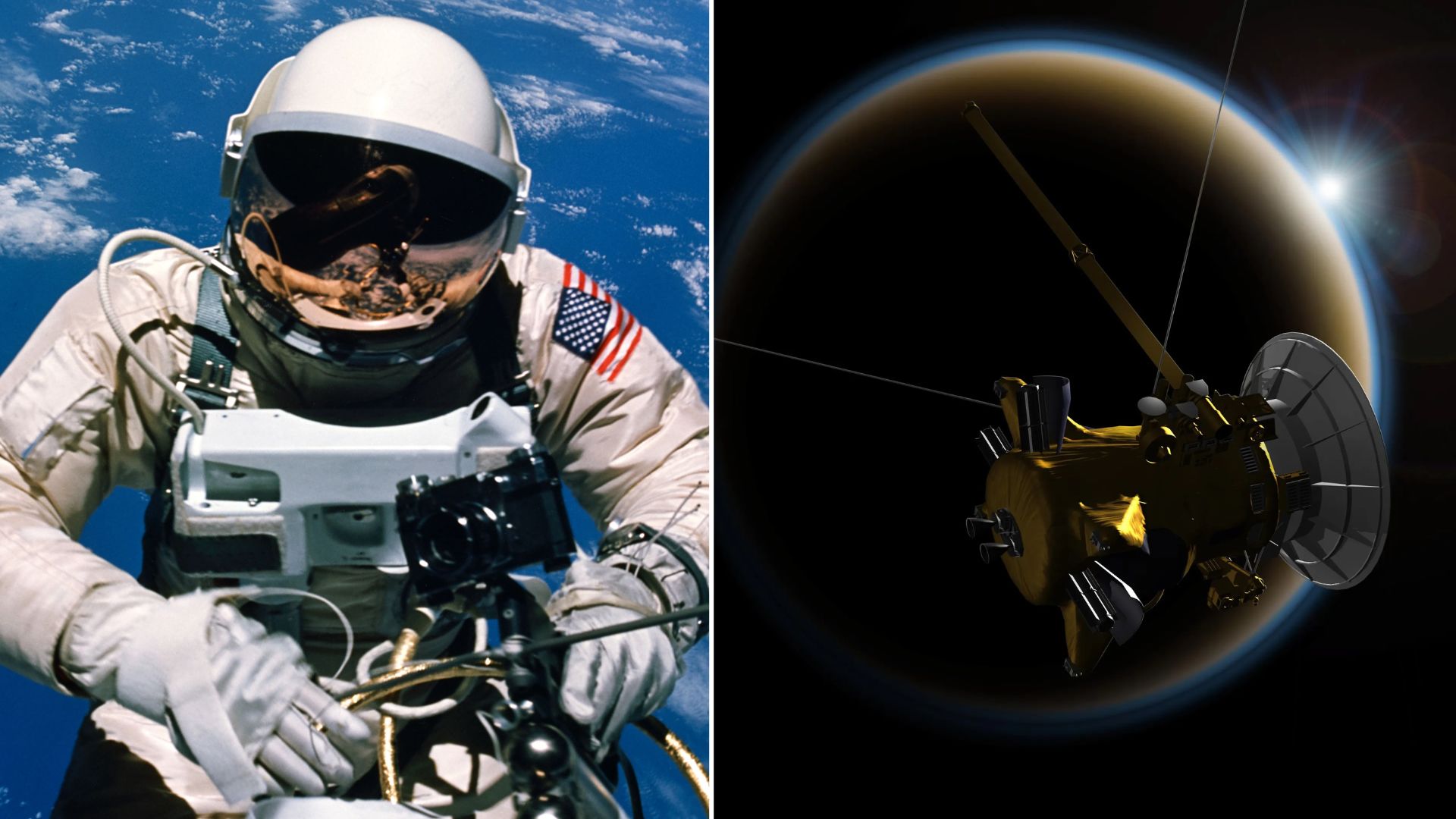
From the first Americans in space to telescopes peering billions of years into the past, these 15 NASA missions transformed humanity's understanding of the Universe.NASA Few institutions have shaped humanity’s understanding of space quite like NASA. Since its founding in 1958, the agency has launched hundreds of missions, but only a handful fundamentally changed science, engineering, or human history. Some placed humans on the Moon. Others transformed astronomy, revealed hidden worlds across the Solar System, or even ventured beyond the Sun’s influence. Here are 15 NASA missions whose legacy continues to shape science and exploration today. 1. Project Mercury (1958-1963) NASA’s first human spaceflight program proved that Americans could survive and operate in space. Alan Shepard became the first American in space in 1961, while John Glenn became the first American to orbit Earth a year later, laying the groundwork for every crewed mission that followed. 2. Project Gemini (1961-1966) Before astronauts could reach the Moon, NASA had to master orbital rendezvous, docking, long-duration spaceflight, and spacewalks. Gemini accomplished all of those objectives, becoming the technological bridge between Mercury and Apollo. 3. Apollo 11 (1969) Perhaps no mission changed history more profoundly. Neil Armstrong and Buzz Aldrin became the first humans to walk on the Moon while Michael Collins orbited overhead. Apollo 11 demonstrated that humanity could travel to another celestial body and safely return home, inspiring generations of scientists and engineers. 4. Skylab (1973-1979) America’s first space station proved humans could live and work in space for months at a time. Crews conducted hundreds of experiments in medicine, solar physics, and Earth observation, paving the way for the International Space Station decades later. 5. Viking 1 (1975-1982) When Viking 1 landed safely on Mars in 1976, it became the first successful mission to operate on the Martian surface. It returned the first images from the ground, analyzed Martian soil, and conducted pioneering experiments searching for signs of life. 6. Voyager 1 and Voyager 2 (1977-Present) Originally designed to explore the outer planets, the twin Voyager spacecraft delivered humanity’s first close-up views of Jupiter, Saturn, Uranus, and Neptune. Both continue operating today, with Voyager 1 becoming the first human-made object to enter interstellar space. 7. Space Shuttle Program (1981-2011) The Space Shuttle transformed access to low Earth orbit by introducing partially reusable spacecraft. Shuttle missions deployed and serviced satellites, launched the Hubble Space Telescope, assembled much of the International Space Station, and flew 135 missions over three decades. 8. Hubble Space Telescope (1990-Present) Hubble revolutionized modern astronomy. Its observations helped refine the age of the Universe, study black holes, discover thousands of galaxies, and capture some of the most iconic images ever taken from space. More than three decades later, it continues producing groundbreaking science. 9. Mars Pathfinder (1997) Pathfinder introduced the world to Sojourner, the first rover to operate on another planet. The mission demonstrated that relatively low-cost robotic exploration could deliver enormous scientific returns and paved the way for the sophisticated Mars rovers that followed. 10. Cassini-Huygens (1997-2017) Cassini transformed our understanding of Saturn and its moons. It revealed water-rich plumes erupting from Enceladus, explored Titan’s methane lakes, and showed that icy moons may possess environments capable of supporting life. 11. Spirit and Opportunity (2003-2019) Expected to survive only 90 Martian days, the twin rovers rewrote expectations. Opportunity operated for nearly 15 years, discovering overwhelming evidence that liquid water once flowed across Mars, dramatically reshaping scientific understanding of the planet’s history. 12. Curiosity (2011-Present) Curiosity’s mobile laboratory confirmed that ancient Mars once possessed lakes, rivers, and the chemical ingredients necessary for microbial life. It continues investigating how the planet evolved from a wetter world into today’s cold desert. 13. James Webb Space Telescope (2021-Present) Built to succeed Hubble, the James Webb Space Telescope has observed some of the earliest known galaxies, analyzed exoplanet atmospheres, and provided unprecedented infrared views of the cosmos. Its discoveries are already reshaping astronomy and cosmology. 14. Perseverance and Ingenuity (2020-Present) Perseverance is searching for signs of ancient microbial life in Jezero Crater while collecting samples for future return to Earth. Its companion, Ingenuity, became the first aircraft to achieve powered, controlled flight on another planet, opening an entirely new chapter in planetary exploration. 15. Artemis I (2022) More than 50 years after Apollo, Artemis I successfully tested NASA’s Orion spacecraft and Space Launch System during an uncrewed mission around the Moon. It marked the beginning of NASA’s Artemis program, which aims to return astronauts to the lunar surface and eventually support human missions to Mars. From the Moon to interstellar space NASA’s greatest missions have done far more than achieve technical milestones. They have expanded humanity’s understanding of the Universe, transformed engineering, and inspired generations to pursue science and exploration. With programs such as Artemis, Europa Clipper, and future Mars missions on the horizon, the next history-making NASA mission may already be on its way. Check out 7 upcoming NASA missions here. Recommended ArticlesGet the latest in engineering, tech, space & science - delivered daily to your inbox.Kaif Shaikh is a journalist and writer passionate about turning complex information into clear, impactful stories. His writing covers technology, sustainability, geopolitics, and occasionally fiction. A graduate in Journalism and Mass Communication, his work has appeared in the Times of India and beyond. After a near-fatal experience, Kaif began seeing both stories and silences differently. Outside work, he juggles far too many projects and passions, but always makes time to read, reflect, and hold onto the thread of wonder.
15 NASA missions that redefined science, engineering, and exploration
Full Article
Original Source
Read the full article at Interestingengineering →KhanList aggregates and links to publicly available news content. We do not host full articles from third-party sources. Always verify important information with original sources.