
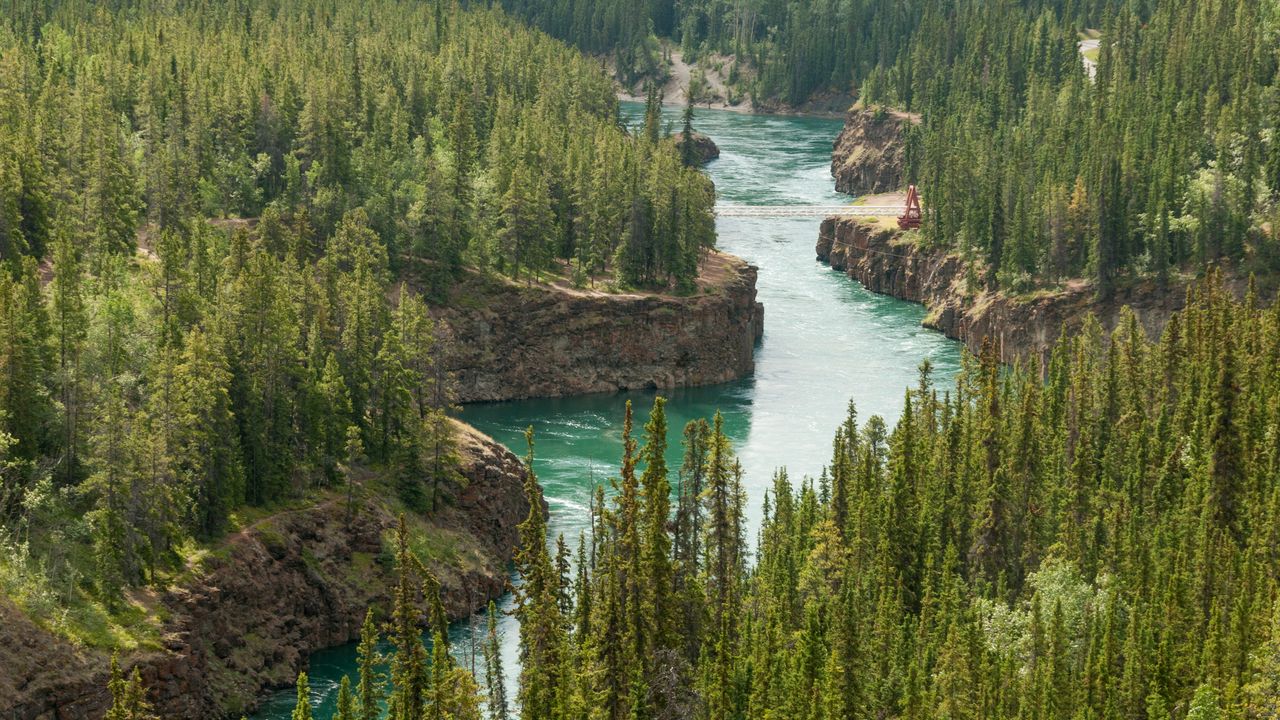
O Canada, how we love you.GettyCrafting a list of the best places to visit in Canada is no feat to sneeze at. The country is 3.85 million square miles, much of which is populated by roaring waterfalls, rugged mountain ranges, wind-whipped coastlines, and mirror-clear lakes that rival the pure blue of the skies. The warm and wondrously diverse people who call Canada home are a delight of equal measure, and make the destination one of the friendliest places in the world.Maybe you're a Drake fan, or you cheer on the Habs every season, or you have a particular taste for rabbit poutine that just can't be satisfied anywhere else—whatever it is that draws you to the land of maple and hot guys named Ryan, there's no shortage of amazing stops to take once you arrive. So, as you look through this list of the best places to visit in Canada, let your multifaceted interests in the nation's many layers lead the way.Fundy Coast, New Brunswick GettyFundy Coast, New BrunswickIf you've ever fantasized about what life would be like as a 19th-century Romantic artist, absolutely consumed with the sublime power of nature, look not to the glaciated valleys of the Lake District, but to this rugged east Canadian coastline, where you'll encounter the unruly Atlantic at its most extreme. The Bay of Fundy lays claim to the largest tidal range on the planet, with waves crescendoing upwards of 50 feet a day. With an ecosystem as capricious as this, the local wildlife is born and bred to go with the flow—think gentle-but-giant humpback whales, colonies of industrious beavers, and torpedoing peregrine falcons, the fastest animals on Earth. You can walk directly on the ocean floor among the flowerpot Hopewell Rocks at low tide, or, if you'd prefer to take it all in from a slightly less precarious position, drive along the 286-mile Fundy Coastal Drive. Plan your visit for the summer, specifically mid-June to early September, when the region blooms with sea life and the parks are fully accessible.Cape Breton, Nova Scotia GettyCape Breton, Nova ScotiaFor a calmer taste of coastal Canada, head up north to Cape Breton, where the forest-meets-the-sea vistas are outdone only by the lobster, which is considered some of the best in the world due to Nova Scotia's frigid waters and the area's superb “merroir,” a term adapted from the wine world's “terroir” to describe how various environmental factors like wave cycles, salinity, and marine diets influence shellfish flavor. In Cape Breton's case, that means sweet and full-bodied crustaceans with a subtle accent of brine. The inland waters of this Nova Scotian island are similarly blessed with exceptional river life. The catch-and-release fly-fishers who flock to the Margaree River every summer regularly reel in 20-plus-pound salmon, with the nearly 100-year-old record standing at 52.5 pounds. Tour through Cape Breton's wonders on the winding 185-mile Cabot Trail, which includes the Margaree River, Cape Breton Highlands National Park, and eight major communities on the island.Cavendish, Prince Edward Island GettyCavendish, Prince Edward IslandWe get it—PEI's homey lighthouses and rocky shores ripped straight from a Winslow Homer canvas signal New England, but this red-sand island stamps its name on an entirely separate and equally vibrant culture. This is one for the sentimental bookworms—swap out the little black dress in your carry-on for the equally timeless, slightly quainter pinafore as you head to Cavendish, the site of Green Gables Heritage Place. If you're a fan of Anne and the classic childhood book series that bears her name, you'll already be familiar with the stomping grounds that inspired Lucy Maud Montgomery to put pen to paper. Take a self-guided tour on the grounds' two walking trails: the modestly spooky Haunted Wood Trail and the Balsam Hollow Trail, which includes Lover's Lane, an agrestic path Montgomery once called her “favorite object in nature”—high praise from a remarkable woman who was such a careful examiner of life.Revelstoke, British Columbia GettyRevelstoke, British ColumbiaSnowbirds who live life by the adrenaline rush have long known about Revelstoke, also affectionately known as “Revy.” The ski resort town sits at the base of the longest vertical drop in North America—5,620 feet, to be exact. For years, Revy carried its reputation as a heli-skiing hot spot that weeded out the fainthearted, but opening up as a public resort in 2007—plus revitalizing its downtown by expanding its après options—has helped soften it up. Should you feel more inclined to take a ride on Revelstoke's mild side, stroll down the main street of Mackenzie Avenue, where mom-and-pop shops have taken up residence in the quaint townhouses skirting the street. For more time outdoors, plan a hike up the Meadow in the Sky Parkway when BC's wildflowers are in full bloom, or let gravity take the wheel on the Pipe Mountain Coaster with the assurance that you can go as fast (or slow) as you'd like.Vancouver, British Columbia GettyVancouver, British ColumbiaIn Vancouver, you get the best of British Columbia's natural beauty, plus all the convenience of a metropolitan city. When you've had your fill of Grouse Mountain's Pacific Ocean views, or whale watching from easy day trips like nearby Granville Island, you have a whole other world of urban adventure awaiting you back on dry land. After all, this is one of the country's greatest food cities. In a cultural mosaic as diverse as Vancouver, where nearly 200 languages are spoken, and half the population has a native language other than English, you can bet there's going to be great grub. Start with some of the best Chinese food outside of China, but venture on from there to French, or Japanese, or Peruvian, ad infinitum. On the whole, this is one of those rare destinations where you can grab some of the world’s best dim sum for brunch, take in some art in the afternoon at a world-class gallery, and top it off with some night skiing—all while barely leaving the city’s limits. It also happens to be great for family travel thanks to kid-friendly activities like an aquarium, a wonderful public market, and the iconic suspension bridge.Montreal, Quebec Getty ImagesMontreal, QuebecWhile some may dub Montreal the “Paris of North America,” don't make the mistake of thinking of it as a second city. It's a place that commands its own long list of superlatives for iconic architecture, fantastic cuisine, diverse neighborhoods, and a rich history that feels at once both European and distinctly Canadian. There are definite musts, like trying smoked meat at Schwartz's Deli (which national treasure Celine Dion is an owner of), climbing the eponymous Mont Royal (which becomes especially glorious when the fall foliage comes in), and taking a few spins around La Grande Roue de Montréal (which boasts some of the best views of the city's historic Old Port neighborhood). But don't be afraid to let your feet wander—you never know what kind of gem you might uncover on the next side street, be it the cozy bookstore of renowned comics publisher Drawn & Quarterly, the über-stylish collection inside vintage store Marché Floh, or the furry friend–filled interior of Happy Cat Café, the first of its kind on the continent.Quebec City, Quebec GettyQuebec City, QuebecWhen you think of walled cities, you may imagine Campeche in Mexico, Xi'an in China, or Dubrovnik in Croatia, but someone has to hold it down in the Great White North, and Old Quebec is the only walled city across the US and Canada. To step into its perimeter is to take a step back in time, to imagine being amongst its historic cathedrals and ornately topiaried gardens in its heyday as the once-capital of French culture in North America. As a UNESCO World Heritage Site, every stone here has a history, whether it lines the Quartier Petit Champlain, one of the oldest shopping corridors in the country, or is embedded in the towering Notre-Dame de Québec Basilica-Cathedral. The city is home to many firsts: Here's a Snapple fact—did you know the first cheese in North America was made in Quebec City, and you can still sample cheese from those very same makers at the Fromagerie de l'Isle d'Orléans? After you've had your fill of history and are itching for a breath of fresh, floral-scented air, sniff your way over to the lavender fields at La Seigneurie de l'île d'Orléans. Plan your visit for July, when the flowers are in peak bloom.St. John's, Newfoundland GettySt. John's, NewfoundlandWith a population stretching just over 110,000, Newfoundland's capital, St. John's, may not be the most imposing city, but it is mighty indeed. When it comes to Canadian friendliness, Newfoundlanders do it like no one else, and they even have a pub tradition called a “Screech-In” to welcome newcomers into the community. The components involve reciting a local chant, drinking a shot of Screech rum (which has a 40% ABV, for those curious), and giving a big kiss on the lips to a codfish, or an appropriate substitute. Once fully initiated, you can go about exploring everything St. John's has to offer with the confidence of an honorary local. Have your photo taken along Jellybean Row, with the technicolor houses that give the city its vibrant look; take a day trip to the nearby fishing village of Quidi Vidi; and be the first person on the continent to witness dawn at Cape Spear Lighthouse, which is said to be the easternmost point in North America, barring the inclusion of Greenland.Fogo Island, Newfoundland and Labrador GettyFogo Island, Newfoundland and LabradorOne does not simply stumble upon Fogo Island, and while the journey is quite the trek—comprised of a drive from the airport to a ferry that leads you to another drive—it's well worth the effort. Plus, the ferry ride is just shy of an hour and punctuated with blasts of North Atlantic wind. It's that same epic force that dictates life on the island, casting something of a cinematic veneer over the resilient coastal landscape. Lashed at by the wind and waves, it's against this backdrop of unbridled nature that the cod-fishing communities of Fogo Island have made their homes. The locals hold onto a distinctively settler heritage, with many families tracing their roots back to Ireland and England some three centuries back. It's a beautiful and historic bottleneck that puts on different charms depending on the time of year. The islanders like to say there are seven seasons here—in the fall, when the berries carpet the ground, there's also Feile Tilting, a celebration of Tilting’s Irish heritage, as well as the Shoretime festival, a biannual gathering of artists, ecologists, and cultural thinkers. During “trap berth” (between spring and summer), you can spy icebergs and plenty of whales; summer is for wildflowers and pond swimming. Some locals will tell you the shut-in season of winter is the most gorgeous time of all. It's made for snowmobiling and snowshoeing through the island’s interior by day, and come evening, getting invited into someone's warm shed for a tipple and a chat.Toronto, Ontario GettyToronto, OntarioAn unwritten rule: there are two t's in Toronto, but if you pronounce the second one, it's abundantly clear you're stopping by from elsewhere. That said, you may know the city better as “The Six,” as christened by local rapper Drake when promoting his 2016 album Views, the cover of which also iconically displays him sitting atop the very Torontonian CN Tower. It's a nickname that nods to the “416” area code, and the six municipalities—Toronto, East York, North York, Scarborough, Etobicoke, and York—that make up the larger urban complex of Toronto. If that sounds like a lot to you, it's because it is: the city hosts over 200 different nationalities of people who speak just as many languages. Toronto's residents don't give up on all the textures and nuances that make up who they are, which means you'll always have the chance to explore something new, whether you'd like to do as the tourists do and visit well-trodden and nonetheless beloved sites like the St. Lawrence Market, or “go local” and find nicher, newer venues like the BAND (Black Artists Network in Dialogue) Gallery.Ottawa, Ontario GettyOttawa, OntarioFor the country's capital, Ottawa still carries an undersized reputation as one of the quieter Canadian cities—but in the last few years, it has blossomed into a destination assured in its second act. Between its lively culinary scene and slate of world-class museums, Ottawa has all the trappings of a sleeper hit. While we'd never wish to bore you with bureaucracy, the free guided tours of Parliament Hill are definitely worth attending to catch a glimpse of how the whole running-a-federal-government thing works. And just a brisk 10-minute walk away, the 100-year-old ByWard Market makes for great perusing as a pedestrian-only pocket of town peppered with farmers markets and boutique stores selling souvenirs, including all things maple. Ottawa is also a great family destination with no shortage of special-interest museums that cater to the curiosity in all of us. Geek out over the 200+ specimens and artifacts from the Canadian Arctic housed at the Canadian Museum of Nature, the golden age of flying at the Canada Aviation and Space Museum, the secrets of postwar history at the subterranean Diefenbunker Cold War Museum, or the production of legal tender at the Bank of Canada Museum.Niagara Falls, Ontario GettyNiagara Falls, OntarioIt's no secret that Niagara Falls is one of the most breathtaking places on Earth, and it's also well-known that the Canadian side is the more scenic of the two halves. While some may dream of the reprieve of a beach come summertime, rather than bake on the hot sand, who wouldn't prefer to bask in the refreshing mist of roaring waterfalls instead? Once you're fully cooled off, the fun doesn't end there. Run it back with even more momentum on a zipline at Wildline, where you'll land at the foot of Horseshoe Falls. If you find that your adrenaline is adequately pumped, head below ground level on the Journey Behind the Falls tour, allowing you to explore the tunnels beneath the water. Rather split the difference? Put on your plastic poncho and book a Gray Line Boat Tour, which gets you up close and personal with North America's greatest natural wonder.Banff, Alberta GettyBanff, AlbertaBanff is the eponymous core of Alberta's 2,500-square-mile adventure haven Banff National Park, long-adored for its crystal-clear alpine lakes, expansive wildflower fields, and scenic hiking trails. In this arm of the Rockies, ski season can last up to late May, and new openings are sweetening the deal on and off the slopes. Earlier this year, skiers and snowboarders gained access to Richardson's Ridge, a 200-acre sweep of skiable terrain at Lake Louise Ski Resort. In 2026, we're also celebrating the 100th anniversary of Mt. Norquay, Banff's oldest ski area. As part of its Norquay 100 Vision initiative, the resort has constructed an elevated wheelchair-accessible walkway between mountain trails with striking views of the valley; an education and heritage center, created with local Indigenous communities; and, in 2027, a two-station gondola will replace the North American Chairlift and provide a more streamlined pipeline summit. With some of the darkest skies in North America, the park is also an excellent place to view the Northern Lights in the winter.Whitehorse, Yukon GettyWhitehorse, YukonWhitehorse is the capital of the Yukon, one of Canada's three territories, and is home to around 30,000 residents—approximately 70–79% of the territory's entire population. There's certainly no metropolitan chaos to be found here, making it an outdoorsy retreat perfect for reconnecting with yourself. The city also acts as a terminal on the Alaska Highway, one of the most scenic drives in the country. From this jumping-off point, there's no telling where the options will take you next. You might want to kayak down the Yukon River, rip a mountain bike down the rugged trails, or pilot a seaplane through the placid airspace above Schwatka Lake. Whatever you end up settling on, be sure to take a deep breath, as Whitehorse was once recognized by the World Health Organization as the city with the cleanest air in the world. Plan a day indoors and learn about the rich histories of the territory's Indigenous peoples, who make up around a quarter of the population, at the MacBride Museum, the first-ever museum in the region, or the Interpretive Centre, which specializes in the Ice Age history of the former subcontinent and land bridge linking Asia and Alaska, Beringia.Drumheller, Alberta GettyDrumheller, AlbertaCanada is one of the best places in the world to visit if you never quite got over your dinosaur phase, and most dino-lovers stop by the small town of Drumheller to dive into all things prehistoric. It boasts legendary excavated finds at the Royal Tyrrell Museum, and buried natural treasures at the 20,000-acre (or so) Dinosaur Provincial Park. While you could design your own itinerary around the campsites and trails marked for visitors, the real adventure begins with an expert leading the way, as a large chunk of the park is designated as a Natural Preserve, accessible only through guided tours. Long before the first paleontologists ever stepped foot on the parklands, the area was inhabited by the Cree, Assiniboin, Salteaux, and Chipewyan First Nations people, who left the grounds—and the millions of years of history pristinely preserved beneath the surface—virtually undisturbed. Through careful observation, experienced guides can point out the countless fingerprints of life on Earth 75 million years ago scattered throughout the grounds.Why Everyone Will Be Going to Osaka in 2025
15 Best Places to Visit in Canada for First Nations History, Quebecois Cuisine, and Dinosaur Bones
Full Article
Original Source
Read the full article at Cntraveler →KhanList aggregates and links to publicly available news content. We do not host full articles from third-party sources. Always verify important information with original sources.