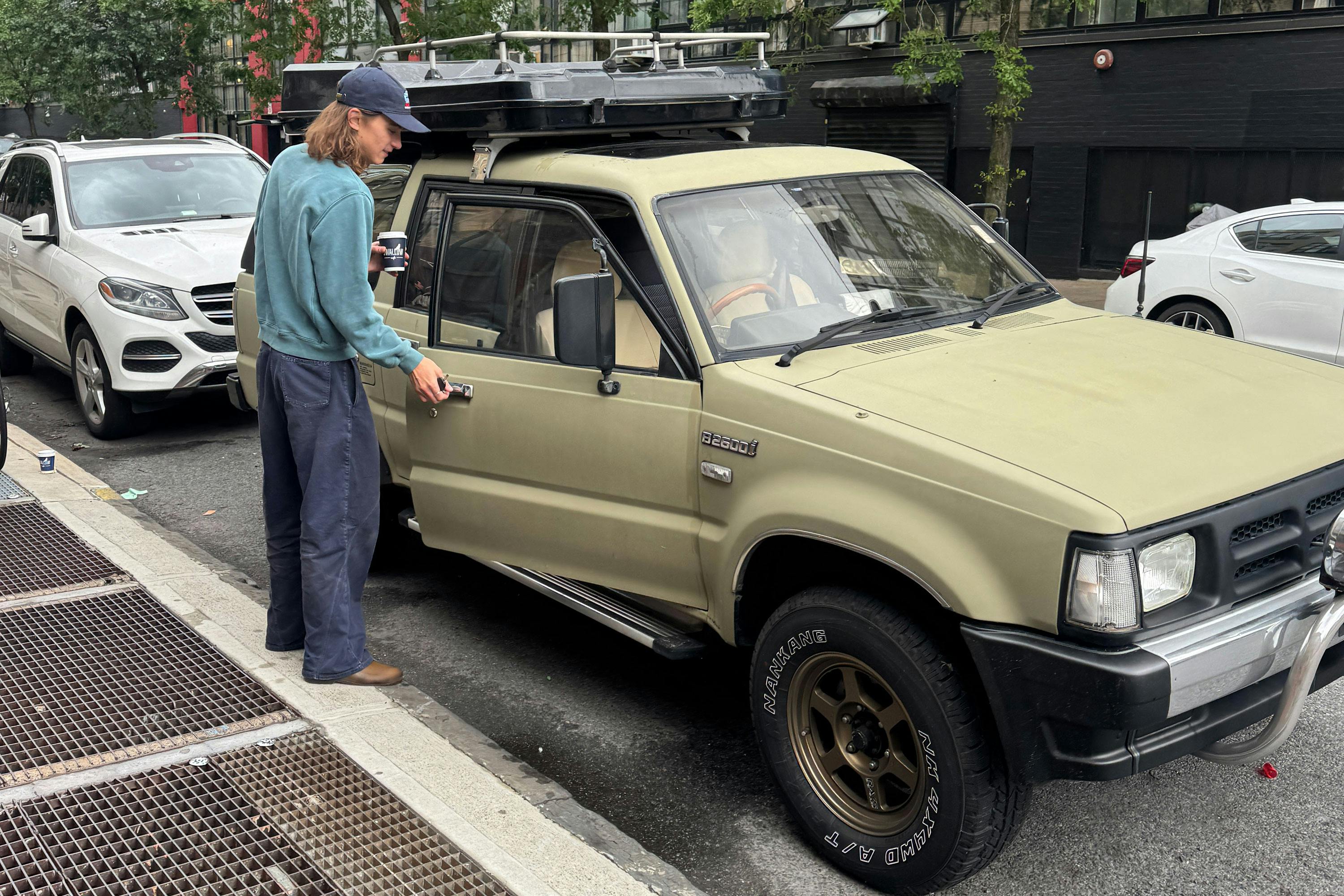
Consider for a moment, if you will, a version of J.G. Ballard’s 1973 novel, Crash, in which all of the vehicles are replaced with self-driving cars. They wouldn’t collide with one another. There would be no climax of metal entanglements. Propelled by inhuman forces, the cars would simply refuse to bend to the perversions of the people who wanted to get off on ramming them together. Can you imagine the sexual frustration? It’s enough to make a person go out and buy a Porsche. Driverless cars are cold logistics given form: conveyance, cartage, chargeable weight. There is nothing to love about them in the same way there is nothing to love about a microwaveable meal or a Nespresso pod. A driverless car cannot cruise a Los Angeles avenue in the faint gloam of the evening or slow down so you can flirt with someone you think is cute from an open window in the humid damp of late summer. The driverless car does not know how to go nowhere. To desire a piece of machinery that exists in opposition to that joyless march toward efficiency is, then, deeply sexy. Each person I spoke with, from fashion designer to chef to WNBA player, owns a car that sputters and vibrates and oozes fluids, grease slicking the gears and oil dripping from the chassis. They all share a desire to feel what they’re driving rather than turning it on and letting a computer take over. These are the kinds of gearheads we can get behind: people who own Porsches, yes, but also some Benzes, a Honda, a G-Wagon, and a 1994 Japanese right-hander. People who are in it for the friction of a stalled engine or the ecstasy of a tuneup. People who are in it for the long haul. The Benz Straight Out of a Music VideoLarry June Rapper San Francisco 2006 Mercedes-Benz SLR McLaren Larry June remembers seeing the butterfly doors and spaceage side vents of the 2006 Mercedes-Benz SLR McLaren for the first time as a teenager. “It was in a music video, I can’t remember who. But from then on I had always wanted it,” he says. It took a couple decades, but June said he finally found one at a Beverly Hills dealership after his son encouraged him to start looking online. “When they shipped it up, that was my first time driving this mode,” he says. The brakes and steering were a little stiffer than he was used to, a byproduct of the car being a test ground for ambitious experiments in metals and structure. “It’s an older car with older technology than my other cars, but that’s what makes it dope,” he says. “It’s super light; the whole thing is carbon fiber.” A love of cars runs in June’s DNA. His father had a rotation, and he remembers the lineups in San Francisco where neighbors would show off their rides. “I would see all the older guys pulling up in 5.0s, Grand Nationals, Vipers, the whole neighborhood had cars coming through,” he says. That also imbued a lesson: cars are meant to be driven. He takes the McLaren out a few times a week and has been able to test out the car’s legendary speed. It attracts some understandable attention from aficionados who probably feel the same way about the McLaren that June did as a teenager. “People want to take pictures, and I don't mind it, but I don't like the attention 24/7,” he says. “I only drive it early in the morning, by myself, get some coffee or juice, then park it and switch to another car.” The WNBA-Worthy ChevelleBrittney Griner Basketball player Arizona 1971 Chevrolet Chevelle Super Sport 454 For more than a decade, Brittney Griner would walk past the same 1971 Chevelle Super Sport parked at an auto body shop on her way to the Phoenix Mercury’s practice facility. Sometimes she’d stop, talk to the mechanics, and, when she felt bold, ask if the car was for sale. “Early on, I was still on that rookie salary, and it just wasn’t smart. I didn’t even have a house yet,” Griner says. That changed last year when she got a call from the shop. The owner wanted to sell Griner the car — but he wanted her Jeep as a trade. “So we did a little swap. I sent a little money with it, and boom, I got my Chevelle,” she says. She started turning heads the minute she turned on the engine. “When it finally cranked up inside that trailer, my neighbors started coming out because they knew something was worth coming out for,” she says. The run of Chevelles from the late 1960s to the early 1970s is special to Griner because her father had a 1968 that he begrudgingly sold many years ago. When she bought her car, she called her dad and teased him. “I said, ‘Guess what I got?’ and he knew immediately,” she says. That first night with the car, she put her wife in the passenger seat, arm around her shoulder, cruising the neighborhood while the older residents gave thumbs-ups out their windows. The Chevelle 454 is a Chevy Big Block engine, loud and simple and easy to work on. Those are all attributes Griner applies to herself with some satisfaction. “I think I’m a classic,” she says, laughing. “I’m easy. I’m low maintenance. I don’t need all that extra. The simplicity of the car and the raw muscle and the lines it has. I feel like that’s me.” When the time comes, the car will go to her son, who is two and already recognizes the sound of the engine from inside the house. There will be rules attached: “He cannot get rid of it,” Griner says. “Or I will haunt him for the rest of his life.” The Japanese Mazda from Facebook MarketplacePierce Abernathy Model and chef New York 1994 Mazda Proceed Marvie Camper Pierce Abernathy will tell you, without much prompting, that he has the best Facebook Marketplace algorithm of anyone he knows. This is how he found the 1994 Mazda Proceed Marvie, a right-hand-drive Japanese-market SUV with a camper conversion in the back. It was listed by a seller in Virginia who had imported it and clearly cared for it with unusual devotion. Abernathy drove it back to New York City himself. That first hour on the highway, sitting on the right side for the first time in his life, was a little frightening. “Anyone who gets in the car to drive it takes a second to get used to it,” he says. The Mazda has original paint, low mileage, and an interior that the previous owner had modified with quiet intentionality. The whole thing was function over form. When Abernathy took it to a mechanic’s shop for its first inspection, the guy called everyone else over to look at the engine. “I have some sense of pride,” Abernathy says, “even though I know nothing [about what’s] going on in there. I just bought the car. But I’m like, ‘Yeah, I bought a good one.’” He parks it on the street and is at peace with the dents and dings that come with that arrangement. The car was made to be used, and using it is its own form of care. The aux cord connection between his radio and his phone is especially mercurial; he’ll sometimes lose his driving music if he shifts his knee in the wrong way. Still, “I can’t imagine having a new car,” he says. “All these quirks are endearing to me; I feel closer to the practice of driving. It’s this nostalgia that doesn’t even come from my own life.” The Mercedes-Benz 300 with Brooklyn swaggerJon Caramanica Journalist New York 1993 Mercedes-Benz 300 CE “It’s a dope-boy car,” Jon Caramanica says when asked why he wanted this particular model of Benz 300 series. “It’s from a certain generation of cars that were flashy in a very specific time in New York City history. They are beautiful and functional, and they have a panache that is very hard to replicate.” Caramanica inherited his family’s 1983 Mercedes 300 CD and “drove it into the ground” before finding the 1993 model in 2022. The ’83 is now in storage in upstate New York, although Caramanica has an abiding fondness for the big-bodied family heirloom. “I’d have it parked in my living room if I could,” he says. The journalist and pop music critic at The New York Times grew up in Mill Basin and Sheepshead Bay on Brooklyn’s southern edge, a rare corner where driving is the preferred way to get around. His dad owned a body shop on 54th Street, and Caramanica remembers spending days there watching expert mechanics repair seemingly lost causes. But Caramanica’s parents understood how tempting that environment could be. “They didn’t let me get under the hood or tinker. They didn’t want that life for me,” he says. Still, his love of cars survived. Unlike a lot of New Yorkers, he doesn’t mind driving. “There are energies and rhythms you get to see when you’re stopped at a red light on, like, East 16th and 2nd Avenue that you wouldn’t have access to if you were walking or on the train,” he says. “I learned New York by car long before I learned it by subway. It opened up the city to me.” Caramanica’s Mercedes has also played a starring role in his “Song of the Week” video series for the Times. “I learned to listen to music in the car,” he says. “It’s me sitting in the driver’s seat and turning to you, the viewer, and saying, ‘Hey, here’s what’s going on with this piece of music.’ It’s natural.”The Pedigreed Porsche Named After a Motor LegendAloisa Ruf Artist and photographer Germany 1968 Porsche 912 Many kids get cars as a gift from their parents. Fewer receive a classic car that doesn’t run. When Aloisa Ruf was 17, she started bugging her dad about what her first car was going to be. “He helped me find this 1968 912 Porsche, and I was so excited,” she says. “And he told me, ‘If you can fix it, it’s yours.’” Given the Ruf family’s pedigree as an auto manufacturer and performance tuning company, it’s understandable that they do things a little differently. Aloisa worked with family members including her cousin — who happens to be the head of Ruf’s classic car restoration department — to do an “A to Z” refurbishment. The process was demanding. “They were challenging me in a no-bullshit kind of way,” Aloisa says of her relatives. “Testing me all the time to see if that’s really what I wanted to do.” She made the requisite repairs to get the car road legal by 2021, drove to Munich that same day to show it off at a car meetup, and within the year had taken it to Austria and Italy alone, windows down, listening to music. The 912 has its original paint, which means it shows patina and scars, and a fickle ignition process that requires exactly three pumps of the gas pedal before it will start. “If it’s four, you’ll get wet spark plugs,” Aloisa says. Her father joked that any thief who could figure that out deserved to keep it. Still, she prefers the quirks of her car to the cold distance of modern vehicles. “This world of autonomous driving and automatic gearboxes and massive touchscreens for I don’t even know what, you kind of lose the connection to the car you’re driving,” she says. “It’s more of a vessel to get from A to B.” Aloisa named the car Bertha after Bertha Benz, who in 1888 became the first person to drive a motorized vehicle long distance. Benz’s husband, Carl, had built it but lacked the nerve to try. Aloisa found the parallel fitting. As she was restoring the 912, she was also thinking about her own path as an individual and inheritor of the Ruf family name. “The whole process opened a door. I learned so much, and it renewed my passion,” she says. “I was trying to find a balance between my own creativity and my work within the company, and I found it while I was driving the car.”The Car Culture Archivist’s Classic HondaBrent Lawson Writer and mechanic Los Angeles 1986 Honda Civic DX Brent Lawson grew up in LA when car culture had its own media ecosystem and small magazines were flourishing in every niche. The magazines are mostly defunct, the builders are aging out, and the subcultures they sustained are either dying or going undocumented. Lawson, a writer, has made it his project to change that. “I’m interested in the builders trying to keep the MINI scene or the Honda scene or the hot rod scene alive,” he says. He’s doing some of that sustaining work himself. A few years ago, Lawson got deep in obscure Discord servers talking to gearheads in Germany and Japan about tuning obsessions and sharing mod ideas. He was so inspired by these conversations that he wanted to archive them somehow. So, he created a series of zines to illustrate the history of certain specific types of car culture. The car scene “isn’t as toxic as it once was,” Lawson tells me. Custom cars, in particular, can be seen through a lens of gender anarchy. “They’re designed in a factory as a binary,” he says. “Then people take them, modify them, and change the whole identity of the car. That always resonated to me as very queer.” His own car is a 1986 Honda Civic DX currently being restored at a friend’s shop. It’s not drivable yet, but that’s part of the point. Lawson is less interested in ownership as a static condition than as an ongoing practice. He totaled a 2000 BMW years ago — an accident he attributes to not understanding the car he was driving. Classic cars, he says, fixed that. “When you drive a stick and your car doesn’t have airbags, the last thing you want to do is slam into somebody on the freeway,” he says. “Owning classic cars has made me a better driver and a more curious person.” The Military-Grade G-WagonDevon Turnbull Artist and sound engineer New York 1992 Mercedes-Benz G250D Ambulance Devon Turnbull found the 1992 Mercedes-Benz G250D on a surplus machinery auction website in Germany in 2017. It is, technically, a G-Wagon, and one that spent its working life as a frontline extraction vehicle for the German army. “I had never been to Germany, and I had no experience with anything like this,” Turnbull says. Undaunted by the logistical nightmare of getting the thing stateside, Turnbull found a G-Class expert in Germany who agreed to help him out. “I took a redeye to Frankfurt and got started,” he says. When he landed, Turnbull drove two hours south to a salvage yard full of airport equipment and buyers from Africa and the Middle East, all looking to ship machinery home through Frankfurt’s freight infrastructure. Among the decommissioned ambulances, moss growing on flat tires, he found his truck and bought it on the spot. Turnbull had planned to convert it quickly, and he rented shop space from a furniture builder in Berlin. “I didn’t plan on spending six months,” he says. “I basically moved there and just worked on it.” The work was physically brutal: knee injuries, cuts across his forehead from drilling underneath the chassis. At Turnbull’s lowest point, an electrician in Hamburg who was supposed to be fixing some of the car’s complex wiring went silent with the truck in his garage. Turnbull sat in a hotel room waiting to hear back. “I was like, ‘What am I doing?’ I thought I had made a huge mistake.” That same week, Virgil Abloh called to tell Turnbull that his graphics had made it into Abloh’s first Louis Vuitton collection. Turnbull went to Paris, signed the contracts, and eventually wrapped up the truck conversion. He drove it to Morocco before shipping it home, later took it from Milan to Denmark to Iceland by ferry, and is planning a trip to Alaska. That Turnbull made this conversion with his own hands is something he considers part and parcel to his work handcrafting speakers and audio equipment: “There’s an amazing sensation you get when you’re in a thing that you built for yourself.”The 4Runner Worth the Lifestyle ChangeDonovan Green Model Los Angeles 2001 Toyota 4Runner As Donovan Green found out, it is difficult to both love cars and live in New York City. But when she moved to Los Angeles in 2024, her interest — which she credits to her mother’s intimacy with the maintenance work on their family cars — went from curiosity to necessity. Green initially wanted a Lexus LS400, the make her mom used to drive. She also scouted a 2002 Tacoma but knew she wouldn’t need the pickup bed. What she found instead was a black 2001 Toyota 4Runner. She test drove it. The rear window rolled down into the tailgate. “I knew my dog would love it,” she says. That was enough. The 4Runner is her daily ride, and for the first time as an adult, she gets to be behind the wheel of something that feels bigger than a mode of transportation. “It’s a huge milestone for me,” she says. “I’ve always loved cars and trucks. This feels like a big step.” The Well-Loved Road Tripper with Major PersonalityAaron Levine Fashion designer Ohio 1995 Porsche 993 C2 Few people have had as much influence on the way American men dress as Aaron Levine. Part of that success is his mild obsession with the intersection of aesthetics and utility, which is what led him to his current car, a mid-’90s Porsche that he bought when the odometer had spun past 100,000 miles. Levine got it a few years ago, after its owner died and his widow gave the car to the mechanic’s shop that had taken care of the car for years. “All the service records were immaculate,” Levine says. “He loved this car.” That the car had some miles on it, and that its repairs and tweaks had been thoroughly documented, was attractive to Levine. “It’s a driver’s car. I’ve taken it on a lot of multi-day road trips. It’s comfortable,” he says. Sure, there were things he could’ve fixed or modded to enhance its creature comforts — the steering wheel doesn’t adjust, pedals are bolted to the floor, and the air conditioning hasn’t worked in years — but the flaws keep him present. “It’s like I talk to it,” he says. “You can feel how it’s running through the shifter through your butt in the seat. You can hear if it’s happy, if something’s up, if it’s had a good breakfast and is limbered up and ready to run.” The depth of connection Levine has with his car hasn’t carried over to his family, though. “My kids hate it; they just think it’s old,” he says of his twin teenage daughters. But he knows they’ll be begging him to let them use it one day. For now, he calls it a “selfish” obsession. “I like to make things that are beautiful to look at. That are made of wonderful materials. I like for you to reach for them over and over and over again,” he says. “That’s what this car is to me. It’s built to work.”The 911 Turbo That’s Practically a FriendAnthony Akinbola Artist New York 2012 Porsche 911 Turbo 997.2 Anthony Akinbola didn’t get his driver’s license until a couple of years ago when he realized that his desire to move to the Hudson Valley would require him to get comfortable behind the wheel. “I couldn’t take Ubers to all these open houses and showings,” he says. He had a Mercedes GLC 43 AMG for a little while — Akinbola bought it before he had a license and learned to drive with his studio assistant riding shotgun — and eventually swapped it for a Porsche Boxster to celebrate a career milestone. “My work had just been collected in the Guggenheim,” he says. “I wanted it to be a physical checkpoint. Like: I’m not going back.” The Boxster felt like it also signaled an entrée into the Porsche community, where he found equal parts evangelists and archivists. He bonded with Geoff Isringhausen, an influential importer and collector, who taught him about the nuances of each model and era. Akinbola says those conversations led to him focusing on a single car: the 2012 Porsche 911 Turbo 997.2. He found one in Oregon and shipped it to New York, but he didn’t feel any real difference between the Boxster and his new car. “I was so disappointed. Like, this is the turbo experience?” he says. Then he took it to be serviced, and the technicians found a loose tube. When the car came back, it was like a different machine. Akinbola’s investment in caring for the car — servicing a 911 isn’t exactly cheap — also created some connective tissue. “It’s a car I listen to,” he says. “It’s like having a companion or a dog. It’s my buddy.” The “Ridiculous” BMW That’s Part of a Lifelong Love for E30sSophie Hur Director and photographer New York 1991 BMW 325i-E30 A couple of years ago, Sophie Hur was looking for a sofa on Facebook Marketplace when the holy hand of the algorithm descended upon her browser and showed her a black 1991 BMW 325i-E30 instead. “I went to see the guy on a Friday, and by Monday I had a new car,” she says. Hur is a director and photographer who works across music and fashion and was a BMW aficionado before moving from Australia to New York, having previously owned two slightly different E30’s, both in red. “I love the boxy shape of them; they’re just classic to me,” she says. The New York chapter of Hur’s E30 love affair would be a little different as she got back in touch with driving stick shift. “I spent the weekend driving around with the owner because he wanted to make sure he was selling it to someone who was going to love it and drive it well,” she says. One thing the owner didn’t mention until late in the game: the car has a busted odometer, which can be a headache for understanding exactly what care a car needs to keep running. That hasn’t deterred Hur from enjoying it, though. “It’s a ridiculous purchase. I know that,” she says. “But every time I drive it it makes me smile, and that feeling has never faded.”The Vintage Honda with the Flip-Up HeadlightsLeon Xu Artist New York 1986 Honda Prelude 2.0 Si For the car lover who has everything, may I suggest the collected seasons of “Initial D,” a street racing anime that is a personal favorite of the artist Leon Xu and one of the main reasons he bought a 1986 Honda Prelude 2.0 Si. “I’ve always loved the flip-up headlights,” he says. “And these 80s cars are boxier and have more character. I’ve gravitated toward that as I’ve gotten older.” The simplicity of the design was also appealing to Xu, who liked that the Prelude was “literally just a car.” “I think it teaches you how to be a better driver because it trains you not to rely on technology,” he says. Unfortunately, Xu is now looking for his beloved car’s next owner. Last year, he was injured in a car crash, and the Prelude took some damage that Xu isn’t in a place to fix. “I just want to make sure it goes to somebody who will take care of it,” he says. Xu’s “Initial D” days might be over, but he’s not heartbroken. “I see it as a chapter of my life,” he says. “I think I solidified the car’s history with my own pretty well.” A Native New Yorker’s Daily Driver & Weekend CruiserMaxwell Osborne Fashion designer New York 1986 Mercedes-Benz 450 SL and 2017 Mercedes-Benz G-Wagon I like to imagine that when the EPA decided to create a city vs. highway miles per gallon rating, what they were really doing was introducing a dual spirit to the concept of driving, formalizing the idea of town and country. Maxwell Osborne, co-founder of Public School, embodies that split with his pair of cars: a 1986 Mercedes-Benz 450 SL and a 2017 G-Wagon. “I grew up in Brooklyn and got my license at 16. The day I could drive in New York, I was driving everywhere,” Osborne says. He was never a serious gearhead, but the designs of both cars stuck in his mind since he saw them growing up. The 450 SL is a weekend cruiser that mostly sits garaged during the winter; he found it during an estate sale and split it with his cousin. It has a car phone that no longer works, and Osborne says the heavy weight of the car makes it a little less comfortable driving in the city day to day. The G-Wagon he bought from a friend in Miami, and he finds it the perfect vehicle for navigating New York. “I love how rough and rugged it is, and it gets me through the city, especially the potholes,” he says. “It’s great for moving clothing racks, clothes, boxes. It’s solid so I’m not too worried about people bumping into it when I park on the street.” There’s a sort of spiritual harmony in Osborne’s choices, although one his dog, Stitch, isn’t at peace with it. “She doesn’t like either car really,” he says. “But she prefers the G-Wagon since she knows getting in means she’s probably going somewhere she can run around.”The Bike that Gets the Job DoneLeo Gamboa Creative Bay Area 2016 Honda Ruckus motorcycle Quick, what do Queens and San Francisco have in common? “Parking and traffic,” Leo Gamboa, VP of collaborations at Levi’s, says. So it makes sense that Gamboa would be highlighting his beloved 2016 Honda Ruckus, a vehicle that is not quite a scooter and not quite a motorcycle but a secret third thing. “I live in the hills so it’s the perfect vehicle for cruising around. It tops out at about 30 miles per hour,” he says. Gamboa fell in love with the Ruckus when he was at a friend’s BBQ. She had a pair of them and let Gamboa, who had owned a scooter in Queens, do a test drive. When the friend moved to LA, she sold one to Gamboa, who uses it a few times a week. The stripped-down feel of the bike feels right. “Growing up, I was always on a skateboard, a scooter, a bike. The simple vehicles always appealed to me,” he says.
14 of our Favorite Gearheads Tell Us About Their Daily Drivers
Full Article
Original Source
Read the full article at Highsnobiety →KhanList aggregates and links to publicly available news content. We do not host full articles from third-party sources. Always verify important information with original sources.