
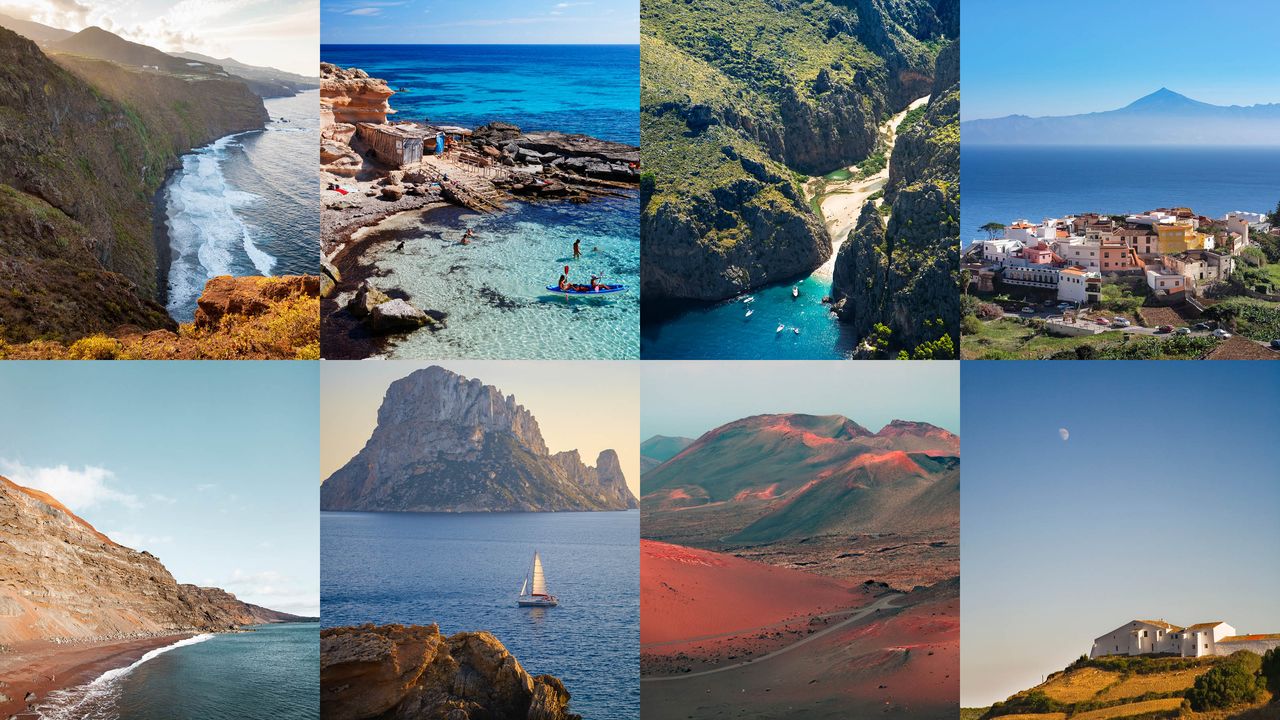
Our in-house editors weigh in on their favorite islands in Spain, plus list their top picks on where to stay.Formentera sunset, Sarah Bannerman Too many of the best Spanish islands have slipped under the radar for too long. Granted, that's how many in-the-know travelers may want it to stay—but who're we to gate keep? Greece's abundance of island idylls is no secret, while swanky hotels and chic beach clubs aplenty have popped up along our favorite Croatian escapes for more than a decade. However, while we've been grooving through the night on Ibiza's dance floors and digging our toes into the sand on Mallorca's spellbinding beaches, there are plenty of gems yet to claim their time in the spotlight. Here, the Conde Nast Traveller editors from Spain and the UK—all self-acclaimed Hispanophiles—share the must-visit spots on the aforementioned greats, while introducing us to the charm of Spain's lesser-known islands.Editor's picks of the best Spanish island hotelsBest Spanish islandsMore inspiration on where to stay in SpainEditor's pick of top Spanish island hotels:Getty ImagesFuerteventuraCondé Nast Traveler Spain editor María Ángeles Cano’s favorite Spanish island for: total removal from daily lifeIt is difficult to get over the initial impact of your first landing in Fuerteventura. Before your eyes, a landscape unfolds that leaves you speechless. It is as desert-like as it is extraordinary, making you feel as if you are at the end of the world. This is the oldest island in the Canary Islands and the second largest in the archipelago, so you need time to take in its natural wonders and volcanic landscapes. You’ll be surprised by the white sand of its paradisiacal beaches, such as Cofete and Sotavento, and by its crystal-clear waters, which are also perfect for water sports.Fuerteventura is the island for adventurers, as it is one of the world’s main destinations for windsurfing and kitesurfing. The Corralejo Dunes, the Villaverde windmills, and curious places such as Bajo de la Burra beach, known as Popcorn Beach, are just some of the many places worth visiting and, of course, staying for a while.Where to stay: Luxury has become increasingly available on the island in recent years, and the options have expanded to suit all tastes. First came Paradisus by Meliá Fuerteventura, followed by ZEL Fuerteventura, right next door, both located by Sotavento Beach in Costa Calma. Both are perfect for wellness-focused holidays and sports. If you prefer a smaller and cozier retreat in a charming village like La Oliva, Casa Montelongo is the place for you: a design-filled, peaceful gem perfect for taking in the local essence.MenorcaHead of editorial content for Condé Nast Traveler Spain David Moralejo’s favorite Spanish island for: biological treasuresMenorca has the largest marine Biosphere Reserve in the Mediterranean, protected by UNESCO and extending more than 12 miles offshore. Its Posidonia oceanica seagrass is a biological treasure, the same that makes the sea appear turquoise. The calm of the sea is carried inland because it is unbeatable: Menorca is famous for its tranquillity and peace, which even the voracity of overtourism cannot break.But where can you get lost to find calm? In Cala Algaiarens, located in the north of the island and very close to the beautiful city of Ciutadella. Also on the Camí de Cavalls, to the north, is Cala Morell, with its imposing rocky landscape and the only Talayotic necropolis in the Balearic Islands, with up to 14 caves carved into the rock.In the S'Albufera Natural Park, a 70-hectare nature reserve, you will find some of the most impressive and hidden beaches on the island, such as Cala Morella Nou, very close to Cape Favàritx.Mahón, the capital, is worth a stroll through its English-style streets, art galleries, and lively bars. And if you want to keep walking, you can even climb Monte Toro, the island's highest point. From here, you can almost embrace the beauty of Menorca and—weather permitting—even Mallorca.Where to stay. We wouldn't know which one to choose. Villa le Blanc, a Gran Meliá Hotel, to experience the warmth of a small but grand resort; Torralbenc, the perfect example of Menorcan lifestyle; Son Ermità & Binidufà because Vestige Collection has reinvented luxury on the island; Amagatay and Morvedra, with the freshness of the Annua Hotels brand; Cristine Bedfor, a charming house in the center of Mahón.Getty ImagesLa GraciosaCondé Nast Traveler Spain contributor Marta Sahelice’s favorite Spanish island for: a wild escapeLa Graciosa has been on everyone’s lips ever since Quevedo and Elvis Crespo turned their song of the same name into a summer hit. Yet for many years, the eighth Canary Island—once considered merely an islet dependent on Lanzarote—remained largely unknown. Not to those of us who love walking barefoot along its unpaved streets, cycling across its volcanic trails, or paddling beneath the dreamlike Montaña Amarilla, though. But we are the same people who have tried not to say its name too loudly for fear of breaking the spell—or no longer finding a room in one of its few hostels and guesthouses at any given time.Today, with half the world singing its praises, La Graciosa offers considerably more comfort, from self-catering apartments to sea-view suites. Even so, it is still not a destination for everyone. Its beaches are wonderfully unspoilt, but there are no lifeguards and the waves can be powerful. Its seafood-led cuisine is delicious, but do not expect any stars beyond those scattered across its light pollution-free skies. And while its natural beauty is breathtaking, it is also fiercely protected: here, the island still sets the pace, not tourism.Where to stay: Evita Beach offers stylish, well-equipped apartments and suites just steps from the sea in Caleta de Sebo. Some have private terraces and sweeping ocean views, making it an ideal base for experiencing the island without sacrificing comfort.inigoarzaIbizaCondé Nast Traveller UK commerce editor Sarah Bannerman’s favorite Spanish island for: shoulder season escapismIt’s true what they say about Ibiza being famed for its nightlife—every summer, the world’s most lauded DJs gather to stake their claim on residency at superclubs, and between May and October, the island comes alive. No matter the time of day or night, there’s a party to be found. But there’s a quieter side to Ibiza, one I think deserves to be celebrated. As with all the Balearics, Ibiza’s coast, sea, and sand are rich in a blaze of gold and turquoise color and are undeniably beautiful. Orange clay cliffs border the sea, and soft green pines dot the land. When it comes to places to eat, there’s a booming farm-to-fork offering here that rivals its beach clubs—don’t miss Juntos Farm and La Paloma in the center of the island, or Cala Gracioneta if you’re by the sea. Wellbeing is also a focus, and those seeking connection to nature—and disconnection from hectic city life—retreat here en masse year-round. Perhaps it’s the fabled pull of Es Vedra—the most magnetic point on earth—that deems it so alluring in the wellness space?Where to stay: Ibiza’s hotel scene spans the boujee to the boutique, and both are done really, really well. In 2025, I stayed in what might just have been my favorite hotel on the island, Hacienda Na Xamena—its spot near Santa Gertrudius, not far from the new Soho Farmhouse, is remote and resplendent, with a handful of rooms and suites that all overlook the water. Elsewhere, there are Six Senses near Portinatx and Nobu Ibiza Bay near the water’s edge in Talamanca.Getty ImagesLa GomeraCondé Nast Traveler Spain contributor Anabel Vázquez’s favorite Spanish island for: taking it slowLa Gomera is the kind of place that simply feels good for you, particularly if you spend your days staring at screens and crossing streets to the rhythm of traffic lights. On this small Canary Island, life moves at a softer, more musical pace, as gentle as the accent of the people that live there.Imagine the Azores meets Vietnam meets some far-flung planet, and you'll be thinking along the right lines. You can do just about everything here: surf at Valle Gran Rey, hike through Garajonay National Park, eat potaje and drink lemonade at the flower-filled Casa Efigenia. Or, of course, you can do absolutely nothing.With just 22,000 inhabitants and six villages, traveling to La Gomera feels a little like checking into a retreat. Silence can be found and there are very few tourists (yes, places like this still exist). The landscape feels almost Jurassic, the food is wonderfully fresh and there's a feeling of being far away from everything.Where to stay: Bancal Hotel & Spa, perched atop a cliff and part of a new vision for tourism in the Canary Islands. Everything about it feels unmistakably Gomera.Getty ImagesGran CanariaCondé Nast Traveler Spain editor María Casbas’s favorite Spanish island for: feeling like you have it allGran Canaria is often described as a miniature continent, and for once, the cliché feels entirely justified. Drive across the island and the scenery changes almost by the minute: the golden dunes of Maspalomas give way to dramatic ravines, pine-covered mountains, and villages suspended above the clouds. Then there is Las Palmas de Gran Canaria, a lively capital where you can wander through the cobbled streets of Vegueta in the morning, have lunch overlooking Las Canteras Beach, and end the day with a swim in the Atlantic.The best way to discover the island is to hire a car and take to the road. Head inland to Tejeda for vertiginous views and almond pastries; continue north to Agaete for whitewashed houses, natural pools, and freshly caught fish; or make your way south to Puerto de Mogán, where bougainvillaea tumbles from balconies above its canals. Gran Canaria has beaches, of course, but also history, nightlife, excellent food, and landscapes that make you wonder whether you are still on the same island. Whatever kind of holiday you have in mind, chances are you will find it here.Where to stay: Santa Catalina, a Royal Hideaway Hotel, is the grande dame of Las Palmas de Gran Canaria, surrounded by the gardens of Parque Doramas and close to the city’s restaurants, historic neighborhoods, and beaches. For mountain views and complete tranquillity, choose the Parador de Cruz de Tejeda, in the heart of the island.Westend61MallorcaCondé Nast Traveller UK digital writer Connor Sturges' favorite Spanish island for: leisurely explorationDespite Ibiza’s efforts to shake off its party-hard reputation and Menorca’s attractiveness as an outdoor haven, Mallorca has long been the year-round Balearic. Balmy summer afternoons are spent on the island’s dazzling beaches, whether paddling in the shallow waters off Port d'Alcúdia or finding a pine-fringed cove on either side of Cala d'Or’s buzzy scene. Travelers come for the powdery sand and crystalline waters, but return for what they discover once they’ve uncovered the island’s secrets. Inland, farm stays and vineyards lure in foodies and oenophiles, with cherry-hued reds swirled and local cheese savored under the dappled shade of warped vines. Summers in Palma see bars and restaurants spill onto the streets and into squares, animated chatter ricocheting off of storied church exteriors and the doors of family-owned restaurants. Mild winters are an increasing draw for many travelers, who shelter from the occasional shower in independent galleries, chic boutiques, and the big-hitting cultural attractions that are accessible in minutes thanks to fewer crowds.Where to stay: Hotel Son Xotano is the hottest stay for a countryside, away-from-it-all escape. Cap Rocat is Mallorca’s undisputed coastal jewel, a glittering property set across 74 acres over a mile of protected coastline.La PalmaCondé Nast Traveler Spain editor Cynthia Martín’s favorite Spanish island for: a foray into natureThey call it the Beautiful Island, and it’s no coincidence. La Palma, the Canary Island farthest from the mainland, captivates with its lush greenery. Here, nature reigns supreme, with pure air and abundant flora and fauna. In fact, since 2002, the island has been a Biosphere Reserve. Undoubtedly, its mountains astonish, flooding a rugged landscape with green, where volcanoes and the sea complete a scene that invites you to simply let yourself be carried away by the calm and energy that radiates from the place.Active tourism is a must here, thanks to numerous hiking trails, with the Volcano Route among the most sought-after. Of course, it’s impossible not to wander through the Los Tilos Forest, photographing hundreds of centuries-old ferns. Don’t miss the Fuencaliente Salt Pans, where you can also enjoy a meal bursting with local flavors and stunning views. And save a night to marvel at the stars—the skies here are among the best in the world, as the Roque de los Muchachos Observatory demonstrates.Where to stay: Book into the 18th-century lighthouse, Faro Punta Cumplida, or in the iconic Hacienda de Abajo, located in historic sugar plantation estates.Getty Images6. El HierroCondé Nast Traveler Spain editor María Ángeles Cano’s favorite Spanish island for: an island with historyWhen you land on the westernmost island of the Canaries, the only things you know about it are its noble titles: it was declared a Biosphere Reserve by UNESCO in 2000, and 14 years later, a Geopark. Once there, it’s easy to realize that any designation falls short for this diamond in the rough, an island that contains all four elements within its small surface: from the intimidating green that can be fully admired from the Mirador de la Peña, to the fiery red of the volcanic landscape of Tacorón, passing through the deep blue of the natural pools of La Caleta.Despite being the least visited island in the archipelago, there is nothing in El Hierro that isn’t worth seeing: the seafaring spirit of El Tamaduste, La Restinga—the southernmost village in Spain—the archaeological remains of the Guinea settlement—one of the island’s first aboriginal communities—the red-and-black sand beach of El Verodal, and even Hotel Puntagrande, a small seaside accommodation. In this miniature paradise, even the capital, Valverde, is worth a visit, with its typical Canarian architecture. If you’re lucky and choose the right moment, you can witness its most important celebration: the Descent of the Virgin of the Kings. It takes place every four years, on the first Saturday of July, when the Virgin is carried through all the island’s towns amid music and dancing—about a month of pure spectacle. No visitor has managed to overcome the beauty of El Hierro after returning home; it’s not easy to grasp such a wild yet carefully preserved natural beauty.Where to stay: Embrace this hush-hush island's slower pace of living by checking into this striking rental property.Getty ImagesLanzaroteCondé Nast Traveller UK senior visuals editor Sophie Knight's favorite Spanish island for: epic designLanzarote has had a less-than-flattering reputation for a while now, being better known for soulless resorts and package holidays. But those who don’t look past this outdated image are missing out on the most surprising of the Canary Islands. There’s a thriving surf scene here—serious surfers make tracks for La Santa, while fair-weather boarders prefer popular Famara on the north coast. Architect César Manrique was responsible for some of the island’s most curious buildings—white-washed structures that embrace the volcanic landscape. Yet another unexpected string in Lanzarote’s bow is the vintners making unusual wines—visit La Geria winery, the prettiest of them all.Where to stay: Hire one of the best villas in Lanzarote, such as Stark La Cabaña, or a fisherman’s cottage-turned-Airbnb in Playa Quemada.Getty ImagesOns Islands, GaliciaCondé Nast Traveler Spain editor Maria Casbas’s favorite Spanish island for: going off-gridUnlike its sister Cíes Islands, Ons has remained blissfully unspoiled. Visitor numbers are limited, mobile signal fades as the ferry pulls away from the mainland, and the island invites you to slow down, breathe, and listen.Discovering Isla de Ons is a reminder that luxury doesn’t always mean opulence; sometimes it’s the hush of the ocean, the salt on your skin, the whisper of pines in the wind, a plate of seafood eaten barefoot—and the quiet joy of being exactly where you should be.Where to stay: There are no hotels on Ons. Back on the mainland, we recommend Faro Silleiro, a former lighthouse recently opened as a charming boutique hotel from where you can contemplate the immensity of the Galician Atlantic.Getty ImagesTenerifeCondé Nast Traveller Germany senior digital editor Lisa Riehl’s favorite Spanish island for: returning to time and time againTenerife is a place I like to return to regularly. Because among all the unfamiliar destinations, the familiar ones often have an incredibly calming effect. I find it much more relaxing to travel when I don't have to work my way through a list of must-sees. I have been flying to the underrated island of Tenerife for eight years. After climbing Mount Teide (check!), watching the sunset at Punta de Teno (check!), and splashing around in Lago Martiánez (check!) on my first trip, I was able to drift away from the tourist trails. Hiking through the laurel forests and coastal paths of the Anaga Mountains, swimming in one of the natural pools recommended by the locals in the north, or simply letting the afternoon pass by in a “guachinche,” Tenerife's traditional taverns. For a lovely dinner that feeds the soul, go to Restaurant Haydée, where chef Victor Suárez has turned his Canarian grandmother’s dishes into a fine dining menu.Connor has gained experience since graduating at titles including The Sunday Times Magazine and Food & Travel, with stints in luxury travel PR and publishing along the way. ... Read MoreMore hotels nearby$$$ | Spain, Barcelona, Carrer de la Marina, 19-21With views overlooking the waterfront and city, you'll feel on the top of the world at this five-star stunner.$$ | Spain, Barcelona, Gran Via de les Corts Catalanes, 668Classic luxury abounds at this opulent five-star property that lets guests moonlight as royalty.$ | Spain, Barcelona, Carrer de Còrsega, 344–352A stylish boutique hotel close to local life and home to full-on joie-de-vivre.Palasiet Wellness Clinic & ThalassoSpain, Benicàssim, Calle Pontazgo, 11The Mediterranean wellness retreat on the serene shores of Benicàssim combines seawater therapies, physical activity, and holistic health programs for weight loss, detox, and emotional balance.
14 Dazzling Spanish Islands Sure to Inspire, From Barefoot-Chic Ibiza to Off-Grid El Hierro
Full Article
Original Source
Read the full article at Cntraveler →KhanList aggregates and links to publicly available news content. We do not host full articles from third-party sources. Always verify important information with original sources.