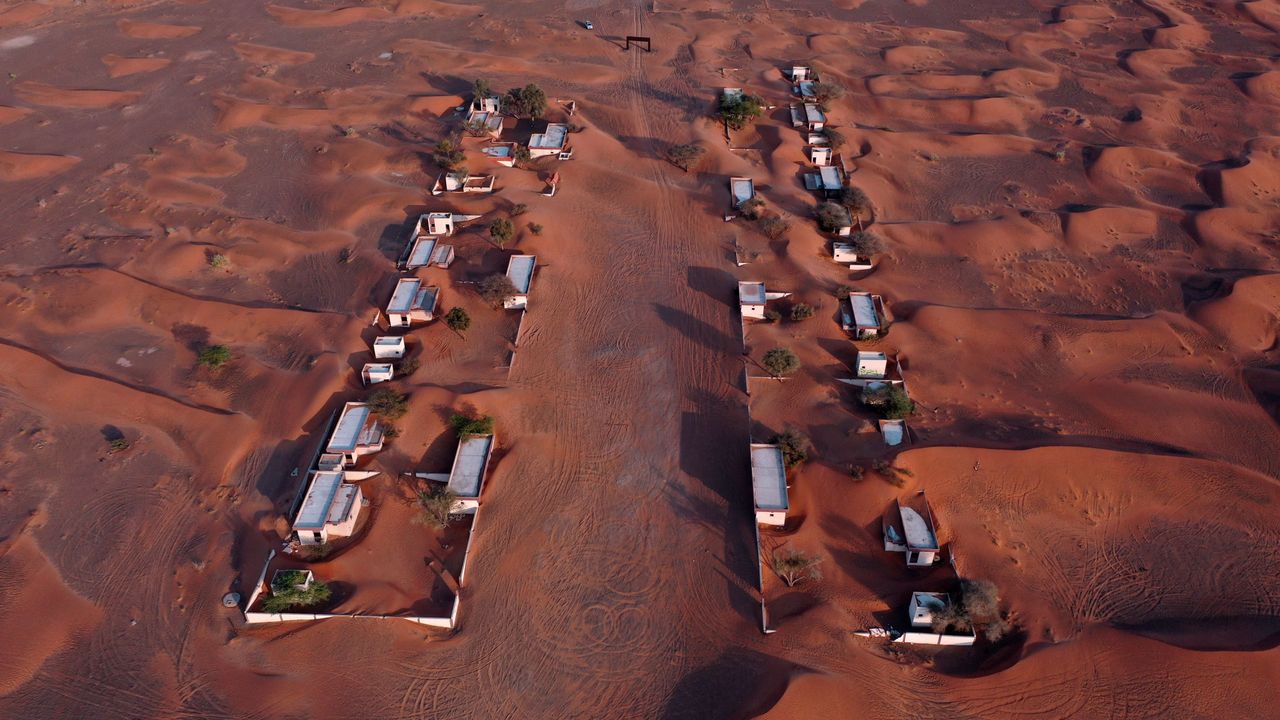
From ancient hand-carved villages to gold rush settlements, these striking settings are time capsules to bygone erasThe abandoned village of Al-Madam in the United Arab Emirates.Photo: GIUSEPPE CACACE/Getty ImagesArchitecture is both art and tool—but rarely do we get to experience one without the other. In abandoned cities, all of this changes. No longer beholden to the needs of daily life, buildings can be viewed from a purely aesthetic perspective, observed more like sculpture than structure. Of course, deserted towns often tell human stories, too: those of frantic gold rushes, devastating natural disasters, and industrious aspirations. But whether nestled in lush forests or barren deserts, these towns bear the scars of time, showcasing human ingenuity while reminding us of the inevitability of decay. Below, we explore 14 of the most breathtaking abandoned cities and towns worldwide, each telling its own hauntingly beautiful tale.Mesa Verde National Park, ColoradoThese cliff dwellings were hand carved by the Ancestral Pueblo people. Photo: Peter Unger/Getty ImagesSome 800 years ago, around the late 1190s, the Ancestral Pueblo people who lived in what’s now southwest Colorado, began moving from the tops of mesas into dwellings they built into the sides of natural cliffs. Set in alcoves, these structures included single-room storage units for food, all the way up to 150-room villages, such as Cliff Palace, which once housed about 100 people.In the mid-1200s, the group began migrating to present-day New Mexico and Arizona, eventually abandoning the cliffside dwellings altogether. Today, you can visit these marvels of ancient architecture, preserved within Mesa Verde National Park. Stepping inside the structures requires joining a ranger-led tour, but you can also see the cliff dwellings from afar by driving or hiking either the Mesa Top Loop Road or Cliff Palace Loop Road.Bodie, CaliforniaThough some of the settlement was lost to fires, a number of buildings still stand. Photo: Zack Frank/Getty ImagesNow part of Bodie State Historic Park, the ghost town of Bodie, California, was once a gold-mining destination with around 2,000 structures and a population of about 8,000 people. The town gets its name from W.S. Body, who discovered small amounts of gold in the hills of nearby Mono Lake in 1859. The discovery of a rich vein of ore in the 1870s created a gold rush and the population shot up from a few dozen to over 10,000 over the course of a decade. The bust, however, began as soon as the early 1880s and droves of residents began to leave. By 1942, mining officially ceased in Bodie.Today, only a small percentage of the original structures still remain, due mostly to two large fires that ripped through the town in 1892 and 1932. But visitors can still stroll the main street and see the remaining buildings, preserved as they were when the last residents left about 50 years ago. Ghost hunters and film crews frequently visit the site today, drawn by the town’s reputation as one of the best-preserved (and most reportedly haunted) mining towns in the American West.Kolmanskop, NamibiaOnce abundant with diamonds, when the supply was depleted, the town was abandoned. Photo: Maydays/Getty ImagesKolmanskop in southern Namibia is a former diamond mining town, now a ghost town. Located in the Namib Desert, eerie photos of the settlement show early 20th-century homes, some with brightly colored wallpaper still visible, flooded with sand. It’s as though the desert is swallowing up an entire city.The town’s boom began after a railroad worker discovered diamonds in 1908. By 1912, Kolmanskop was responsible for 11.7% of the world’s total diamond production, and a full-fledged town had sprung up. At its height, the town even boasted a hospital, ballroom, ice factory, and the southern hemisphere’s first x-ray machine. However, intensive mining depleted the area by the 1950s, and people left in droves. By 1956, the settlement was abandoned. In the decades since, the surrounding sand dunes have pushed through the buildings, as if the desert is reclaiming the space.Pyramiden, SvalbardOperations at the coal mining settlement closed in 1998. Photo: Mino Andriani/Getty ImagesCups remain on tables, newspaper clippings are still pinned to the walls, and skiing equipment is left in the hallways of the buildings at Pyramiden, a Russian coal mining settlement in the Norwegian archipelago of Svalbard. All that’s missing? The people. In the 1980s, the town had a population of over 1,000; however, dwindling coal prices, difficulties in coal extraction, and a horrific plane crash all contributed to mining operations stopping in April 1998. These days the town’s abandoned buildings, industrial complexes, and streets are still intact, but the only creatures stirring in the area are Arctic foxes, seabirds, and, occasionally, a polar bear or two.Al Jazira Al Hamra, Ras Al Khaimah, UAEA storm rolls over Al Jazira Al Hamra. The arid climate used to host a village of aquatic enterprise. Photo: Michael R. Cruz / Getty ImagesJust 90 minutes north of Dubai, in the emirate of Ras Al Khaimah, is Al Jazira Al Hamra, a ghost town with roots stretching back to the early 14th century. Once a thriving pearl-fishing and trading village, the site is now defined by crumbling coral and mud-brick houses, silent mosques, and abandoned marketplaces. It paints a vivid picture of life before the oil boom, which consequently saw villagers abandon the town in the 1960s, leaving behind a perfectly preserved snapshot of traditional Emirati life, including carved wooden doors and traditional wind towers.Villa Epecuén, ArgentinaVilla Epecuén is characterized by salt-encrusted ruins and the fragile remnants of a town lost and found again. Photo: Getty ImagesA still-flooded bench in Villa Epecuén, near Buenos Aires, Argentina. Photo: Matias Ezequiel Feldman / Getty ImagesIn 1985, Villa Epecuén vanished beneath the waters of a swelling lake near Carhué. The the once-thriving lakeside resort town was immediately submerged under 33 feet of water. For more than two decades, its streets and structures were preserved in underwater silence, only emerging from obscurity in the early 2000s, when the waters surrounding it began to recede. Today, it stands as a haunting testament to the interplay of human ambition and nature's relentless force, and its salt-crusted ruins continue to be a favorite subject for photographers.Tskaltubo, GeorgiaEven a mere glimpse at an abandoned sanatorium in Tskhaltubo, Gerogia sends chills up our spine. Photo: Akaki SulavaCelebrated for its healing mineral springs and luxurious Soviet-era sanatoriums, Tskaltubo now lies silently amidst Georgia's verdant landscapes. This town once attracted visitors seeking both health and indulgence, its opulent halls a testament to the town's status as a premier health resort destination. However, the collapse of the Soviet Union in the early 1990s brought an abrupt end to Tskaltubo's golden age. With economic upheaval came neglect, and the once-glamorous sanatoriums and baths fell into disrepair. Today, Tskaltubo's grand architecture stands as a testament to its faded glory—the sweeping arcs, decorative motifs, and faded murals all reminiscent of its once poignant beauty.Al-Madam, Sharjah, UAEAl-Madam was rendered economically isolated due to the construction of modern highways. Photo: Getty ImagesIn Sharjah’s desert landscape lies Al-Madam, a haunting reminder of a once-thriving desert community. Established in the 1970s, Al-Madam was conceived as a governmental modernization effort aimed at reshaping the landscape during the unification of the seven emirates. Featuring 12 modest homes and a mosque at its core, the village was once a hub of Bedouin life and commerce. It was eventually swallowed by sand after being abandoned in the 1990s, leaving behind a collection of half-buried homes, shops, and mosques, crafted from mud and bricks—a testament to traditional Emirati architecture.Kennecott, Alaska, USKennecott benefits from the breathtaking yet remote nature of Alaska. Photo: Getty ImagesWith rusted machinery and derelict buildings, the quiet silhouette of Kennecott's faded crimson facades are all that remains of this town weathered by harsh Alaskan winters. Kennecott was once a thriving mining town that buzzed with activity in the early 20th century, providing comfort and community to hundreds of residents. Its rich copper mines drew people from far and wide, fueling dreams of prosperity. However, as the mines depleted and resources shifted, the town was gradually abandoned, leaving behind an eerie stillness. Today, abandoned and reclaimed by nature, it is preserved as a ghost town that once helped electrify the US.Craco, Matera, ItalyItalians in Craco may have loved its views—but its uncertain location forced evacuation nearly 50 years ago. Photo: Getty ImagesWith architecture defined by its distinctive shapes and sturdy materials, Craco’s roots reflect a blend of medieval Italian style and Norman influences. From its fortified walls to the intricately carved details on doorways and windows, the town’s architectural legacy tells a story of resilience, craftsmanship and, ultimately, abandonment. Like many abandoned hubs, Craco faced its demise due to a series of natural disasters—including landslides in 1963, a flood in 1972, and an earthquake in 1980—which made the area unsafe for inhabitants, leading to the complete evacuation of the town.Mandu, Madhya Pradesh, IndiaJahaz Mahal in Mandu looks like something out of an explorer movie set. Photo: Universal Images Group / Getty ImagesNestled in the heart of Madhya Pradesh, India, Mandu is a treasure trove of cultural richness and architectural splendor. This ancient city traces its roots back centuries as a formidable fortress retreat. Once a thriving center of Afghan architecture and royal grandeur, Mandu's palaces and mosques now stand frozen in time, their intricate designs and artistic embellishments weathered by centuries of abandonment. The overgrown gardens and crumbling facades set the stage for a history of shifting powers and political upheaval that led to Mandu’s eventual decline.Humberstone, ChileThis deserted town in Chile once included a swimming pool built from a ship’s hull. Photo: John Elk/Getty ImagesIn the Atacama Desert of northern Chile, the ghost town of Humberstone stands as a rusted monument to the nitrate mining boom of the late 19th and early 20th centuries. Founded in 1872 and named after English engineer James Humberstone, the settlement once employed thousands of workers who extracted saltpeter from the surrounding desert for use in fertilizer and explosives, which were then exported worldwide.At its peak, Humberstone boasted a theater, a swimming pool built from the repurposed hull of a ship, and rows of company housing painted in faded pastels. But the invention of synthetic nitrate in the 1930s crushed demand for the natural product, and by 1960 the mines had closed for good. Now a UNESCO World Heritage Site, Humberstone’s skeletal machinery, wooden storefronts, and sun-bleached theater seats remain scattered across the desert, preserved by the region’s arid climate as a rare snapshot of industrial life.Pripyat, UkraineUnlike some mining towns, Pripyat was not a city its residents intended to leave permanently. Photo: komyvgory/Getty ImagesJust two kilometers from the Chernobyl Nuclear Power Plant, Pripyat was once a model Soviet city, an “atomograd,” or “nuclear city.” Home to nearly 50,000 residents, most of them plant workers and their families, the city’s average age hovered below 30 years old, and the layout therefore prioritized schools and sports facilities. The city also featured an amusement park slated to open just days after the 1986 reactor explosion forced a mass evacuation. Residents were told to pack only the essentials, believing they’d return within days; instead, Pripyat was abandoned permanently. These nuclear cities were often built similarly: prefabricated state-funded high-rise apartment blocks, vast public squares, and expansive green spaces, all deliberately designed to optimize rapid evacuations.Today, the city’s Ferris wheel and bumper cars sit rusting untouched, the surrounding apartment blocks standing hollowed out by looters and the natural decay of time passed while trees push through the pavement where playgrounds once stood. Despite lingering radiation, Pripyat draws photographers and history enthusiasts eager to witness one of the most complete—and haunting—portraits of a city abruptly frozen.Hashima Island, Nagasaki, JapanHashima Island stands like a floating brutalist playground. Photo: Daisuke Kishi/Getty ImagesNicknamed Gunkanjima, or “battleship island,” for its imposing silhouette when seen from bird’s-eye view, Hashima Island sits off the coast of Nagasaki. But today, its concrete high-rises are crumbling into the sea. The island was developed in the early 1900s by Mitsubishi to house coal miners, and by 1959, it held over 5,000 residents packed into Japan’s first large-scale reinforced-concrete apartment blocks—among the densest urban environments on earth at the time. When Japan shifted from coal to petroleum in the 1970s, the mine closed abruptly, and the entire population left within months. Left to the elements, Hashima’s tower blocks have since collapsed into skeletal ruins, their corridors eroded by vegetation and sea spray. Closed to the public for decades, the island reopened for limited tours in 2009 and has since become a magnet for urban explorers and film crews. In fact, the James Bond film Skyfall was partly set on the island.How to Spend Your Marketing Budget Now: The marketing landscape has changed. Here’s your roadmap to smarter spending, better client acquisition, and growth in 2027So your clients want to live forever? Read AD PRO's Trend Report on The Longevity Home for everything you need to know about building for longer, healthier lives.Are you subscribed to AD PRO's The Source? Sign up for our twice-weekly newsletter for the latest scoops and insider news straight from the editors at AD.In the 2026 Outdoor Design Forecast, AD PRO dives into the newest amenities, layouts, materials, and products for customized indoor-outdoor livingRead More13 Things You Didn’t Know About New York City’s Guggenheim MuseumFor example, Frank Lloyd Wright wanted the exterior of the building to be painted in his signature shadeFrank Lloyd Wright’s Fallingwater: Everything You Need to KnowWhile the iconic American architect designed more than 1,000 buildings, this private home situated over an active waterfall is his most celebrated projectWhere Was The Odyssey Filmed? How the Blockbuster Came to Life Across Six CountriesWhen production designer Ruth De Jong asked director Christopher Nolan the “parameters” for building the film’s sets, “He said, ‘The entire world’”17 Luxury Long-Term Airbnb Rentals for Living Large Around the GlobeFrom Morocco to Mexico, these extended stays encourage doing the absolute mostInside the New Museum’s New Restaurant, Where Sleek Steel Meets Subterranean DesignHow a cozy eatery was brought to life inside the museum’s slick, OMA-designed expansionThese Are the Nearly Invisible Design Decisions Beloved Hotels, Restaurants, and Museums Get RightCreatives behind some of the world’s most enduring destinations explain how atmosphere turns beautiful spaces into unforgettable experiencesThe 5 Best Places to Visit in October for Leaf Peeping—and Landmark ArchitectureIf your ideal souvenir is a camera roll full of beautiful buildings, start here to plan your fall getaway6 Maine Airbnbs for the Ideal Coastal Summer GetawayEastern white pines, cold, frothy water, and big lobster platters awaitMeet 8 Artists Leading America’s Craft RevivalOver centuries, craft techniques from near and far have taken root all across the country. Now, an eager group of young practitioners is tending to those creative seeds—and planting new ones13 Barcelona Airbnbs That Nod to the City’s Design EvolutionFrom an earthy 19th century loft to a modern penthouse offset with mosaic tilesThe Best Airbnbs in Florence Offer Rooms With Spectacular ViewsForgo the stuffy hotel en lieu of a home that’s completely your own
14 Abandoned Cities Around the World With Eerily Beautiful Architecture
Full Article
Original Source
Read the full article at Architecturaldigest →KhanList aggregates and links to publicly available news content. We do not host full articles from third-party sources. Always verify important information with original sources.