
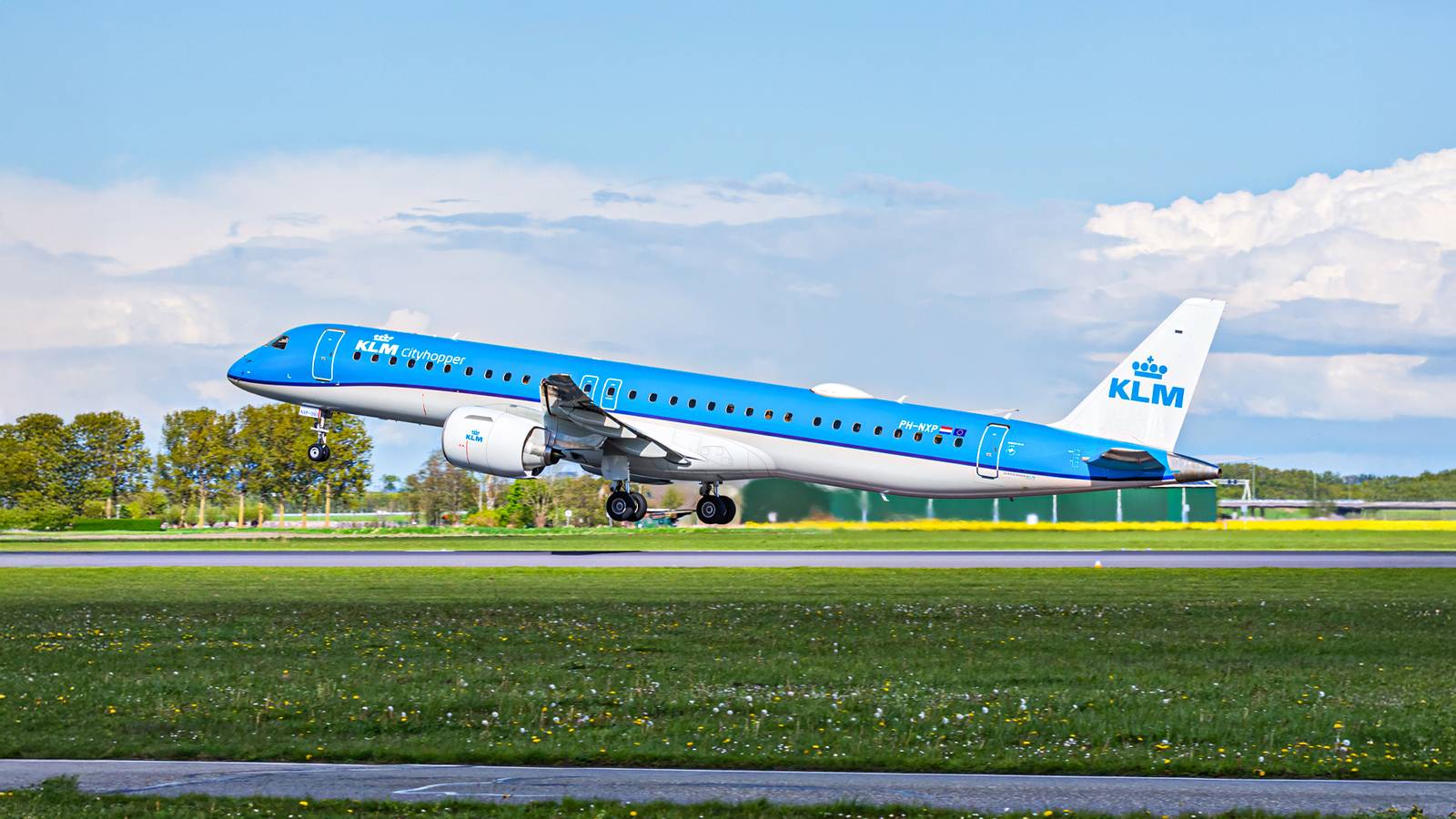
Published Oct 30, 2026, 4:00 AM EDT Luke Diaz is a freelance military writer with experience with active duty experience in the US Navy as well as defense and industrial engineering. He is a former Naval Flight Officer who performed tactical air control on the carrier-based E-2 Hawkeye. The global industry of building airliners is dominated by just two plane makers in a seemingly impenetrable duopoly. Boeing and Airbus have a combined backlog of 12,420 single-aisle jets yet to be delivered based on 2026 order numbers, which represents over a decade of production based on current output rates. This means if an air carrier purchases a new A321neo or 737 MAX today, they will not receive the plane until the mid 2030s. Meanwhile, Brazil's Embraer does not build mainline single-aisle jets or twin widebodies, but its regional jet line is far less impacted, with delivery time averaging 13 to 15 months from the moment an order is placed. The E2 family, comprising the E190-E2 and E195-E2, experiences a far less crowded order book, allowing the Brazilian planemaker to offer rapid delivery timelines. Yet, for many mainline carriers, introducing the E2 would require investing in an entirely new aircraft family, triggering substantial investment in support and training. Despite the immediate availability and lower trip costs of the E2 family, most mainline airlines willingly endure years-long backlogs for Boeing and Airbus narrowbodies rather than reinvesting in Embraer's platform. On heavily trafficked trunk routes, a larger aircraft burns less fuel per seat, allowing airlines to maximize revenue per departure from constrained, expensive hub airport slots. And even when airlines look to replace aging sub-150-seat aircraft, those who choose to pivot away from Boeing or the A320neo family heavily favor the Airbus A220 over the E2. The Queue That Charges Interest Every Year Credit: Matheus Obst | Shutterstock Even though most carriers are willing to join the queue, waiting is not free. For airlines stuck in the Airbus or Boeing backlog, the delay itself actively leaks cash through a mechanism known as Pre-Delivery Payment (PDP) compounding interest. Because ordering dozens of mainline jets requires hundreds of millions of dollars upfront, very few airlines use pure cash. Instead, they take out specialized PDP financing. When Boeing or Airbus delays a delivery by 12, 18, or 24 months due to supply chain backlogs, the entire financial structure stretches out. Under this arrangement, lenders advance cash directly to Airbus or Boeing as manufacturing milestones are achieved. These loans are structured to serve as interest-only financial bridges with zero principal paid up front during the wait. It is only after the plane is delivered to the customer that the loan balance is either paid off or converted into a long-term lease. When the manufacturer can't deliver an airplane on time, the airline must continue paying interest on millions of dollars of borrowed funding for longer than expected. The capital burned over an extra year or two, while no revenue-generating aircraft is available to offset the cost, can put carriers in financial jeopardy. If a delay pushes the loan out, interest expense compounds at elevated market rates. The willingness of mainline airlines to absorb the heavy interest burdens and compounding penalties of a backlogged Airbus or Boeing delivery rather than taking immediate delivery of an Embraer E2 comes down to long-term economics. The primary driver is the absolute dominance of seat-mile economics over a 20-year aircraft lifespan. Flying a smaller E2 instead of an A321neo on a high-demand slot essentially forfeits dozens of potential revenue-generating fares per flight, a loss that quickly outpaces the cost of maintaining a pre-delivery payment financing facility. What A Second Fleet Family Really Costs Credit: Avelo Airlines The strategic flexibility of the mainline narrowbodies also provides a crucial risk hedge. A 737 MAX 8 or A321neo possesses the fuel capacity and aerodynamic range to fly five-to-six-hour routes, including lucrative transatlantic hops or transcontinental missions. The E2 family is structurally optimized for shorter, regional operations. If market demand shifts, a network carrier can easily reassign a narrowbody from a domestic route to an international service. An E2 cannot bridge that operational gap, meaning airlines that opt for the quicker delivery time would capture short-term fleet relief at the expense of long-term network adaptability. That is further complicated by how the original E170 and E175 continue to endure as the backbone of the US regional network. Thus, the newer E190-E2 and E195-E2 have found a different class of operators. A second family creates costs in four places. Pilots need type training, and because captains are promoted from within, one new type forces a chain of transition courses well beyond the first crew. Mechanics need training and tooling. Spare parts and spare engines must be bought for a fleet that is small at first. Smaller fleets also need more crew per aircraft because reserves cannot be shared. The Calculus Of Return On Investment On The Flightline Credit: Dutchmen Photography | Shutterstock AirInsight's study of the 100 to 149 seat segment concluded that these commonality costs are modest, about 1.5% to 2% of operating costs over an aircraft's life. It found that a subfleet of more efficient jets could pay back in about a year. Still, aircraft are liquid financial instruments often sold and leased back to asset managers. The global user base for the 737 and A320 families ensures that these jets maintain stable residual values and enjoy a competitive secondary market. To date, major E2 adopters include Porter Airlines, which became the world's largest customer for the E195-E2 with an order for 75 units. The Canadian regional flyer is followed by KLM Cityhopper, Azul Brazilian Airlines, Binter Canarias, and Helvetic Airways. ANA Holdings also increased its firm commitments for the E190-E2 to 23 aircraft, Luxair is expanding its E2 fleet, and the airline Abra Group placed a landmark order for 20 E195-E2 jets to serve Avianca and GOL. ANA, JAL And, Avelo Are Not All Escaping The Queue Credit: JAL Avelo is the cleanest case of a true second family. It flies only Boeing 737s today, ordered 50 E195-E2 jets with rights for 50 more. It plans a dual fleet of 737-800s and E2s while retiring its eight 737-700s, according to The Points Guy. Chief executive Andrew Levy said the new jets are almost entirely for growth into smaller markets, with first deliveries in early 2027. ANA Holdings will be the first Japanese operator of the E2, Air Data News noted, and it formed the extra order before its first delivery in 2028. ANA ordered 15 E190-E2 jets in February 2025 and added eight more this year, bringing its firm total to 23 with five options, according to Aviation Business News. The jets will replace older regional aircraft in the group. Japan Airlines chose the E190-E2 for its regional subsidiary, ordering 16 with options on 10 more. Bloomberg reported that the E2 beat out the A220 in the evaluation. The JAL subsidiary already flies 18 E170s and 14 E190s, so the group is replacing one Embraer generation with the next and not a new family. First deliveries are scheduled for 2029. Notably, none of the three is substituting the smaller Embraer for a larger airplane due to production delays. Every one of these airlines simply chose the E2 based on the merits of the aircraft's performance and suitability for the network routes it will be flown on. Their dates offer the more useful clue, because Japan's first E2 deliveries arrive in 2028 and 2029 even though the aircraft takes only about a year to build. Avelo's timeline looks quicker, yet it still reflects an order placed in 2025 for jets that arrive in 2027. That gap between factory time and delivery date raises the next question about what actually limits Embraer. Why Build Time Is Not A Delivery Date Credit: Embraer Build time measures how long one aircraft spends in the factory, but the delivery date depends on how many aircraft stand in line ahead of it and whether parts arrive on time. Embraer currently names component supply as its main obstacle, much like its two larger competitors, according to an ANSA report carried by the Italian trade agency ICE. The company is also taking more control of parts supply, including full ownership of a Mexican joint venture, while it works to raise output toward 2030. Output is rising but remains small beside the big two. Air Data News reported that Embraer expects 80 to 85 commercial deliveries in 2026, and ANSA said the company wants 110 to 120 a year by the end of the decade. Reuters reported that production slots remain open before 2030, which Embraer treats as an edge over larger rivals. Air Data News cautioned that a smaller backlog alone does not show how soon a new customer gets an aircraft. The engine is the second constraint. E2 jets use Pratt and Whitney geared turbofans, and Aviation International News noted that powder metal quality problems in those engines also hit the A220 and A320neo family. Reuters reported that Embraer's rate of aircraft stuck on the ground fell from a peak of 22% in March 2025 to about 1%, and that Embraer expects no E2 grounded for engine reasons by the end of 2026. This is also why the A220 offers limited relief. It uses engines from the same maker, and Airbus has trimmed its A220 ramp as wing shortages at Belfast and engine timing slowed assembly, Travel Extra reported. Its backlog is smaller than the A320neo family's, but a smaller queue still moves at the pace of the factory.
12,420 Airbus A320neo & Boeing 737 MAX Jets Are Backlogged While Embraer's E2 Takes 13-15 Months To Build
Full Article
Original Source
Read the full article at Simpleflying →KhanList aggregates and links to publicly available news content. We do not host full articles from third-party sources. Always verify important information with original sources.