
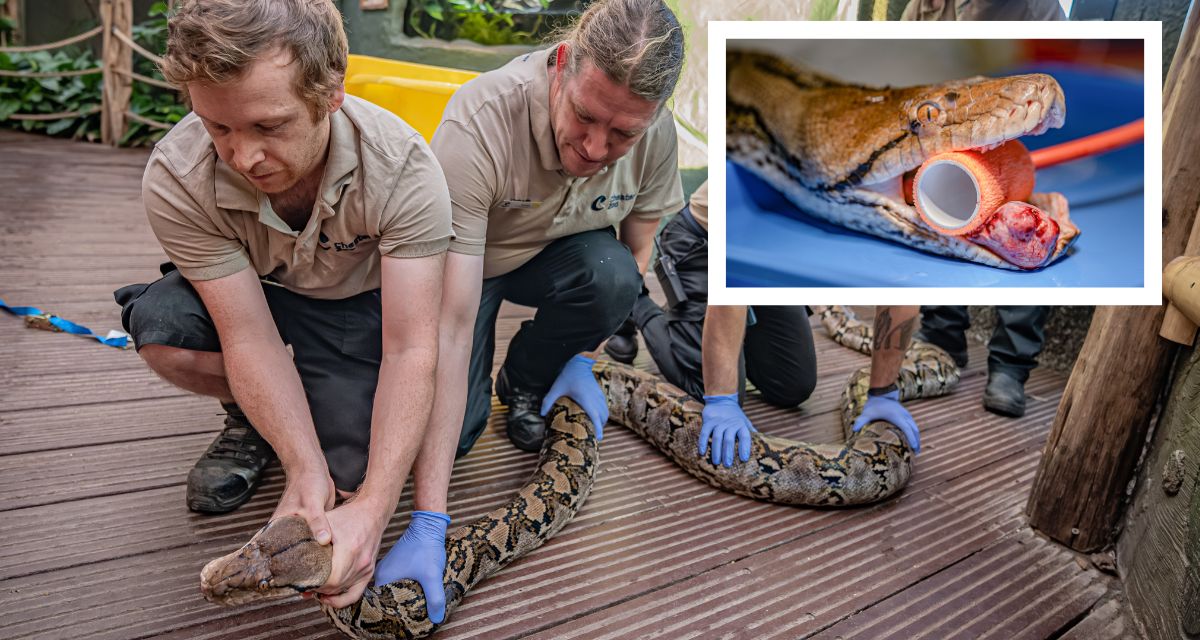
Jodie Foster was saved from a malignant tumor using electrochemotherapy. No, not Hollywood icon Jodie Foster, but a massive, 23-year-old reticulated python residing at the Chester Zoo in England. Chester Zoo staff noticed that Jodie Foster (a nickname derived from her official initials “JF,” which technically stand for “juvenile female”) had become less active in her habitat and had seemingly lost her appetite. That’s when the veterinary staff diagnosed her with fibrosarcoma, a malignant tumor, in her jaw. This obstruction prevented her from swallowing her prey. Unfortunately, after her initial surgery, the tumor came back. Knowing a second surgery likely wouldn’t fully resolve the issue, the team worked with cancer specialists at the University of Liverpool to come up with a rather novel idea: electrochemotherapy. All images courtesy of Chester Zoo Desperate times, novel measures The concept itself isn’t all that radical. Electrochemotherapy, which combines a low dose of a chemotherapy drug (like bleomycin or cisplatin) with short, high-voltage electrical pulses to directly target and destroy cancer cells, is commonly used in human patients as a specialized treatment. But in reptiles? Jodie Foster is allegedly the first. As reported by The Guardian, Jose Alvarez Picornell, of the University of Liverpool’s department of small animal clinical science, said: “Electrochemotherapy is an emerging treatment, and this was the first time it had been used in a snake.” All images courtesy of Chester Zoo It was an ambitious approach for an animal that had never undergone the procedure before, let alone one of her size. But it allowed specialists to target the remaining cancer cells in Jodie’s jaw after the tumor had been removed. Jodie Foster’s ‘Hollywood Ending’ Chester Zoo released a video documenting the process. It shows Jodie Foster’s tumor removal, the electrochemotherapy, and her a few months later back to her normal “bright and feisty” self (as indicated by the feather of her recent meal protruding from her healed mouth). “A Hollywood ending for Jodie Foster 🐍🎬 So proud to see our experts play a part in this pioneering treatment and help get Jodie cancer-free. What an incredible team effort – huge well done to everyone involved! 💙” wrote the University of Liverpool in the comments. A true breakthrough in animal medicine The team hopes that Jodie Foster’s “Hollywood ending” paves the way for more animals to benefit from this type of treatment. If electrochemotherapy can be safely adapted for a reticulated python, it could feasibly open the door to new possibilities for treating cancer in other animals whose options have previously been limited. It’s not like human treatment hasn’t worked for animals before. Pacemakers originally developed to regulate human heart rhythms have saved the lives of dogs and cats, while advances in human prosthetics have helped animals receive custom-made artificial limbs. Treatments such as chemotherapy and radiation have also become increasingly common in veterinary medicine. Jodie Foster’s case proves that when experts are willing to collaborate, innovate, and try something new, all Earth-dwellers can get a second chance at life, regardless of species. Speaking of collaboration, enjoy this video showing the Chester Zoo staff working together to transport Jodie Foster to surgery. Talk about team effort.
110-pound python named Jodie Foster is the first snake to receive human cancer treatment
Full Article
Original Source
Read the full article at Upworthy →KhanList aggregates and links to publicly available news content. We do not host full articles from third-party sources. Always verify important information with original sources.