
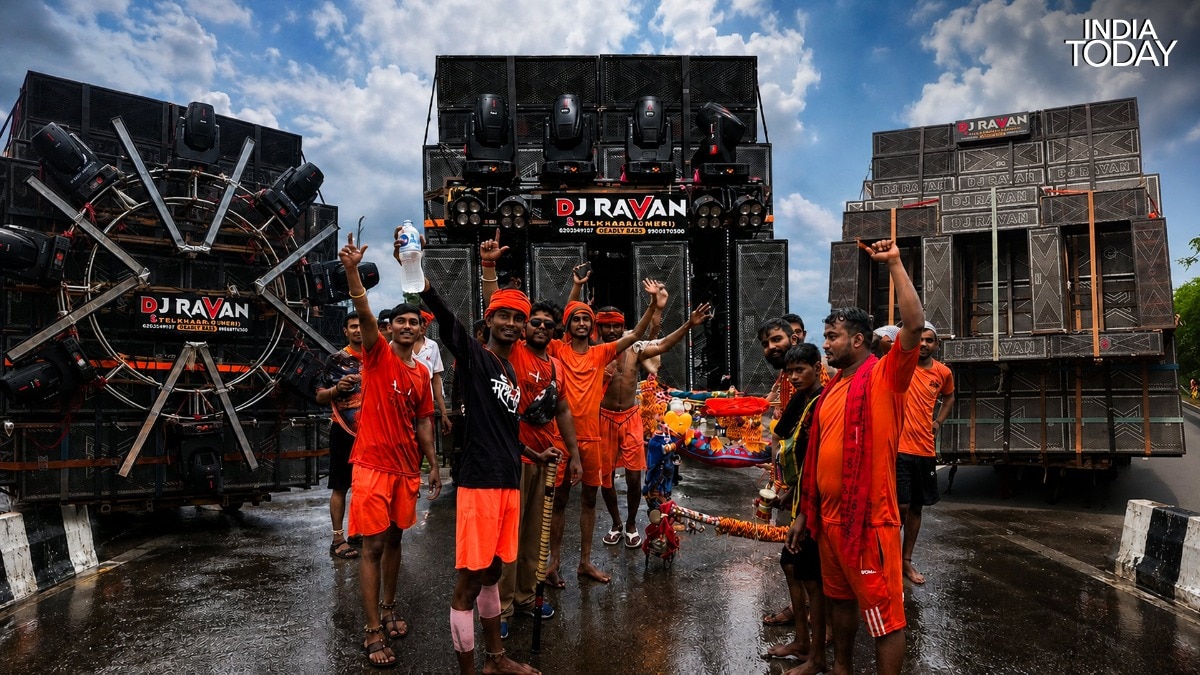
The Kanwar Yatra brings lakhs of devotees onto roads across north India each Sawan. It's not just some of the hooligans among the kanwariyas who are a problem. Their music can leave commuters with palpitations. Here's what the kanwariyas said about themselves and their gigantic DJ sets.The Kanwariyas have become synonymous with their Mad Max-style trucks, fitted with massive sound systems that pump out ear-splitting music and relentless low-frequency bass. (Images: Anand Singh, Instagram via @dj_ravan_001)"Who was the first Kanwar?" one of the young men from a group of Kanwariyas asked as I hesitantly approached them on the outskirts of Delhi. I guessed Shiva. They laughed at the answer. "No. Ravana. Ravana was the first Kanwar. And who was Ravana?" A Shiva bhakt, I said. "Yes, but what else?" they asked rhetorically, adding, "He was a Brahmin. He was also an asura. We are also asuras. Have you seen any educated, employed person carrying the waters in a Kanwar? It is just us. We are paying for our past sins."The words were rather poignant, coming from a group of youths who could pass off as ruffians, or to some, kabaddi players. These young men, all of them in their 20s, seemed to have found asura as a way to appropriate their place in the Kanwar Yatra. The thumping bass from their Mad Max trucks was seemingly a sign of Shiva devotees' arrival, as they travelled from Har Ki Paudi in Haridwar to their villages, "seeking redemption".On the streets of Kalkaji in South Delhi, the music from their trucks registered 93 to 110 decibels on the Decibel Meter app. Legally, normal daytime levels of noise sit around 55 decibels in a residential area. A jet engine operates in the same range as the Kanwariyas' Mad Max trucks. A shotgun blast is around 120 decibels. The bass is deliberate. "Dhammak honi chaahiye, sheesha hilne chaahiye (The earth must shake. Windows must rattle)," one of them said."That is the measure of arrival for us Shiv bhakts," the Kanwariya added. For people stuck behind these trucks for hours, the constant bass and nerve-racking can trigger palpitations and anxiety. The trucks often move slowly, or stop without warning. The men on them are sometimes high on alcohol or other substances. The combination turns ordinary traffic scary, sometimes deadly.This is not to say that Kanwar Yatra is about hooliganism and chaos. It's just that the high-powered DJ systems and chest-thumping participants make some in the Kanwar Yatra stand out. Kanwar Yatra is the annual pilgrimage in which devotees carry Ganga water from Haridwar to offer at local Shiva temples in their villages, towns and cities.In recent years, large sections of it have taken the form of processions built around sound systems, Mad Max-style trucks, and open displays of intoxication.Kanwariyas India Today Digital spoke to said police in some stretches now restrict speaker size to 10X12 feet, and allow them only on the front sides of vehicles. The groups treat these limits as a "challenge"."We pool money, around Rs 25,000 for two days in one group of 15-20, and hire DJs known for volume. DJ Kasana, DJ Ravan, DJ SarZen," they pointed out, saying, I should check out their Instagram pages. For a group that size, the cost comes up to roughly Rs 1,700 per person."In fact, the kanwariyas also compete during the Kanwar season, and whoever is the loudest wins," he said.Surprisingly, most of the DJ names mentioned by the kanwariyas have lakhs of followers. Kanwariyas pose for a photo at the Delhi border as they make their way back to their hometowns after collecting Ganga water from Haridwar during the annual Kanwar Yatra. (Image: Anand Singh) WHAT 110 DECIBELS CAN DO TO THE BODYNoise at the levels recorded around the Kanwar trucks is dangerous in multiple ways. The WHO identifies environmental noise as a health risk associated with cardiovascular disease, hypertension, sleep disturbance, cognitive impairment, hearing impairment and mental-health effects.The body's response to loud noise can involve stress pathways that affect the cardiovascular and metabolic systems.At 110 decibels, that we recorded around Kanwar trucks in Delhi, the exposure was well above the 85 dBA threshold at which repeated or prolonged exposure can cause noise-induced hearing loss.The US National Institute on Deafness and Other Communication Disorders says that at 100 dBA, hearing damage can occur after around 14 minutes, while at 110 dBA it can occur after about two minutes, depending on the exposure."Loud sound I hear behind the Kanwar trucks all day while driving the cab causes ringing or buzzing in my ears," said Ajeet Rajput, the cabbie I went around with.The effects are not confined to just ears. Research cited by WHO links environmental noise with increased cardiovascular risk, including hypertension and ischaemic heart disease.People who have been stuck around these trucks producing sustained low-frequency bass in traffic have reported palpitations, heightened stress or a sense of panic.THE KANWAR GROUPS AND THEIR MAD MAX TRUCKSThe first group I met was resting under open truck flaps in the rain. No DJs because they were resting, but the residue of the night before was there in the form of booze breath.The second group I encountered moved on foot with dhols. Not very loud, but visibly very high, most likely on bhaang or other marijuana derivatives.The third matched the image that has come to define Kanwar Yatra in the National Capital Region. Speakers that can make your ears bleed, gym rats aboard the truck and flanking it, and if you moved closer to the group, the cross-faded smell of alcohol and marijuana.The scene matched the exact image the young man had told me earlier: the procession was the declaration that they are asuras, "seeking Shiva's favour, so their lives might improve". Most were between 20 and 25. Many admitted they were unemployed. This self-description was consistent across groups India Today Digital spoke to."In Haridwar the police enforce restrictions more tightly. Once the water is collected and the journey towards villages in Haryana or Uttar Pradesh begins, the music becomes louder," a Kanwar told India Today Digital.The consequences of lax control by the administration fall on everyone else. On August 10, schools across large parts of Uttar Pradesh remained closed because of Kanwar Yatra. Private schools shifted to online classes. For students, the academic calendar paused unexpectedly. The reason given was safety and traffic management.Processions of this scale and temperament make ordinary movement and ordinary business difficult.Small collisions, or even perceived disrespect, such as someone's car brushing a truck, a pedestrian crossing at the wrong moment, have escalated into attacks by Kanwariyas, and even schoolchildren have not been spared.In south Delhi's Kalkaji, a group travelling from Haridwar towards a village called Harkesh Nagar blasted, "Agle janam mujhe paida keejo Gujjar jaat mein". The sound meter on my phone climbed to 110 decibels next to their truck.The problem with Kanwar trucks is not only that they are loud, they also move slowly through roads that are already struggling with traffic. National highways and city arteries fill with these trucks in Sawan every year, and the bass continues.The men I met did not see themselves or their music as a threat. They saw themselves as devotees. They spoke about Shiva, Ravana and redemption, and an appropriated identity. For everyone else on those roads, there was no choice but to listen.- EndsPublished By: Anand SinghPublished On: Aug 12, 2026 07:00 IST
110 decibels of devotion and the asuras in Kanwar Yatra
Full Article
Original Source
Read the full article at Indiatoday →KhanList aggregates and links to publicly available news content. We do not host full articles from third-party sources. Always verify important information with original sources.