
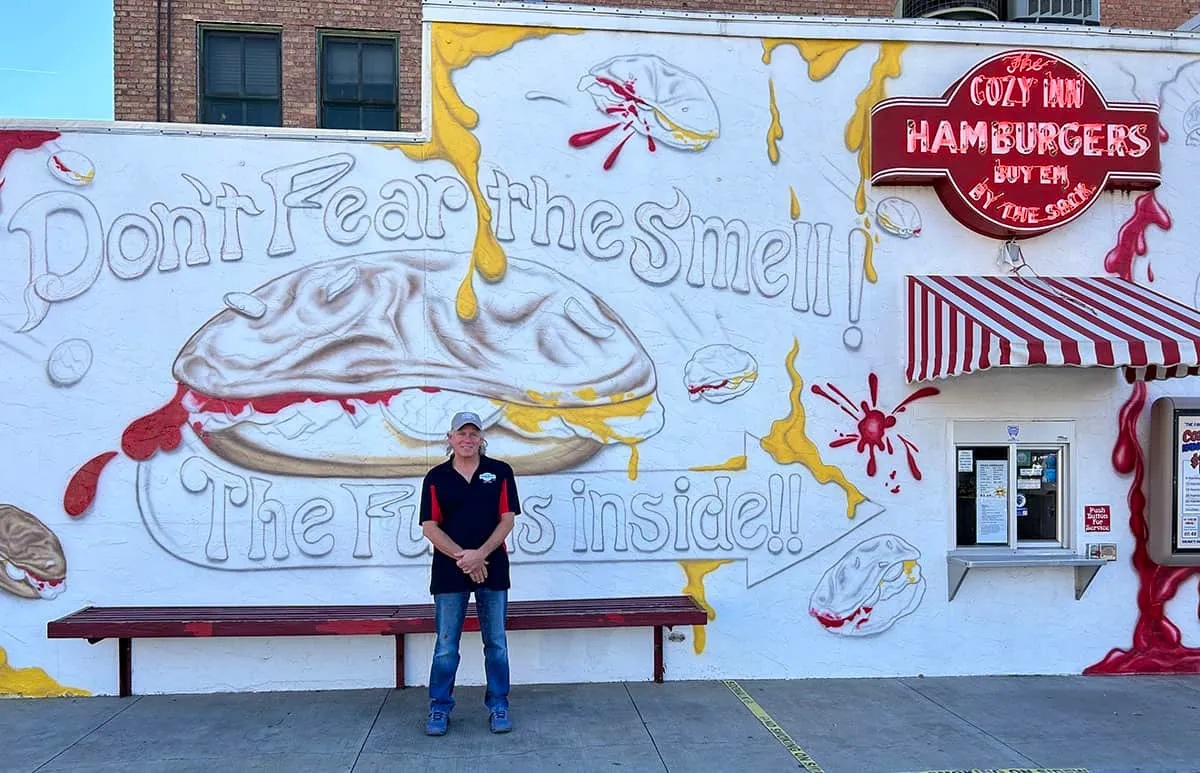
The panel ruled that a local ordinance distinguishing murals from commercial signs is not tailored to fit government interest in traffic and pedestrian safety.(CN) — A 10th Circuit panel on Friday lit the grill for a cheeseburger joint’s whimsical building mural, finding the Salina, Kansas, sign code constitutionally undercooked.Salina classified the UFO-themed cheeseburger painting on the side of the Cozy Inn restaurant as a sign rather than a mural because it advertised the restaurant’s food. Citing city sign code and concerns about “traffic and pedestrian safety, aesthetics, and property value,” the city ordered owner Stephen Howard to stop work until he obtained a permit.“Salina’s evidence failed to justify the distinction between regulated signs and unregulated murals,” U.S. Circuit Judge Scott Matheson wrote in a Friday opinion. “It did not show that signs pose greater danger to Salina’s interest in safety, aesthetic, and property values.”Howard commissioned local artist Colin Benson to paint the mural in November 2023. The finished work would depict “whimsical hamburger-esque flying saucers piloted by aliens attacking the Cozy Inn with blasts of ketchup and mustard,” along with text inviting passerby to follow the smells coming from inside.“Hamburgers are basically the same thing [Cozy Inn] sells, and therefore, it would be signage,” city officials wrote in a letter ordering Howard to stop work.Howard applied for a permit, but the city placed his application on indefinite hold. He sued in February 2024, claiming the sign code unconstitutionally restricts speech and that the city violated his First Amendment rights by indefinitely delaying his application.The district court found that the city’s distinction between signs and murals was not narrowly tailored to its interests in public safety and aesthetics. The 10th Circuit agreed.In the 27-page opinion, Matheson, a Barack Obama appointee, said the city failed to provide evidence that signs pose greater risks than murals.The city submitted a student law review article, a presentation containing statistics on distracted driving and testimony from city planner Dustin Herrs. None supported its argument that regulating signs but not murals advanced its interests.Attorneys representing the Goldwater Institute and the Manhattan institute submitted this artistic rendering to demonstrate the strange line Salina rulemakers drew between advertising, above, and art, below. (Courthouse News via court documents)Asked whether the city had evidence that painted wall signs were more dangerous to pedestrians than painted murals, Herrs declined.The city also presented expert testimony from Mark White, an attorney with a master’s degree in regional planning. White cited research on differences in neurological responses to public artwork and commercial advertisements.But Matheson said White failed to explain why the restaurant’s proposed artwork threatened the city’s interests more than other unregulated displays.The panel also upheld the lower court’s finding that the city’s indefinite delay in processing Howard’s application amounted to a prior restraint on his speech.“Given that Mr. Howard’s application has aged for three years without his consent, Salina imposed a prior restraint on his speech,” Matheson wrote.U.S. District Judge David Urias, a Joe Biden appointee, U.S. Circuit Judge Gregory Phillips, an Obama appointee, jointed the opinion.Neither side responded to a request for comment.Subscribe to our free newslettersOur weekly newsletter Closing Arguments offers the latest about ongoing trials, major litigation and rulings in courthouses around the U.S. and the world, while the monthly Under the Lights dishes the legal dirt from Hollywood, sports, Big Tech and the arts.Additional Reads
10th Circuit gives go-ahead for Kansas restaurant’s cheeseburger mural
Full Article
Original Source
Read the full article at Courthousenews →KhanList aggregates and links to publicly available news content. We do not host full articles from third-party sources. Always verify important information with original sources.