
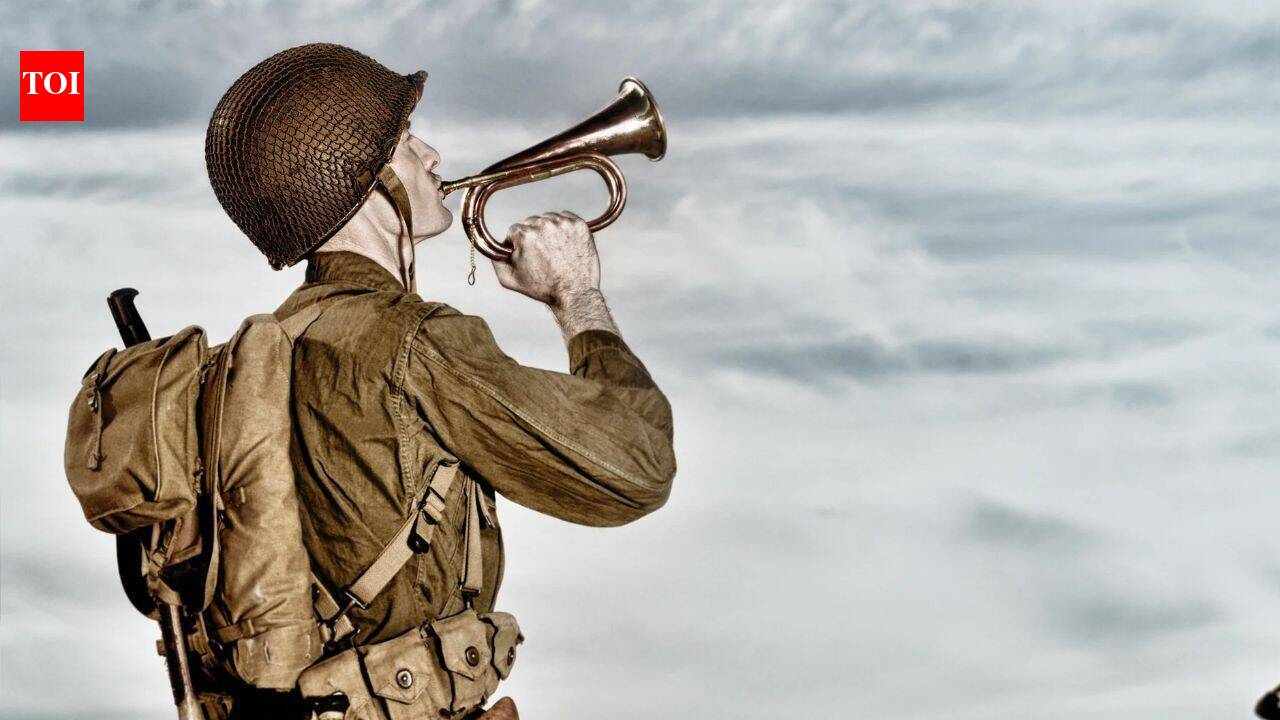
Representative image from CanvaDouglas Halley, a 103-year-old British D-Day veteran, has been reunited with three wartime medals he lost in 1945 after accidentally leaving them pinned to the uniform he returned at the end of World War II. The medals, the 1939 to 45 Star, the France and Germany Star, and the War Medal 1939 to 45, arrived just in time for Remembrance Day, thanks to the help of a young historian and the UK Ministry of Defence, according to Good News Network and Yahoo News.Halley served in the Royal Artillery and landed on the Normandy beaches during Operation Overlord as part of the second wave of troops. More than eight decades later, he can once again wear the honours that recognise his service, an outcome his family describes as deeply meaningful. Read more about this incident, as per the reports, here:A young man called to warHalley was born in South Yorkshire, England, and was training to become a butcher when he was called up to serve in 1943. He was just 20 years old when he joined the war effort, a fact that makes his later survival and long life even more striking.His role in the Royal Artillery involved operating the Bren light machine gun, a weapon he later said was the reason he is losing his hearing. After the war, he remained in the forces until the 1950s before returning to civilian life.When he landed in Normandy in June 1944, he was part of the second wave of troops during Operation Overlord. He has described slipping from a rope ladder as he descended from his ship, falling into the water, and then running for cover as machine gun fire broke out around him.The medals he lostHalley was awarded three medals for his service: the 1939 to 45 Star, the France and Germany Star, and the War Medal 1939 to 45. These honours recognise participation in major campaigns and service during the war years.But in 1945, when he returned his uniform at the end of the war, the medals were still attached. That simple mistake meant he lost them at the very moment they had become some of the most prestigious honours he would ever receive.For 81 years, the medals remained missing. Halley carried the memory of what they represented, but he did not have the physical objects to show for it.A historian found the recordIn January 2026, 27-year-old Joseph Smith came across Halley’s military record while researching veterans’ stories for a project called The Last of the Greats. Smith, along with three friends, has been travelling across the UK documenting the experiences of surviving veterans so younger generations can learn about and remember their sacrifices.Smith saw a Facebook post from Halley’s grandson, Luke Halley, about his grandfather’s story. He contacted Luke to ask whether the family still had the medals, not knowing that they had been lost decades earlier.Once he learned what had happened, Smith did not stop there. He helped the family contact the Ministry of Defence and fill out the necessary forms to request the medals’ return.The Ministry of Defence respondedThe Ministry of Defence successfully located Halley’s medals and agreed to mail them back to him. On November 10, 2026, the medals arrived by post, more than 80 years after they were first lost.For Halley, the moment was emotional. He said he was “delighted” to have the medals back for himself and his family, and especially grateful that they arrived in time for Remembrance Day, as per the reports.He also thanked Smith for tracing the medals and ensuring they were returned safely. “They may be just a piece of metal, but the medals are something that I hold very close to my heart... They remind me of all my brothers in arms who I was with who helped me get through in the war," Halley said, reported Talker News.What the medals mean nowFor the Halley family, the returned medals are more than a personal keepsake. They are a tangible link to a chapter of history that is rapidly disappearing as the number of living World War II veterans continues to shrink.Luke Halley said the family plans to display the medals alongside photographs of his grandfather in his army uniform. He described the medals as a “lovely keepsake” that can be shared with family members and passed down through generations.That kind of preservation matters. It turns a private family memory into something that can be seen, discussed, and understood by people who never met the veteran themselves.A reminder about remembranceHalley’s story is a reminder that remembrance is not only about ceremonies and public holidays. It is also about the small, personal acts that keep history alive, whether that means recording a veteran’s story, helping a family recover a lost medal, or simply listening to someone who lived through it.Smith’s work through The Last of the Greats reflects that idea. By documenting veterans’ stories and helping families recover lost items, he is contributing to a broader effort to preserve the human side of history.For Halley, the return of his medals is a personal victory. For his family, it is a legacy. And for anyone who hears the story, it is a reminder that the sacrifices of war are not always visible, but they can still be honoured.
103-year-old D-Day veteran gets wartime medals back after 80 years
Full Article
Original Source
Read the full article at Timesofindia →KhanList aggregates and links to publicly available news content. We do not host full articles from third-party sources. Always verify important information with original sources.