
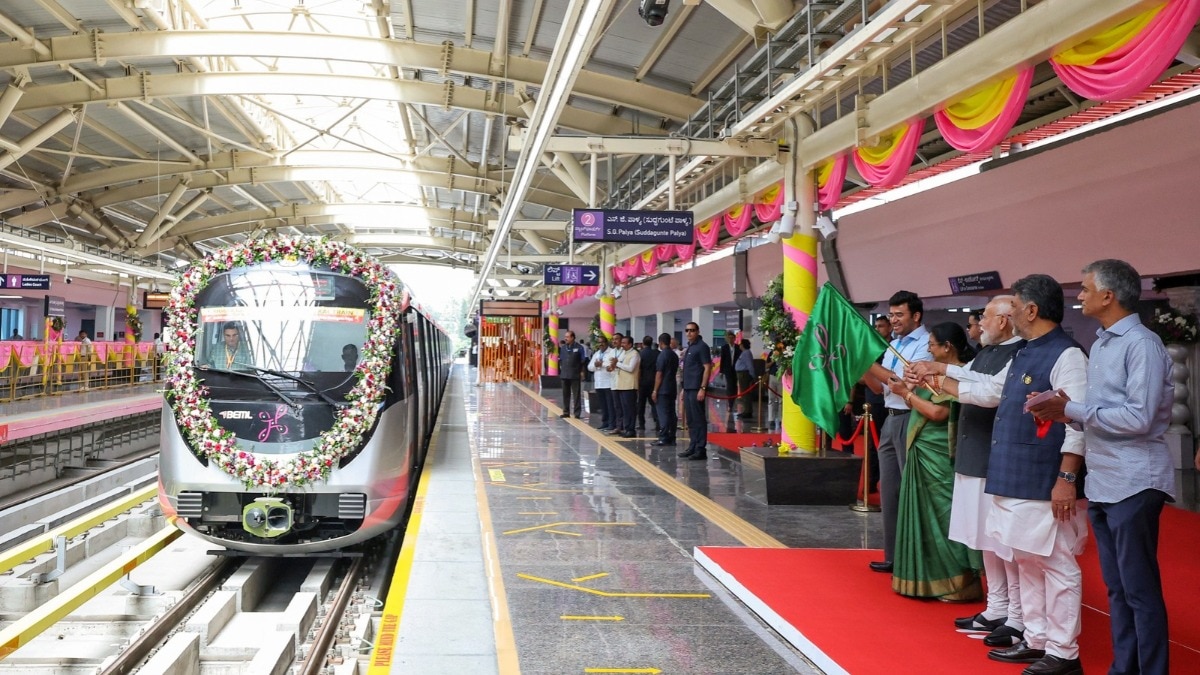
The Namma Metro crossed the 100 km milestone on November 13 amidst a political war of words over the Centre's declining capital contribution to the projectBengaluru’s metro-rail network has again become India’s second-biggest metro service by track length, after briefly losing the position to Mumbai this year. While Mumbai reached a network length of 101 km in April, surpassing Bengaluru’s 96 km of operational metro-rail length, the tech capital is now ready with a new 7.5-km-long section that takes the total length of Namma Metro to 103 km.While crossing the 100 km milestone, the metro service is also poised at a crucial juncture. “In the next 1.5 years, we want to cross 170 km,” said Krishna Byre Gowda, minister for Greater Bengaluru development, on November 11.This will happen in two stages. The 7.5-km-long stretch, inaugurated by Prime Minister Narendra Modi on November 13, is the elevated part of a new Pink Line, which will run through the city’s central parts in a north-south alignment. The remaining 13.88 km of this line is underground, and is being targeted for launch by mid-2027.Simultaneously, parts of a 59-km-long Blue Line, connecting Central Silk Board to K.R. Puram, Hebbal and finally the Kempegowda International Airport, are nearing completion—two sections by 2027 and the third by 2028. The Blue Line will run through Bengaluru’s tech corridor along Outer Ring Road, which is one of the city’s biggest traffic nightmares. For traffic-choked Bengaluru, then, the need to get these metro-rail stretches up and running cannot be overstated. However, Bengaluru's track-record in expanding its metro network has been slow while costs have escalated. On an average, the Namma Metro, which opened in 2011, has added just under 7 km annually over 15 years. The Delhi Metro, on the other hand, reached its 100 km mark within eight years.The pace of progress on Namma Metro’s new Pink Line was starker: approved in 2014, work on tunnelling began only in 2020.Ahead of its inauguration, a political slanging match broke out, with Karnataka complaining that it is forced to bear a lion’s share of the Bengaluru Metro Rail Corporation’s project costs despite the special purpose vehicle being a 50:50 joint venture with the Centre.According to Byre Gowda, the combined outlay across five completed, ongoing and proposed projects—Phases 1, 2, 2A, 2B and 3—amounted to Rs 77,891 crore, of which Karnataka has to shoulder Rs 65,291 crore, or 84 percent, while the Centre's funding contribution was limited to Rs 12,600 crore, or 16 percent. “The state is effectively investing nearly Rs 5 for every rupee contributed by the Centre,” said Byre Gowda, adding that the central government’s capital contribution has progressively declined after the initial phase of Namma Metro.Byre Gowda suggested that the Centre explore a more equitable sharing of financial responsibilities via mechanisms to hedge against currency depreciation or raise rupee-denominated borrowing from domestic financial institutions. According to him, costs on the first three phases have gone up by Rs 24,641 crore over the original sanction, with Karnataka bearing most of the increase. In addition, he said that the Centre’s approval for Phase 3A, or the Red Line, was pending for 22 months.Disputing these figures, the BJP’s Bangalore South Lok Sabha MP Tejasvi Surya argued that the Centre's share rose from 48.5 per cent in Phase 1 to 57.9 per cent in Phase 3, taking into account the Rs 28,958 crore in foreign loans arranged through the Centre's sovereign guarantee.“Twelve years for a mere 7.5 km stretch is a glaring example of the Congress's lethargic approach to infrastructure that benefits taxpayers,” Surya said on November 12. He attributed the delays in new project approvals to the Karnataka government’s frequent plan revisions to accommodate tunnel roads and double-decker flyovers.The metro’s proposed Red Line connects Sarjapura to Hebbal but the Karnataka government is simultaneously pursuing a tunnel road project between these two points. “The state government's proposed North-South tunnel road overlaps Namma Metro's Red Line, forcing costly redesigns,” said Surya, adding that the delay in the Orange Line, which was approved in 2024, was due to similar plan revisions. The ruling Congress, he said, must answer for the delays in the city’s metro expansion instead of “passing the buck”.Subscribe to India Today Magazine- Ends
103 km, 15 years: Why Bengaluru metro rail must expand faster
Full Article
Original Source
Read the full article at Indiatoday →KhanList aggregates and links to publicly available news content. We do not host full articles from third-party sources. Always verify important information with original sources.