
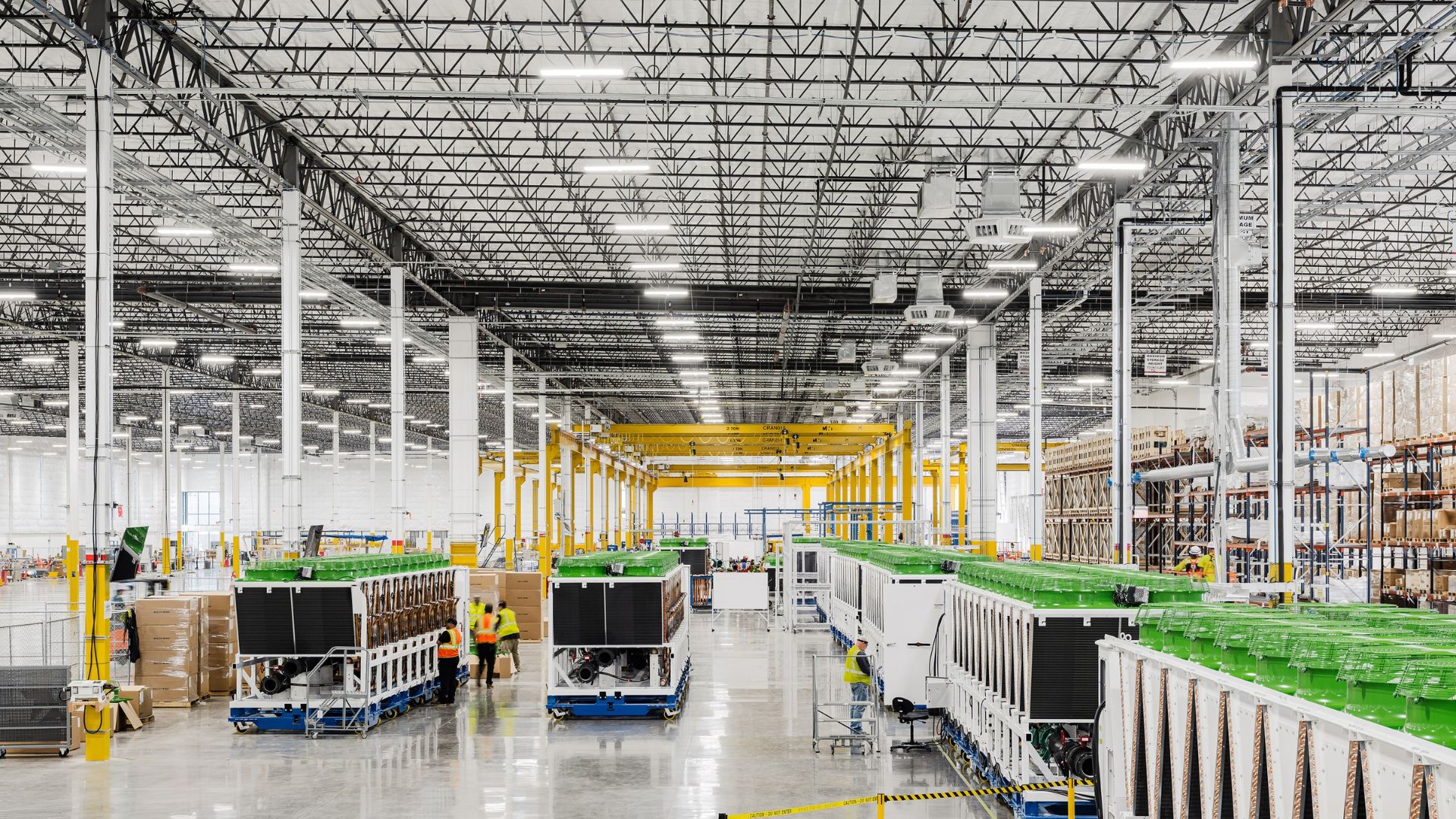
XNChiller Production in XNRGY‘s Mesa, M2 facility.XNRGYKey TakeawaysTech giants currently face various obstacles in expanding massive server clusters across North America.High-capacity operations like XNRGY's play a key role in resolving these thermal challenges.Factory floors in Mesa, Arizona, and Montreal, Quebec, scaled rapidly to address this operational challenge. Artificial intelligence runs hot. While the tech world focuses on chips and AI models, data centers face a huge crisis: keeping processors from melting. Liquid cooling specialist XNRGY Climate Systems proved it can handle that heat, announcing a single-month production output that can chill AI clusters. Tech giants currently face various obstacles in expanding massive server clusters across North America. Power supply and heat management remain the biggest barriers to growth. High-capacity operations like XNRGY’s play a key role in resolving these thermal challenges. Power density spike AI models demand high power density because thousands of chips run nonstop matrix math at full capacity. Chipmakers pack transistors into tiny packages to speed up data processing, concentrating high power draw in a small space. Data centers concentrate these power-intensive accelerators into dense server racks drawing 40 to more than 120 kilowatts each to maximize inter-chip communication speed. This concentrated electrical load converts directly into intense local heat, which requires additional high-capacity cooling infrastructure that further raises the total energy needed per square foot. Factory floors in Mesa, Arizona, and Montreal, Quebec, scaled rapidly to address this operational challenge. “Results of this magnitude do not happen by accident. They are driven by long hours on the shop floor, precise engineering, tight supply chain coordination, and an unyielding commitment to quality at every phase,” said Wais Jalali, founder, chairman, and CEO of XNRGY, in the press release. Notably, scaling up production required a complete redesign of standard assembly practices. The Canadian firm implemented automotive-style lean manufacturing protocols to speed up unit completion without compromising thermal performance standards. Units ready to ship inside XNRGY’s Montreal manufacturing facility. Credit: XNRGY Operational strategy During October, the company shipped approximately 115 XNChillers and 500 airside units to support high-density AI infrastructure. This hardware delivers over 350 megawatts of cooling capacity, translating to nearly 100,000 tons of refrigeration for hyperscale facilities. The system also moves more than 70 million cubic feet of air per minute to maintain optimal thermal pressure and heat rejection across server bays. This rapid expansion is remarkable for a company that shipped its first cooling unit only five years ago, in 2021. According to the firm’s website, XNChillers use oil-free, frictionless compressors with Aero-Lift bearing technology as a robust alternative to magnetic levitation. Compressor shafts lift naturally without external power or complex sensors, broadening the system’s operating temperature range. Dual compression stages with independent inlet guide vanes join a high-speed brushless motor for precise thermal load control. Advanced algorithms also prevent performance surges and provide real-time monitoring to maximize overall efficiency. Global data center electricity consumption will more than double by 2030, climbing from 460 TWh in 2024 to over 1,000 TWh in 2030. That represents an increase from roughly 1.5 percent of total world electricity to a much larger share of global energy supply. Installed power capacity for data centers will expand alongside this energy usage, nearly doubling from 103 gigawatts to 200 gigawatts. Eventually, the manufacturing scale of specialized infrastructure suppliers will dictate the overall speed of AI industry expansion.Get the latest in engineering, tech, space & science - delivered daily to your inbox.Mrigakshi is a science journalist who enjoys writing about space exploration, biology, and technological innovations. Her work has been featured in well-known publications including Nature India, Supercluster, The Weather Channel and Astronomy magazine. If you have pitches in mind, please do not hesitate to email her.
100,000 tons cooling capacity shipped to north American data centers after record output
Full Article
Original Source
Read the full article at Interestingengineering →KhanList aggregates and links to publicly available news content. We do not host full articles from third-party sources. Always verify important information with original sources.