
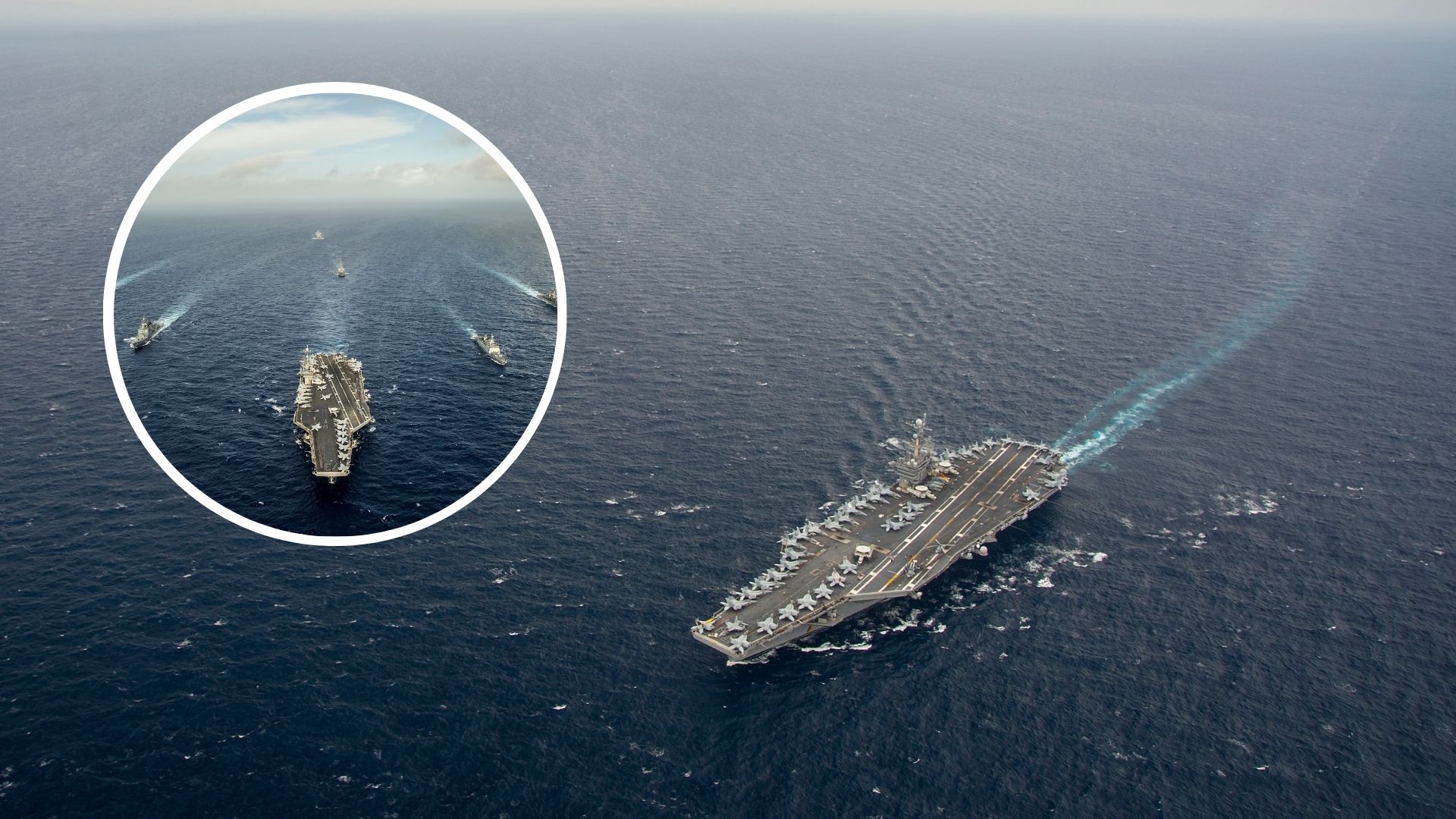
A massive U.S. aircraft carrier has arrived in Middle East amid the ongoing Iran war. The USS George Washington with its strike group has begun scheduled deployment after arriving in the CENTCOM theater on August 19. The deployment of the giant carrier with nearly 100,000-ton displacement is aimed at relieving the USS Abraham Lincoln, which has been at sea for over 250 days.The George Washington’s presence consequently gives U.S. commanders another flexible source of air power in and around the Middle East. George Washington entered the Central Command theater Reports have revealed that moving such a large and capable naval formation into a region experiencing serious tensions demonstrates that Washington is prepared to maintain substantial military capabilities there. The George Washington entered the Central Command theater with elements of its carrier strike group, including the cruiser USS Robert Smalls and destroyer USS Shoup. The group subsequently transited the Arabian Sea. The deployment is officially described as part of a scheduled rotation, with the George Washington expected to take over responsibilities from the USS Abraham Lincoln Carrier Strike Group.The immediate purpose of the deployment is to provide a replacement for the USS Abraham Lincoln, which has spent an exceptionally long period at sea supporting U.S. military operations.The arrival of the new carrier represents more than a routine movement of an aircraft carrier. It highlights the pressure currently facing the U.S. Navy as Washington attempts to maintain a strong military presence in the Middle East while also meeting its security commitments in the Indo-Pacific.The new vessel is the flagship of Carrier Strike Group 5 and operates with Carrier Air Wing 5. Its accompanying force provides a combination of air power, air defence, surface warfare and other capabilities, making a carrier strike group far more than simply a large aircraft carrier.Replacing the Lincoln gives the Navy an opportunity to rotate personnel and equipment while retaining a carrier-based aviation capability in the region. Limited number of large nuclear-powered aircraft carriers The transition also highlights a broader challenge facing the U.S. Navy: maintaining a worldwide carrier presence without placing excessive strain on ships and crews. America’s fleet has a limited number of large nuclear-powered aircraft carriers, meaning a prolonged crisis in one region can affect deployments elsewhere.The Middle East requires substantial military resources because of continuing tensions with Iran, while the Indo-Pacific remains a central theatre of American strategic planning. The carrier’s presence can also serve as a form of deterrence. Potential adversaries must account for the possibility that a carrier strike group can rapidly generate significant combat power without requiring the United States to build permanent military infrastructure at the location. Get the latest in engineering, tech, space & science - delivered daily to your inbox.Prabhat, an alumnus of the Indian Institute of Mass Communication, is a tech and defense journalist. While he enjoys writing on modern weapons and emerging tech, he has also reported on global politics and business. He has been previously associated with well-known media houses, including the International Business Times (Singapore Edition) and ANI.
100,000-ton nuclear carrier with strike group arrives in Middle East to relieve massive vessel
Full Article
Original Source
Read the full article at Interestingengineering →KhanList aggregates and links to publicly available news content. We do not host full articles from third-party sources. Always verify important information with original sources.