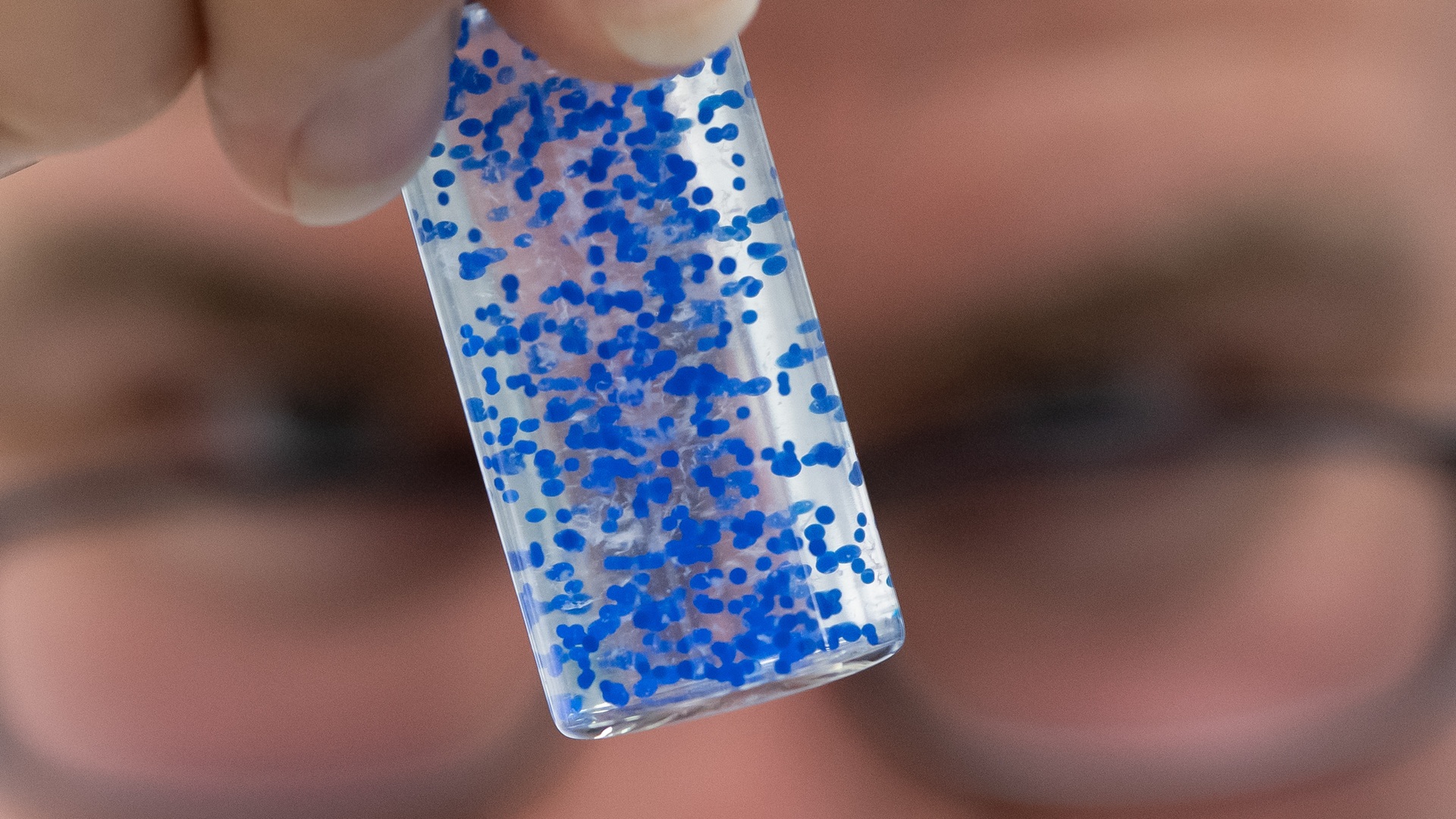
Representative image showing microscopic particles suspended in a liquid.Getty Images Researchers in Japan have unveiled how thousands of microscopic particles can spontaneously pair up, move, and reorganize themselves by breaking Newton’s action-reaction symmetry. The study was carried out by Yutaka Sumino, PhD, and Kiwamu Yoshii, PhD, both professors at the Faculty of Advanced Engineering at Tokyo University of Science, Japan. For the project, they created a large-scale colloidal system containing over 10,000 colloidal particles and observed their behavior for more than an hour. Under an alternating electric field, particles of different sizes started interacting unevenly. Larger particles attracted smaller ones more strongly than the smaller particles attracted them back. This interaction caused passive particles to form pairs and propel themselves through the liquid. “Our system provides an experimentally controllable example of nonreciprocal many-body physics, where broken action–reaction symmetry gives rise to collective phenomena,” Sumino explained. Breaking force balance In ordinary passive systems, interactions are reciprocal. As per Newton’s third law of motion, for every action there is an equal and opposite reaction. Simply put, when one object exerts a force on another, the second one exerts an equal and opposite force in return. To create a system with nonreciprocal interactions, the research team suspended polystyrene colloidal particles measuring 1 and 1.5 micrometers in radius in water. They then confined them between transparent electrodes coated with indium tin oxide. Nonreciprocal interactions in a colloidal system containing over 10,000 particles.Credit: Professor Yutaka Sumino from Tokyo University of Science, Japan Once the research team applied an alternating electric field, electrohydrodynamic (EHD) flows formed around the particles. They revealed that the strength of these flows depended strongly on particle size. Larger particles produced stronger flows than smaller ones, meaning their EHD-mediated attraction was also stronger. As a result, this imbalance produced nonreciprocal interactions between particles of different sizes. The particles then spontaneously joined into asymmetric pairs with a clear front and back. While neither particle could propel itself individually, together they behaved as a self-propelled unit. As more pairs appeared, they began assembling into larger clusters. But unlike conventional attractive particles, the clusters did not simply continue growing. Clusters refuse to grow The results showed that rather than growing, the clusters repeatedly broke apart, rearranged, and formed again. The self-propelled pairs continuously generated movement inside them and prevented the formation of giant static aggregates. The researchers compared this behavior with suspensions containing particles of only one size. In those systems, the interactions remained reciprocal, while the particles gradually assembled into static crystalline structures. Numerical simulations reproduced the experimental results and indicated that nonreciprocal pair propulsion is the minimal mechanism needed to sustain the unusual cluster dynamics. “This study demonstrates that the breaking of action-reaction symmetry can be a universal mechanism for matter to spontaneously form dynamic order,” Sumino concluded in a press release. “However, in this study, we discovered that colloidal particles under an electric field exhibit unexpected behavior: they attract each other but do not form huge clumps, instead gathering and then splitting.” The team said similar nonreciprocal interactions could occur in biological systems, like cell colonies and groups of animals. The findings could provide a framework for studying how collective behavior emerges in different systems. Meanwhile, the mechanism could also influence the development of new technologies, including programmable materials and externally controlled microrobotic systems . The study has been published in the journal Physical Review Letters. Recommended ArticlesGet the latest in engineering, tech, space & science - delivered daily to your inbox.Based in Skopje, North Macedonia. Her work has appeared in Daily Mail, Mirror, Daily Star, Yahoo, NationalWorld, Newsweek, Press Gazette and others. She covers stories on batteries, wind energy, sustainable shipping and new discoveries. When she's not chasing the next big science story, she's traveling, exploring new cultures, or enjoying good food with even better wine.
10,000 tiny particles defy Newton’s action-reaction law to stay in constant motion
Full Article
Original Source
Read the full article at Interestingengineering →KhanList aggregates and links to publicly available news content. We do not host full articles from third-party sources. Always verify important information with original sources.