
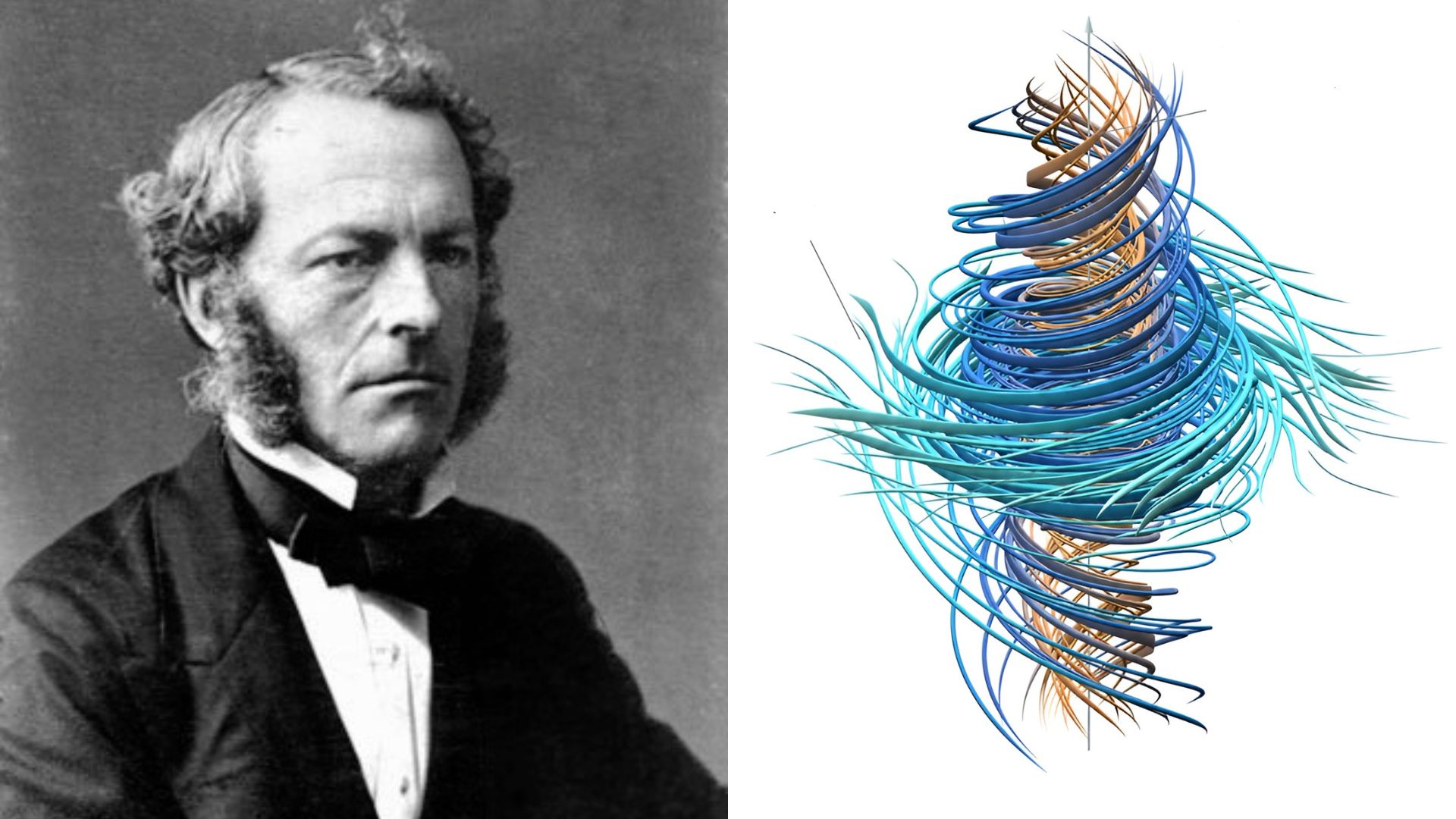
OpenAI says one of its internal systems has found a finite-time singularity in the three-dimensional Navier–Stokes equations, potentially resolving one of mathematics’ seven Millennium Prize Problems. The result describes a fluid that starts smooth and at rest before a vortex collapses inward. Its core stretches and accelerates until velocity becomes unbounded, yet the system keeps its total energy finite. That combination makes the proposed solution striking. The equations must produce their own breakdown despite viscosity, which normally smooths violent changes in fluid motion. Vortex becomes the problem Picture a spinning column of fluid being pulled tighter and longer as it rotates. The central region keeps shrinking, concentrating motion into an increasingly small area. Eventually, velocity blows up within a finite time. OpenAI says the surrounding mathematics remains controlled enough to keep the fluid’s energy finite. The difficult part lies in making that behavior emerge naturally from the equations. Researchers could not simply introduce an infinite external force and create the singularity. Near the breakdown, acceleration, pressure gradients, momentum transfer, and viscosity all grow dramatically. They also cancel with enough precision to leave a smooth external force. That balance gives the result its physical character. The singularity comes from the dynamics of the fluid itself. Navier–Stokes has resisted this kind of proof for generations. Jean Leray showed in 1934 that generalized solutions exist, but mathematicians never established whether smooth solutions must remain smooth. 10,000 agents attack math OpenAI did not arrive at the result through a single model producing a lucky answer. The company assembled a large network of agents and gave different groups different versions of the problem. The effort began September 1 after researchers heard rumors about major mathematical problems being solved. Groups pursued competing outcomes, including possible breakdowns. We’re sharing a solution to the Navier-Stokes Millennium Prize Problem, one of the deepest problems at the frontier of mathematics.The proof was produced by a group of agents, using an OpenAI next-generation model significantly more capable than GPT-6 Astra.The problem… pic.twitter.com/8zol3BPTL4— OpenAI (@OpenAI) September 8, 2026 At its peak, the Navier–Stokes effort involved roughly 10,000 concurrent agents. They could run code and read cached internet material inside isolated environments. An earlier result helped point the search toward fluid singularities. Almost 100 agents spent about 50 hours solving an unforced version of the Euler equations’ regularity problem. Researchers fed that result into the Navier–Stokes effort, with Codex helping consolidate useful ideas between agent groups. The agents reached their result on September 5, about 88 hours after the project began. GPT-6 Astra then spent another 17 hours formalizing and checking the proof in Lean. The Navier–Stokes work involved 2.7 million messages and roughly 130 billion output tokens. Proof still needs mathematicians OpenAI is not claiming the $1 million Millennium Prize. It released the proof and its Lean formalization as evidence of advancing mathematical capabilities. Mathematicians still need to inspect the argument and determine whether it meets every requirement of the official problem. OpenAI also disclosed separate work by Levent Alpöge and NYU mathematician Tristan Buckmaster on forced Euler equations. If the proof survives expert review, it would show that a machine-directed mathematical search can uncover a mechanism that has eluded researchers for 90 years. A vortex tightens, stretches, and accelerates until the equations can no longer keep its velocity finite.
10,000 OpenAI agents crack 90-year-old Navier-Stokes mystery in just 88 hours
Full Article
Original Source
Read the full article at Interestingengineering →KhanList aggregates and links to publicly available news content. We do not host full articles from third-party sources. Always verify important information with original sources.