
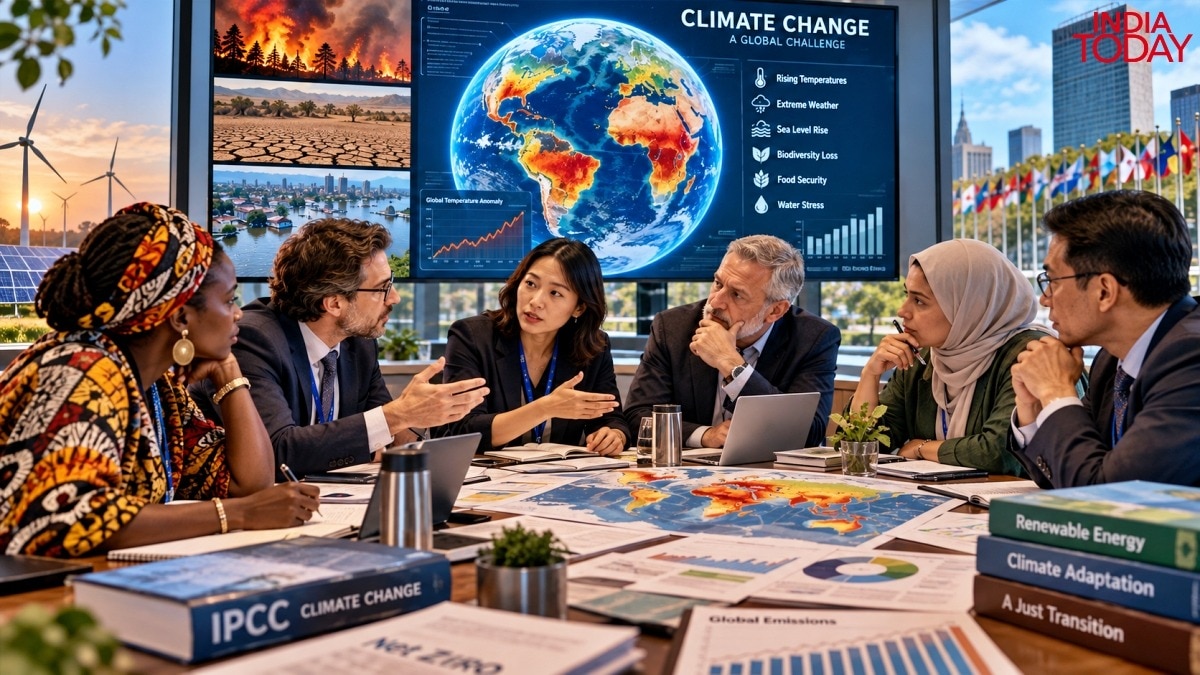
Governments disagree over the timetable for the IPCC's next major climate assessment. Here's why the report matters for developing countries and global climate action, and what goes behind the scenes to draft the essential read.The IPCC report assesses the available scientific, technical and socioeconomic evidence on climate change. (Representational Photo: Generative AI by India Today)From devastating floods in Asia and raging wildfires in North America to record-breaking heatwaves in Europe and melting glaciers in the Himalayas, the climate crisis is unfolding differently across the planet, but with one common thread: a warming world is reshaping how people live, work and survive.As governments grapple with rising risks, one scientific assessment seeks to bring these scattered warnings into a common global picture, a report that could influence everything from national climate policies and energy transitions to how cities prepare for extreme weather.But how do thousands of scientific studies, competing perspectives and years of research become a single document that helps shape the planet’s future? Behind its pages lies an extraordinary international process of scientists, reviewers and policymakers working to establish what the world knows about climate change, what remains uncertain, and what lies ahead.MAKING OF THE CURRENT IPCC REPORTThe world’s next major climate assessment is due, and is caught in a dispute over time. India, China, Saudi Arabia, Russia and Kenya are pressing against the 2028 deadline for the Intergovernmental Panel on Climate Change’s (IPCC) Seventh Assessment Report (AR7), when governments are set to review progress on the goals agreed upon in the landmark 2015 Paris Agreement.The nations are arguing that developing countries need more time to take part and contribute more thoroughly. An image of ministers from Pacific Island nations and Turkey at a pre-COP31 session. (Photo: AFP) The IPCC, a United Nations body that assesses the science of climate change, faces disagreements among governments, and the dispute holds significance because the assessment is expected to inform global climate negotiations and the evaluation of countries’ progress under the Paris Agreement.While some governments want the reports delivered in time for the 2028 climate-policy cycle, others, including India, have called for more time, citing the need for broader participation, particularly from developing countries.The disagreement has put the IPCC’s scientific work at the centre of a debate over representation, timing and climate action.The stalemate has also provided a much-needed opportunity to recall what makes the IPCC report pivotal in carving up plans to save the planet, and why governments across the world keep a close eye on it. The 65th Session of the IPCC is underway in Ethiopia. (Photo: IPCC) WHAT IS THE IPCC, AND WHY IS IT IMPORTANT?Established in 1988 by the World Meteorological Organisation (WMO) and the United Nations Environment Programme (UNEP), the IPCC assesses the available scientific, technical and socioeconomic evidence on climate change.Although it does not primarily conduct original research, it brings together findings from published research and other relevant literature to provide governments with a comprehensive picture of what is happening to our climate.“The IPCC gives you how the climate is changing and how it is impacting the lives of the poor and vulnerable,” said Anjal Prakash, a former Indian IPCC author. Activists participate in a climate protest during the COP30 UN Climate Summit. (Photo: AP) The panel produces comprehensive assessment reports every five to seven years.Its work is divided among three Working Groups; the first examines the physical science of climate change, including its causes and observed changes; the second assesses climate impacts, vulnerability and adaptation; while the third examines ways to reduce greenhouse gas emissions and limit global warming.Their findings are brought together in a Synthesis Report, offering a broad assessment of the evidence and its implications.The IPCC’s influence stems not only from the breadth of its scientific assessment but also from governments’ participation in the process.“The IPCC is pretty widely accepted as the authoritative body on climate science,” said Cara Schulte, a researcher at Climate Rights International, an international NGO working on climate science and human rights. The flood-ravaged neighborhood of Los Corales, Venezuela. (Photo: AP) Its assessment reports bring together hundreds of leading scientists and experts to evaluate existing research and synthesise thousands of scientific findings through a rigorous review process.Schulte noted that to participate in the IPCC process, governments nominate experts, review draft reports and ultimately approve the "Summary for Policymakers".“Governments then use these reports as the scientific basis to inform international climate negotiations and decision-making,” she said.The IPCC’s Sixth Assessment Report, completed in March 2023, provided scientific input to the first Global Stocktake under the Paris Agreement at COP28 in Dubai.The reports do not dictate what governments must do but guide policymakers by making them understand the risks, assess available options and make decisions based on the best available evidence. Environmental activists gather outside the US Supreme Court to protest against oil and gas companies. (Photo: Reuters) HOW DOES IPCC DRAFT AN ESSENTIAL READ?The process begins with identifying the questions an assessment must address and agreeing on its scope. Governments and observer organisations nominate experts, while members of the IPCC Bureau can also put forward candidates.The relevant Bureau then selects authors based on their expertise, research contributions and the needs of individual chapters.Geographical representation, gender balance, participation from developing countries and a mix of experienced and first-time IPCC authors are also considered.Prakash said the selection process examines researchers’ recent publications, their contributions to scientific knowledge and their ability to coordinate work within demanding timelines.Once selected, authors assess the relevant literature and prepare draft chapters.What is a tipping point? "In climate science, a tipping point is a critical threshold beyond which a system or a subsystem changes irreversibly or abruptly." - Robert Vautard, IPCC WGI Co-Chair, explains. Learn more about tipping points in IPCC’s AR7 https://t.co/h90Yn36xu7 https://t.co/hmeDkB9Xu8— IPCC (@IPCC_CH) September 14, 2026Although peer-reviewed scientific studies are a major source, the IPCC also considers other relevant publications, including reports from governments and industry, while assessing their reliability. The drafts then undergo extensive review.Experts from around the world scrutinise the scientific evidence, the completeness of the assessment and the balance of its conclusions. A subsequent draft is reviewed by experts and governments, with Review Editors ensuring that substantive comments are considered.Prakash described the process as exceptionally demanding, with individual chapters sometimes receiving thousands of comments.“Each and every comment has to be read and addressed. You can either agree or disagree, but you have to give an explanation,” he said.Authors must explain how they have dealt with reviewers’ concerns, and the comments and responses are made publicly available after the report is finalised. This process allows readers to examine how the assessment evolved rather than simply accepting its conclusions.DOES THE IPCC REPORT MAKE A DIFFERENCE?The IPCC report influences the scientific community, but also helps ground the numerous international climate agreements, national emissions strategies, adaptation planning and discussions on climate finance, in robust, well-studied evidence.For Prakash, one example is the growing recognition of climate risks in mountain regions, pointing to the disaster that occurred in Nepal earlier this year. An aerial view of homes following a flash flood in Nuwakot district, Nepal. (Photo: Reuters) "Some climate scientists and I have been part of some mountain chapters in reports that actually predicted that these kinds of extreme events would become very pronounced in the future," he said, adding that such assessments of glacier changes and other mountain hazards have helped bring in funding for research, adaptation, and preventive measures.The relevance of such widespread action becomes somewhat essential for a country like India, which stands on the forefront of climate disasters, where climate risks affect agriculture, water resources, coastal communities and people living not just in mountains but all forms of terrain.Assessments of climate impacts can help policymakers identify vulnerabilities, while mitigation assessments examine the options available to reduce emissions.The IPCC's role, however, is limited to disseminating information as it does not implement policies or guarantee that governments will act on its findings. Its role is simply to assess the evidence and explain the implications; decisions about action remain with governments. A Toronto skyline with smokestack emitting pollution at sunset over the river. (Photo: Pexels) HOW DOES INDIA CONTRIBUTE TO IPCC REPORTS?India has contributed scientists to the IPCC’s assessment process, but Prakash argued that the country needs to strengthen its institutional engagement beyond nominating researchers.Indian scientists have held important roles in report chapters, but India could do more to build its capacity to engage with the findings when governments discuss and approve the Summary for Policymakers, Prakash said.“The reports have to be scientifically grounded," he added. "If I am an Indian, for example, I cannot be partial to India,” he said, stressing that the assessment must remain evidence-based even when its findings may not align with a country’s policy interests.In other words, having scientists contribute to a global report is not the same as having the institutional capacity to engage effectively with its findings. Children run across the parched Bhagirathi riverbed as heatwave leaves the water body dried. (Photo: PTI) A RACE AGAINST TIMEPrakash, thus, disagreed with the argument that the current assessment cycle necessarily requires more time to ensure developing-country participation.Drawing on his experience with previous reports, he said the process already involves scientists from developing countries, even as researchers from the Global North remain prominent.He argued that countries could strengthen their participation by committing more resources to the process rather than relying primarily on calls for an extended timeline.The broader debate, however, reflects a difficult balance. IPCC assessments must be rigorous, transparent and representative, but their findings also need to reach policymakers in time to inform major decisions.Ultimately, the panel’s value lies in providing a shared, carefully scrutinised understanding of climate change. Whether that evidence translates into meaningful action depends on what governments do with it.- Ends
1,000 scientists, 100+ hours, 1 verdict: Making of the biggest climate report
Full Article
Original Source
Read the full article at Indiatoday →KhanList aggregates and links to publicly available news content. We do not host full articles from third-party sources. Always verify important information with original sources.