
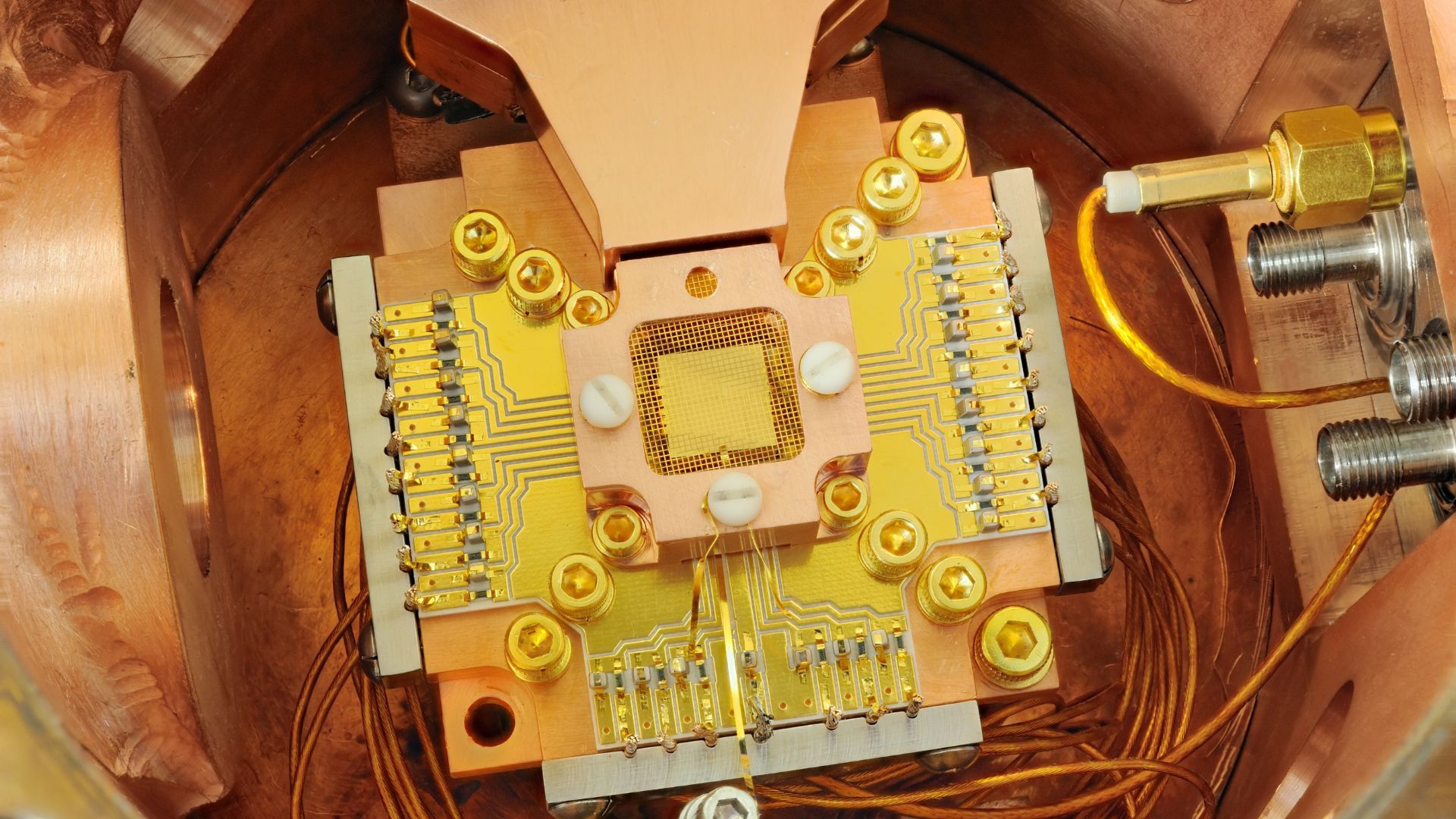
Quantinuum has secured $100 million in U.S. federal funding to work on a problem that could determine how quickly trapped-ion quantum computers can grow. The money will go toward manufacturing research for the hardware behind its quantum processors. Quantinuum will also bring two U.S. manufacturers deeper into its hardware development. The Department of Commerce approved the award through its CHIPS Research and Development Office. The funding comes from the CHIPS and Science Act. The chip challenge Quantinuum builds quantum computers around trapped ions held in place with electromagnetic fields. Controlling those ions requires specialized chips, electronics, lasers, and optical components. Those parts become harder to manufacture as a system grows. Quantinuum wants to address that problem through conventional semiconductor manufacturing. GlobalFoundries will fabricate next-generation ion traps and control electronics for Quantinuum. The work will specifically explore 300mm wafer technology. That choice matters because 300mm wafers support high-volume semiconductor production. Quantinuum is effectively testing how far those manufacturing techniques can carry over into quantum hardware. GlobalFoundries CEO Tim Breen said the partnership will combine the company’s semiconductor manufacturing expertise with Quantinuum’s trapped-ion architecture. The work could also make quantum components more consistent from one production run to another. That matters when researchers need to reproduce increasingly complex hardware. Scaling quantum lasers The manufacturing challenge does not stop at the quantum chip. Trapped-ion computers depend on lasers to manipulate and control ions. Those lasers must deliver precisely controlled light to the ions, making their reliability crucial as more qubits enter a system. Their optical systems can also involve a large number of components that need precise alignment. Quantinuum is turning to Monarch Quantum for that part of the system. The companies will develop and manufacture lasers and optical components for future trapped-ion machines. Monarch CEO Timothy Day said large-scale systems will need more integrated photonics. He pointed to the complexity of today’s optical arrangements as an obstacle to scaling. Integrated photonics could reduce the number of separate components surrounding the processor. It could also make those optical systems more repeatable during manufacturing. That is a different challenge from improving the quantum processor itself. The processor may perform better, but scaling still depends on everything around it working reliably. Washington backs domestic production The award also puts federal money behind a U.S.-based manufacturing network for quantum hardware. Quantinuum was the only trapped-ion architecture selected in this round of CHIPS R&D funding. GlobalFoundries and Monarch Quantum will give the company domestic manufacturing partners for two critical parts of its systems. Rajeeb Hazra, Quantinuum’s CEO, said the funding will help establish the hardware and supply chain needed for fault-tolerant quantum computers. That target remains well beyond simply producing a larger processor. Fault-tolerant machines require extensive error correction, which adds more hardware and control requirements.The manufacturing question therefore becomes increasingly difficult as the machines improve. Quantinuum’s new program is aimed at making those components less dependent on one-off production and more compatible with repeatable U.S. manufacturing.Get the latest in engineering, tech, space & science - delivered daily to your inbox.Aamir is a seasoned tech journalist with experience at Exhibit Magazine, Republic World, and PR Newswire. With a deep love for all things tech and science, he has spent years decoding the latest innovations and exploring how they shape industries, lifestyles, and the future of humanity.
$100 million US push brings 300mm chips into the race for trapped-ion quantum hardware
Full Article
Original Source
Read the full article at Interestingengineering →KhanList aggregates and links to publicly available news content. We do not host full articles from third-party sources. Always verify important information with original sources.