
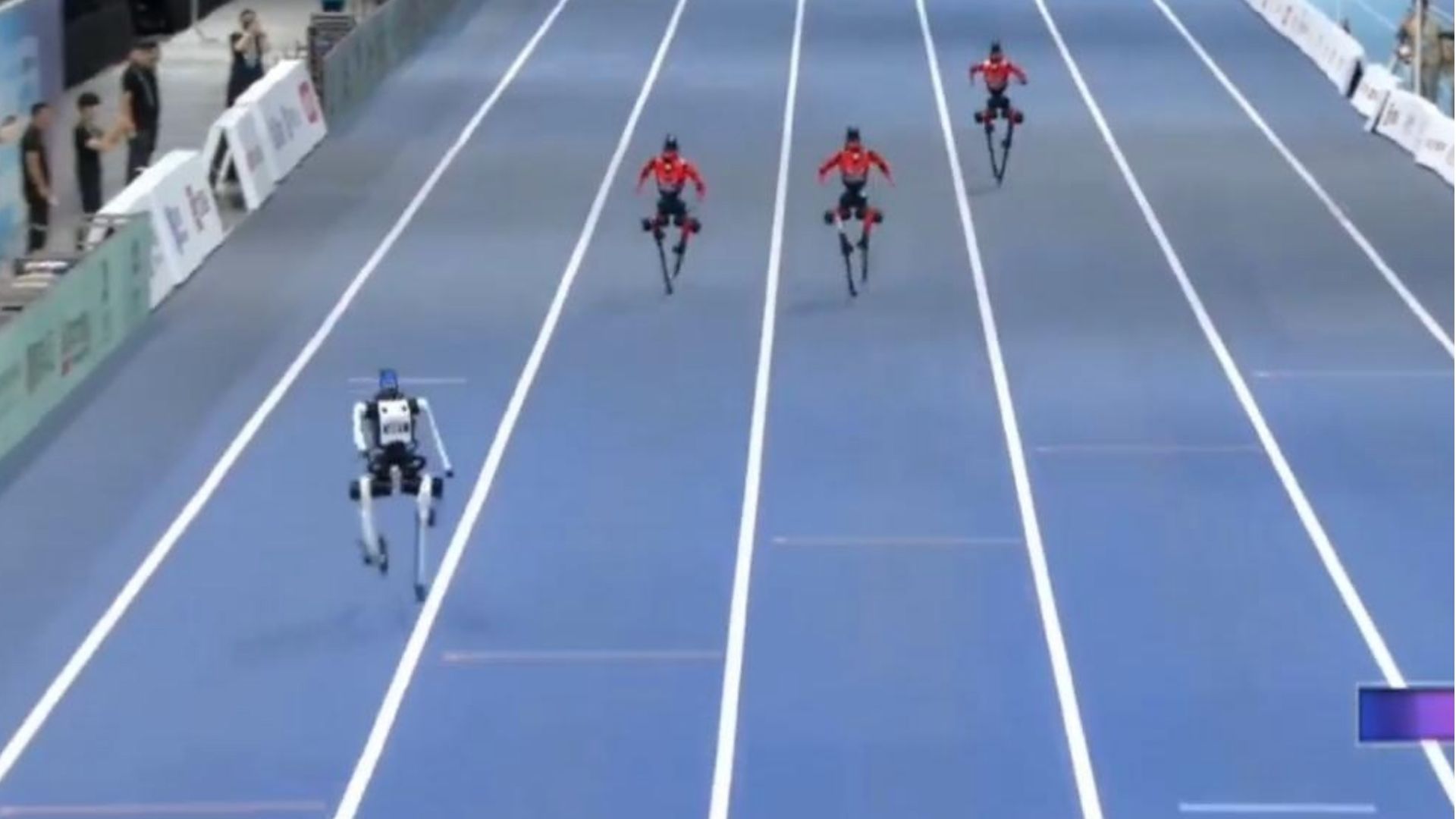
A humanoid robot developed in China completed a 100-meter race in 8.64 seconds at the 2nd World Humanoid Robot Games, setting a new record for the competition. Tiangong Ultra, built by Beijing-based X-Humanoid, clocked the record time while winning the large-group final on the closing day of the five-day event. Its performance was nearly one second inside Usain Bolt’s official human world record of 9.58 seconds, although robot and human results are not directly comparable. Tiangong Ultra breaks its record again The 8.64-second run improved upon the previous fastest time of the games, which Tiangong Ultra had set during the repechage. The humanoid completed the race in 8.86 seconds before shaving another 0.22 seconds off its time in the final. It had already rewritten the event record twice before reaching the decisive race. Tiangong Ultra’s final performance also marked a significant improvement over the inaugural World Humanoid Robot Games, where the fastest 100-meter time was more than 12 seconds. The difference highlights the rapid progress made in humanoid locomotion over the past year. Sprinting at high speed requires a robot to coordinate its legs, maintain balance, respond to changes in momentum, and recover from instability without falling. Tiangong Ultra emerged as the most prolific record-setter at this year’s games. Its closest rival in the final was Lightning, a humanoid robot developed by Chinese smartphone maker Honor. Robots challenge human performance marks Lightning entered the final with its own record-breaking achievements. In April, the humanoid reportedly completed a half-marathon with a net time of 50 minutes and 26 seconds, beating the official human half-marathon world record. The five-day competition also saw robots produce performances that surpassed human records in events including sprinting and the high jump. Such comparisons, however, come with important differences. Humanoid robots do not compete under the same physiological, technical, or regulatory conditions as human athletes, meaning their results cannot replace officially recognized human records. The games instead allow developers to test how their machines perform under pressure. Athletic events expose weaknesses in balance, joint control, power management, perception, and the software coordinating a robot’s movements. Analysts said the competition serves as a broad benchmark for evaluating overall robot performance while providing a proving ground for future real-world applications. The 100-meter large-group final was the last event on the schedule and brought the second edition of the games to a close. Lightning’s 9.32-second sprint Before the competition, Lightning had reportedly completed a separate 100-meter test in 9.32 seconds in Beijing. The humanoid reached a peak speed of 14.5 meters per second during the run, placing its reported time 0.26 seconds inside Bolt’s 9.58-second record. Lightning was developed by Honor as part of the company’s work on humanoid robotics. Tiangong Ultra’s 8.64-second performance at the games was 0.68 seconds faster than Lightning’s reported test result. Together, the runs show how quickly Chinese developers are increasing the speed of humanoid robots while maintaining the balance required to complete a full sprint. Get the latest in engineering, tech, space & science - delivered daily to your inbox.Atharva is a full-time content writer with a post-graduate degree in media & amp; entertainment and a graduate degree in electronics & telecommunications. He has written in the sports and technology domains respectively. In his leisure time, Atharva loves learning about digital marketing and watching soccer matches. His main goal behind joining Interesting Engineering is to learn more about how the recent technological advancements are helping human beings on both societal and individual levels in their daily lives.
100 meters in 8.4 secs: Tiangong Ultra breaks record at World Humanoid Robot Games
Full Article
Original Source
Read the full article at Interestingengineering →KhanList aggregates and links to publicly available news content. We do not host full articles from third-party sources. Always verify important information with original sources.