
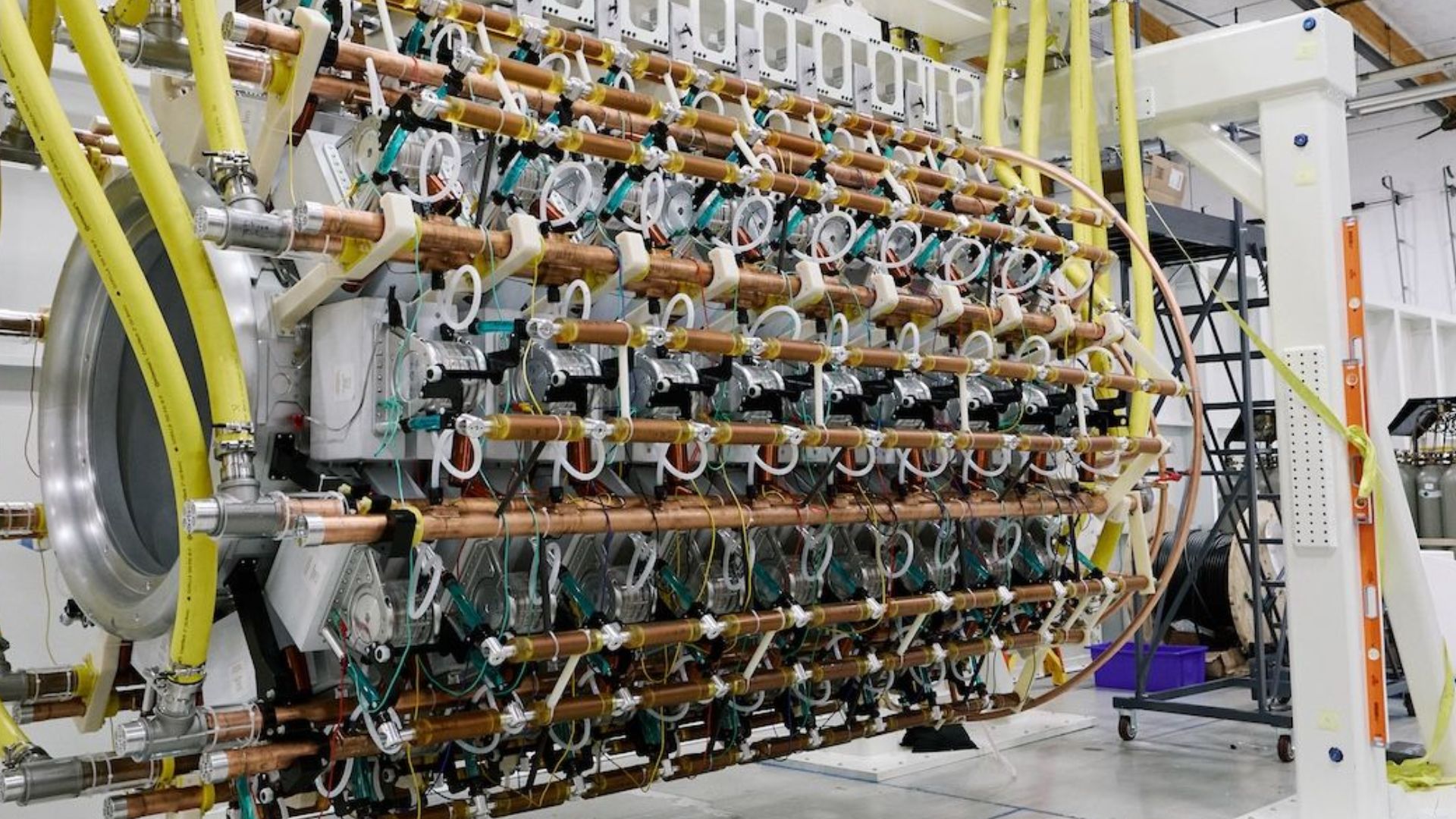
American startup Pacific Fusion has begun construction on a $1 billion manufacturing and research site in Albuquerque, New Mexico. Engineers at the site plan to test a new type of pulsed-power machine by 2030, targeting two long-standing technical benchmarks in nuclear physics. “America pioneered the breakthroughs that brought fusion within reach. Pacific Fusion is focused on converting that scientific leadership into industrial capability and infrastructure that strengthens US energy leadership and national security,” said Dr. Keith LeChien, co-founder and Chief Technology Officer. The primary goal of the facility is to demonstrate net facility energy gain. In past laser and magnetic fusion experiments, researchers measured gain only by comparing the energy that hit the fuel capsule against the resulting fusion output. Using pulsed-power inertial confinement Pacific Fusion is measuring efficiency across the entire plant. Net facility gain means the fusion reaction must produce more energy than the total electrical energy stored inside the machine before firing. No laboratory has achieved this level of overall electrical efficiency. The system relies on pulsed-power inertial confinement. Instead of using massive laser arrays or magnetic coils like tokamaks, the machine discharges intense bursts of electrical current directly into a target. This high-current pulse creates extreme magnetic pressure, which rapidly compresses a small fuel capsule to initiate fusion. To keep costs manageable, the company builds its power systems out of modular, standard electrical parts made from widely available industrial materials. Decades of research The foundation for this technology comes from decades of research at Sandia, Los Alamos, and Lawrence Livermore national laboratories. Pacific Fusion recently completed a test series on a prototype driver called Sirius, built under a joint agreement at Lawrence Livermore. Sirius uses an impedance-matched Marx generator to deliver short, high-voltage pulses into a load. During the test campaign, the prototype completed more than 3,000 continuous shots. Engineers used the resulting data on voltage stability, switch wear, and circuit timing to design the full-scale pulser module that will power the Albuquerque plant. The Albuquerque demonstration machine is also designed to produce high-yield fusion reactions exceeding 100 megajoules per pulse. Outputs at this scale generate extreme temperatures and pressures known as high-energy-density states. These conditions allow physicists to study the behavior of materials and radiation under conditions found inside nuclear weapons. The US government identified a need for this kind of experimental platform thirty years ago, when underground nuclear explosive testing was halted. Because of these capabilities, the Department of Energy’s National Nuclear Security Administration has signed a formal agreement to collaborate with the company. The partnership focuses on high-energy-density physics, computer modeling, advanced materials, and pulsed electrical networks. Hardware assembly plant Alongside the main Albuquerque campus, the company is opening a hardware assembly plant in Los Lunas. That facility will mass-produce the modular pulsed-power stages needed to assemble the full demonstration system. Local utility Public Service Company of New Mexico has also begun studying how future pulsed-power plants could feed baseload power into the regional grid as electrical demand rises. “Today’s groundbreaking shows that America can still build the hard things, and build them faster than any other country, including China,” concluded LeChien. Get the latest in engineering, tech, space & science - delivered daily to your inbox.An active and versatile journalist and news editor. He has covered regular and breaking news for several leading publications and news media, including The Hindu, Economic Times, Tomorrow Makers, and many more. Aman holds expertise in politics, travel, and tech news, especially in AI, advanced algorithms, and blockchain, with a strong curiosity about all things that fall under science and tech.
100-megajoule nuclear fusion facility in US targets breakthrough in race with China
Full Article
Original Source
Read the full article at Interestingengineering →KhanList aggregates and links to publicly available news content. We do not host full articles from third-party sources. Always verify important information with original sources.