
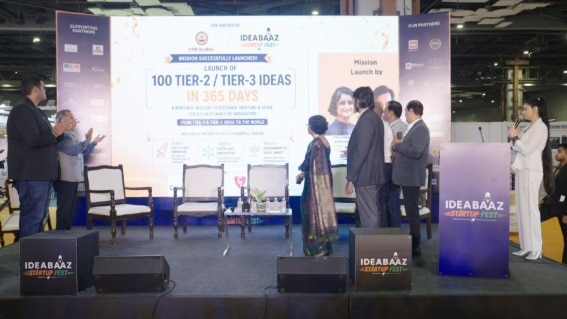
IIT Madras, IITM Global and Ideabaaz have launched Bharat Ascend to identify 100 promising ideas from across India. The first-of-its-kind initiative focuses on startups while looking beyond conventional startup hubs to bring ideas and innovators from smaller towns and cities onto India's startup map.India’s startup story has often been told through a familiar list of cities. Bengaluru, Delhi-NCR, Mumbai, Hyderabad and Chennai dominate conversations around venture capital, incubators and technology companies. Bharat Ascend is trying to look beyond that map.If your idea is creative and offers a solution, IIT Madras's new initiative is the place to turn to.A 365-day national innovation mission launched by IIT Madras and IITM Global, in partnership with Ideabaaz, aims to identify 100 promising ideas from across the country, with a focus on innovators who may sit outside India’s established startup ecosystem.The premise behind the initiative is simple: the absence of a startup ecosystem does not necessarily mean the absence of innovation. A farmer developing a solution to reduce post-harvest losses, a teacher building a new learning model, a manufacturer solving a production problem or an entrepreneur working on a local mobility challenge may have an idea with wider potential but lack access to mentors, investors or institutional networks.Bharat Ascend is designed to create that missing link. The programme will take ideas through five stages, Discover, Nurture, Accelerate, Empower and Impact. The process is intended to move selected ideas beyond the initial pitch and towards validation, prototyping, pilots, investment and scale.That makes the initiative different from a conventional idea competition, where the focus often ends with identifying winners. Here, the larger test will be whether ideas can survive the stages that follow discovery.HOW TO APPLYApply through official channels: Check the Ideabaaz Startup Fest website for active application calls, including opportunities under initiatives such as Bharat Ascend that focus on innovations from Tier-2 and Tier-3 cities.Connect with IIT Madras’ E-Cell: Take part in pitch events such as E-Summit Pitch Arena and PitchFest organised with the Entrepreneurship Cell at IIT Madras. Strong-performing startups may get opportunities to enter advanced stages of Ideabaaz programmes.Explore regional and grassroots opportunities: Keep an eye on local pitch contests, “Dangal” events and regional demo days where founders can present prototypes, gain wider exposure and connect with potential investors and ecosystem partners.Ideabaaz will play a role in connecting innovators with the wider ecosystem, including corporates, investors, universities, mentors, entrepreneurs and government stakeholders.The sectors being considered are equally broad, ranging from agriculture and healthcare to education, climate, mobility, manufacturing, energy and emerging technologies.But the more significant question may be geographical rather than technological: what gets missed when innovation is measured through the existing startup ecosystem?India has expanded its digital infrastructure, educational networks and entrepreneurial base well beyond its largest cities. Yet access to capital, mentors, incubators and industry networks remains concentrated.For an entrepreneur outside these networks, developing an idea can involve a different set of constraints, finding early validation, building a prototype, getting the first customer and convincing an investor.Bharat Ascend is attempting to address that gap by creating a national pathway rather than asking innovators to first move into an established startup centre.The programme therefore places less emphasis on where an idea begins and more on whether it can address a real problem and develop into a viable solution.The success of the initiative, however, will ultimately depend on what happens after the 100 ideas are selected. Discovery can create visibility, but sustained mentoring, customer access, funding and institutional support will determine whether these ideas become businesses, public solutions or technologies that can be deployed at scale.For India’s innovation economy, that could be the more important experiment: not merely finding more startups, but finding ideas that the existing startup map has not yet learned to see.- EndsPublished By: Rishab ChauhanPublished On: Aug 31, 2026 18:12 IST
100 ideas in 365 days: Can IIT Madras find the next big innovation outside startup hubs?
Full Article
Original Source
Read the full article at Indiatoday →KhanList aggregates and links to publicly available news content. We do not host full articles from third-party sources. Always verify important information with original sources.