
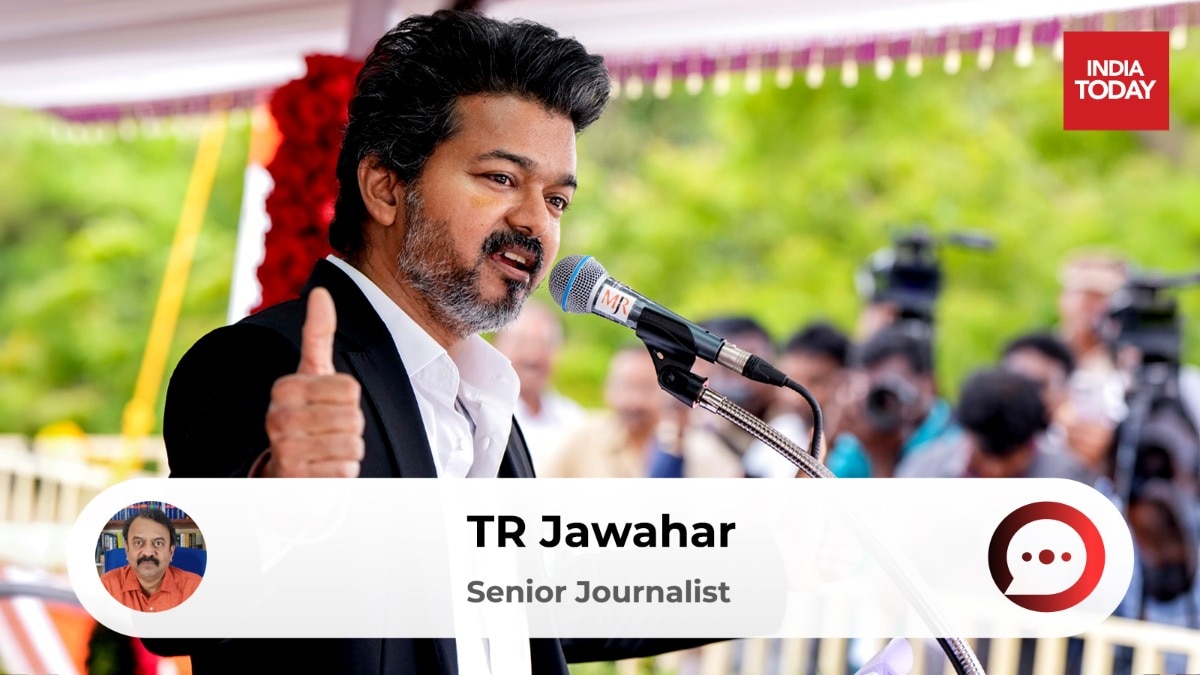
The calendar at Fort St. George marks an intriguing, highly anticipated milestone: one hundred days since the historic swearing-in on May 10, 2026. The new administration in Chennai has celebrated the occasion with characteristic flair, releasing an elaborate official report card titled "100 Days of Governance - A Government for Generations."For most of the past six decades, Tamil Nadu’s electoral centre of gravity lay within the DMK-AIADMK universe: rival formations, often fierce in personality and style, but shaped by overlapping Dravidian vocabularies, welfare politics, and federal assertion. The 2026 result did not erase that inheritance. It interrupted its settled order.An insurgent actor-politician, commanding 108 seats at the head of a delicate coalition, breached the fortress that once seemed the private preserve of the two-leaf and rising-sun flags. The outsider has formally entered Fort St. George.The deeper, far more consequential question, however, is whether Fort St. George has quietly entered the outsider. The face in the Chief Minister’s corner office has indisputably changed; but has the fundamental grammar of Tamil governance changed along with it, or have we merely witnessed an aesthetic changing of the guard? THE ASSEMBLY FLOOR: DECORUM, MGR NOSTALGIA, AND THE SCRUTINY TESTStep inside the hallowed chamber of the Tamil Nadu Legislative Assembly, and the optical rupture is immediately striking. It is not, strictly speaking, the first time in half a century that the House has met without CN Annadurai, MGR, M Karunanidhi, or J Jayalalithaa; their physical absence has been an established fact of life for a long now. Yet, across the preceding few decades, the past merely faded away in polite, incremental stages.With the sudden departure of MK Stalin from the treasury benches following the May 2026 mandate, and his relegation to the quiet role of party elder while his son Udhayanidhi Stalin occupies the seat of Leader of the Opposition, the generational cut-off feels absolute and irreversible. The Assembly’s familiar theatre of rivalry has lost its traditional gladiators, leaving behind a curious, echoing void where titanic personal feuds once generated endless political heat.The treasury benches are now steered by a soft-spoken Chief Minister C Joseph Vijay, flanked by the seasoned, unflappable legislative floor manager KA Sengottaiyan, whose encyclopaedic knowledge of House rules serves as a steady anchor for a bench filled with first-time legislators.Facing them across the central aisle is a combative, restless Udhayanidhi Stalin, eager to establish his opposition credentials, while former Chief Minister Edappadi K Palaniswami attempts to maintain a semblance of authority over a fractured and rapidly dwindling AIADMK flank.Presiding over this delicate theatre of power is Speaker JCD Prabhakar, whose daily management of the proceedings provides rich material for subtle political satire.The veteran Speaker solemnly swears by constitutional non-partisanship from the Chair, quoting chapter and verse from the Quran, the Bible, and the Bhagavad Gita, only to occasionally lapse into unvarnished adulatory prose, hailing the Chief Minister on the floor as a "living MGR."In moments of legislative turbulence, the Chair has even been known to hum or recite philosophical lines from vintage MGR hits, transforming the Speaker’s podium into a nostalgic musical stage.Chief Minister Vijay, for his part, has brought his own cinematic trademark into the House. When cornered by aggressive opposition interventions, he has eschewed the long, classical Tamil soliloquies of the Dravidian veterans, opting instead to disarm the chamber with his signature Kutti Kadhaigal (little parables).Delivered with a soft, calculated cadence that faintly echoes Jayalalithaa’s storytelling style, these parables wrap sharp political rebukes inside innocent moral fables, leaving the opposition visibly amused yet temporarily silenced.Yet, an analytical critique must ask a harder institutional question: Has the quality of legislative scrutiny actually improved, or merely its manners? Fewer flying microphones, unripped rulebooks, and the absence of physical brawls are universally welcome, but decorum is democracy's dress code, not its report card.The real democratic benchmark lies in Question Hour rigour, committee functioning, the space conceded to the opposition, ministerial preparedness and familiarity with primary files, and whether critical legislative bills are subjected to substantive clause-by-clause debate rather than rushed voice votes. Civility has undoubtedly arrived on the floor; institutional depth is still undergoing its rookie probation.The gender and social arithmetic of the new order present an equally fascinating study in contrasts. The 2026 election again demonstrated the centrality of women voters to Tamil Nadu’s electoral math, with women voters turning out in historic numbers to help decide the mandate. Yet women remain visibly under-represented on the legislative floor, an enduring democratic deficit that high turnout alone does not cure.However, the subsequent expansion of the State Cabinet to include four women ministers and seven Scheduled Caste ministers provides a meaningful counterpoint. Representation must be recorded where it advances and interrogated where it stalls.The vocal presence of party leaders outside and across the aisle adds sharp edges to public debates, but true social justice will be measured by whether executive inclusion translates into structural influence within the highest policymaking circles.THE SCRAMBLED PARTY SYSTEM AND THE OPPORTUNISM CAROUSELBeyond the immediate acoustics of the Assembly chamber, the wider political landscape reveals a systemic shockwave. Vijay has not simply displaced a government; he has completely scrambled the State's party system.The historic significance is far larger than routine factionalism: The DMK has inherited the principal opposition role, the AIADMK is in an existential battle for relevance, smaller parties are recalibrating their survival strategies, and the State is left wondering whether 2026 ended six decades of bipolar politics or merely began the construction of another bipolarity with different initials.The principal opposition space is witnessing unprecedented churn. Between late May and late June, six AIADMK legislators - including prominent figures like MR Vijayabhaskar, C Vijayabhaskar, and Esakki Subaya, alongside P Sathyabama, Maragatham Kumaravel, and S Jayakumar - tendered their resignations to the Speaker. AIADMK leadership alleged that the Speaker acted with unusual haste in accepting them, while the Speaker’s office maintained that each resignation was examined under the prescribed constitutional process.The episode raised a profound constitutional question: whether voluntary departure, accepted before a disqualification decision, can allow legislators to escape the consequences of alleged defection. With the AIADMK placing that challenge before the High Court, the legal outcome will matter far more than the political theatre surrounding it.Yet, with by-elections not forthcoming, these defectors remain stranded in an uncomfortable purgatory of their own making.Outside the House, the carousel of political opportunism flourishes with unabashed vigour. Veteran coalition partners and ideological nomads - the familiar "Vaiko and Co." ecosystem - have swiftly calibrated their linguistic sails to the prevailing winds, discovering sudden virtues, ideological depth, and administrative brilliance in the new occupant of Fort St. George.Meanwhile, the State unit of the Bharatiya Janata Party finds itself in a diminished and unsettled position. Following K Annamalai’s pre-election marginalisation and his early June resignation from the primary membership of the party, the State BJP was deprived of its most visible statewide campaigner at a moment when it was already struggling to define its place in a post-election order dominated by TVK, DMK, and AIADMK calculations.This loss of an aggressive media presence has forced New Delhi to adopt a strategy of direct, pragmatic engagement with Fort St. George, bypassing local partisan posturing in favour of functional administrative diplomacy.THE COALITION ARITHMETIC: POWER IN A SHARED HOUSEUnderpinning this entire administrative structure is a mathematical reality that campaign rhetoric often obscures: Vijay’s mandate is historic, but it is not self-sufficient. The Election Commission tally confirmed that the TVK won 108 seats, making it the single largest party in the 234-member Assembly, but leaving it ten short of the 118-seat majority mark.The government rests upon a delicate multi-party architecture, sustained by the formal legislative support of allies including the Congress, the VCK, and other regional formations. A Chief Minister can centralise public messaging in an afternoon; he cannot centralise allied ambition for long.The ultimate durability of this government will depend not solely on the Chief Minister's individual charisma, but on whether coalition partners feel they possess authentic policy influence, institutional dignity, and legislative breathing space.The real tests of coalition discipline will not occur during the celebratory hundred-day honeymoon, but during contentious budget votes, local-body seat-sharing negotiations, and regional portfolio disputes where competing local interests collide.THE WELFARE ARCHITECTURE: DEPRIVATION, CAPABILITY, AND SUSTAINABILITYNo political regime in Tamil Nadu can survive without feeding the State’s deep, historical expectation of welfare delivery. In this arena, the TVK administration hit the ground running, acutely aware that welfare in Tamil Nadu is not an optional policy choice; it is the non-negotiable entry fee to the coliseum of public trust.Within days of assuming office, the administration expanded household electricity relief by fulfilling its promise of two hundred units of free power, subject to consumption thresholds, instantly adding an annual recurring subsidy burden of approximately Rs 1,730 crore to TANGEDCO’s already fragile balance sheet.This was swiftly augmented by the Thaaimaaman Thanga Mothiram scheme, allocating funds for a one-gram gold ring for newborns in government hospitals, and Annan's Seer, offering an eight-gram gold sovereign and a silk saree for underprivileged brides.To shore up its agrarian base, the Cabinet authorised an immediate Rs 6,220 crore cooperative farm loan waiver, while creating specialised enforcement wings - the Singapenn women's safety task force and sixty-five STING anti-narcotics units - and rolling out an expanded Rs 710 crore Kamarajar breakfast scheme and a laptop assistance roadmap for college students.Yet, an incisive critique must move beyond the tired, simplistic quarrel between "welfare" and "freebies." Tamil Nadu's historic development model succeeded precisely because it married direct social transfers to investments in nutrition, education, public health, and human capital.Every scheme rolled out by the new administration must therefore be subjected to a three-tier test: Does it correct real structural deprivation? Does it build productive human capability? Is it fiscally sustainable over a five-year horizon?Free breakfast schemes for school children and targeted maternal assistance directly build human capabilities and combat generational poverty; gold assistance schemes and recurring utility subsidies, by contrast, function primarily as competitive patronage transfers that strain State liquidity.A welfare promise is popular at the microphone; it becomes sound policy only when it survives the scrutiny of the ledger.THE FISCAL LEDGER: THE Rs 3.5 LAKH CRORE TIGHTROPECampaigning in Tamil Nadu is written in soaring poetry; governing Fort St. George is strictly recorded in double-entry bookkeeping. That mathematical reality asserted itself forcefully on August 5, 2026, when Finance Minister N. Marie Wilson rose to present the Revised Budget Estimates for 2026–27.The fiscal ledger revealed the difficult trade-offs upon which the new administration must operate. Total revenue receipts for the year were projected at Rs 3,50,027 crore against an estimated revenue expenditure of Rs 4,05,802 crore, opening a yawning revenue deficit of Rs 55,775 crore.That is the uncomfortable number behind the glamorous announcements: the government is borrowing not merely to build tomorrow's capital assets, but partly to pay today's routine administrative bills.The fiscal deficit was budgeted at Rs 1,21,819 crore, representing 3.00 per cent of the Gross State Domestic Product of Rs 40,67,312 crore — a level that leaves virtually no cushion if borrowing costs rise, central transfers fluctuate, or power-sector subsidies expand. The State’s outstanding liabilities have reached Rs 10.98 lakh crore, representing 27.01 per cent of GSDP.A colossal proportion of the State’s own tax revenue, estimated at Rs 2,26,740 crore, is pre-committed to salaries, pensions, and mounting interest obligations, leaving very little fiscal space for discretionary capital expenditure. This fiscal reality makes the administration's bold target of a $1.5-trillion economy by 2036 an ambitious mountain to climb.The government celebrated securing Rs 1 lakh crore in investment commitments at the Vettri Tamil Nadu Conclave. Yet, economic governance requires separating intent from execution. A memorandum is not a factory; an announced investment is not an executed project; and an executed project is not yet a sustainable job.The government must establish an auditable conversion framework tracking approvals, land allotments, construction commencements, and actual employment generation across the State's industrial corridors - ensuring that growth is not confined to the Chennai-Hosur-Coimbatore belt but genuinely decentralised into the southern and delta districts where youth unemployment remains acute.The fiscal dilemma is nowhere more visible than in the retail liquor policy. The government took a principled public-interest step by ordering the closure of 717 TASMAC retail liquor outlets situated near educational institutions, places of worship, and major transport hubs.The measure was widely praised by civil society and women's groups, yet it directly reduced an excise stream in an economy where the liquor monopoly historically generates over Rs 45,000 crore annually to keep State programmes funded.The State cannot indefinitely preach temperance with one hand while balancing its books on the bottle held in the other. If social reform reduces alcohol revenues, the government must articulate a credible, transparent replacement strategy through broader tax compliance and non-tax mobilisation rather than resorting to off-budget borrowing.THE ADMINISTRATIVE MIRROR: BUREAUCRATIC CRAFT AND PUBLIC DELIVERYAn insurgent movement can storm the electoral citadel in a single campaign, but administrative systems can easily absorb the political energy of a new government in a hundred quiet afternoons.The early weeks at the Secretariat were marked by cautious deliberation. Rather than undertaking a sweeping, vindictive bureaucratic purge, the political leadership opted for institutional continuity - retaining experienced senior secretaries in core economic and infrastructure departments while placing trusted officers in intelligence and law enforcement.A genuine change of political culture also means resisting retaliatory politics, revenge prosecutions, and administrative harassment of opponents, a provisional virtue the new dispensation has largely maintained.An outsider’s first administrative virtue is knowing what he does not know. Experience need not surrender to change; sometimes experience is what prevents change from driving directly into a wall.Yet, governance must ultimately be evaluated across four distinct tests: appointments, institutional continuity, execution of government orders, and crisis response. The introduction of faceless property registrations and single-window industrial clearances points toward administrative modernisation, but their success will be judged by the average citizen's encounter with the State.Governments are sworn in at Fort St. George; governance is experienced at the counter. Whether in municipal corporation offices, taluk centres, government hospitals, or local police stations, the real test of a new politics is not whether it speaks differently of power, but whether ordinary people encounter power differently.The administration faced its sharpest early moral test following a controversial custodial death in Palani, as the opposition also stepped up scrutiny over localised crimes against women and scattered illicit liquor operations.The opposition DMK seized upon these incidents, staging walkouts and demanding administrative accountability. The Chief Minister responded with prompt departmental suspensions, judicial inquiries, and compensation to the bereaved family.Yet, handling such crises requires recognising a fundamental truth: the first custodial-death case was the administration’s clearest early test of whether its language of order would include accountability for those who enforce it. Suspension and compensation are necessary first steps; the real test is whether institutional safeguards, supervisory discipline, and police accountability survive the fleeting attention of the news cycle.On the anti-corruption front, the new administration faces an equally stringent standard. During the election campaign, Vijay asserted that twenty to thirty per cent of public funds were being lost to systemic corruption under the previous regime. The campaigner supplied the percentage; the Chief Minister must now supply the proof.If hundreds or thousands of crores were being lost through public procurement, infrastructure tenders, and departmental contracts, the administration must demonstrate institutional investigations, structural procurement reforms, contract audits, and tangible fiscal recoveries. Without concrete institutional remedies, fiery campaign allegations risk evaporating into routine political rhetoric.Furthermore, a post-Dravidian political claim must ultimately be tested not by the freshness of its rhetoric, but by its treatment of historic inequalities: caste discrimination, Dalit land and employment rights, manual scavenging eradication, inter-caste violence, public-school infrastructure, and the safety of marginalised communities.These are not peripheral issues; they are the foundational ground upon which Tamil Nadu’s progressive inheritance must continually validate itself.DELHI DIPLOMACY: PRAGMATIC RED LINES AND FEDERAL REALITIESThe most original political departure of the TVK government has emerged in the realm of Centre-State relations. For years, federal engagement was characterised by high-decibel friction. The phrase Ondriya Arasu was frequently deployed less as an exercise in constitutional precision and more as a verbal missile to needle New Delhi, where theatrical walkouts from national meetings and fiery open letters often preceded substantive administrative dialogue.Vijay has altered the method of engagement without abandoning Tamil Nadu’s substantive demands. During his maiden official meeting with Prime Minister Narendra Modi on May 27, 2026, and his subsequent appearance at the NITI Aayog Governing Council in mid-June, the Chief Minister pursued a suave, transactional diplomacy. He established firm red lines while consciously draining the relationship of performative hostility.The State’s core constitutional positions remain uncompromising:Linguistic autonomy remains central, with the administration reaffirming Tamil Nadu’s strict two-language formula of Tamil and English while formally rejecting the three-language prescription of the National Education Policy.On the medical entrance front, the government maintained its demand for exemption from NEET on the grounds of rural equity, pursuing the issue through structured administrative memoranda.On the critical issue of parliamentary delimitation, Vijay drew an unyielding line against any formula that penalises southern States for their successful demographic transition. The debate around the proposed Constitution (131st Amendment) Bill 2026 - which was introduced on April 16 and subsequently negatived in the Lok Sabha on April 17 - highlighted this national faultline.The Union government contended that its proposed expansion would have increased Tamil Nadu’s representation from 39 to 59 Lok Sabha seats while keeping its national share roughly stable at 7.23 per cent.Yet the deeper southern anxiety remains entirely valid: that future population-based reapportionment could inexorably dilute the political voice and fiscal devolution of demographically disciplined States. By articulating this concern with economic precision rather than street agitation, the State presented a formidable constitutional argument.On the fiscal ledger, Vijay pressed for the unconditional release of Rs 3,284 crore in pending Samagra Shiksha education funds, Rs 2,283 crore for the Hogenakkal Phase-III drinking water scheme, national hub status for the Kulasekarapattinam Space Manufacturing Hub, a second AIIMS in Coimbatore, and formal reconsideration of the proposed three per cent disinvestment in the Neyveli Lignite Corporation (NLCIL).The change is not in Tamil Nadu’s core demands; the change is in the method. The megaphone has been retired, the memorandum has taken its place, and the State has demonstrated that firmness does not require fury.Yet, here too, one must separate the memorandum from the money. Federalism is not proved by raising one’s voice at Delhi; nor is it proved merely by pleasant photographs with the Prime Minister. It is proved by returning with funds, sanctioned projects, statutory protections, and the administrative space to govern.One hundred days is too early to demand completed projects, but over the coming fiscal quarters, the success of this non-confrontational reset will be judged strictly by whether Delhi’s goodwill translates into cleared cheques and approved files.THE VERDICT: CHARISMA MEETING CAPACITYAt the hundred-day mark, Tamil Nadu has plainly changed governments. The new administration has altered the tone, the symbolism, and the visible choreography of power. It has brought a calmer administrative temper, a generational rupture on the Assembly floor, and a constructive, non-theatrical approach to federal relations.Chief Minister Vijay has confounded his most cynical detractors: he has not governed by cinematic monologue, he has displayed personal dignity, and he has demonstrated an authentic willingness to respect institutional expertise.Yet, one hundred days cannot prove a systemic transformation; it can only reveal governing instincts. It tells us what a new regime values, whom it trusts, and how it responds to crises, and whether campaign certainties survive their first contact with official files.Politics does not change by a new style alone. It changes when welfare becomes structurally sustainable, when police accountability survives the news cycle, when coalition compromises do not paralyse policy, when investment commitments become verified jobs, when marginalised communities gain real institutional power, and when federal diplomacy delivers tangible financial returns.Vijay has entered Fort St. George with immense public goodwill and dismantled the myth that an outsider cannot steer the State ship. But the initial hundred-day honeymoon is now behind him.Fort St. George has outlived many political certainties, weathered countless ideological storms, and absorbed generations of ambitious leaders into its ancient rhythm. Its newest resident now faces the oldest, most demanding question of democratic governance: can charisma successfully transform into enduring State capacity?- EndsPublished By: Shipra ParasharPublished On: Aug 18, 2026 17:51 IST
100 days of Vijay: Has Tamil Nadu really changed its political script?
Full Article
Original Source
Read the full article at Indiatoday →KhanList aggregates and links to publicly available news content. We do not host full articles from third-party sources. Always verify important information with original sources.