
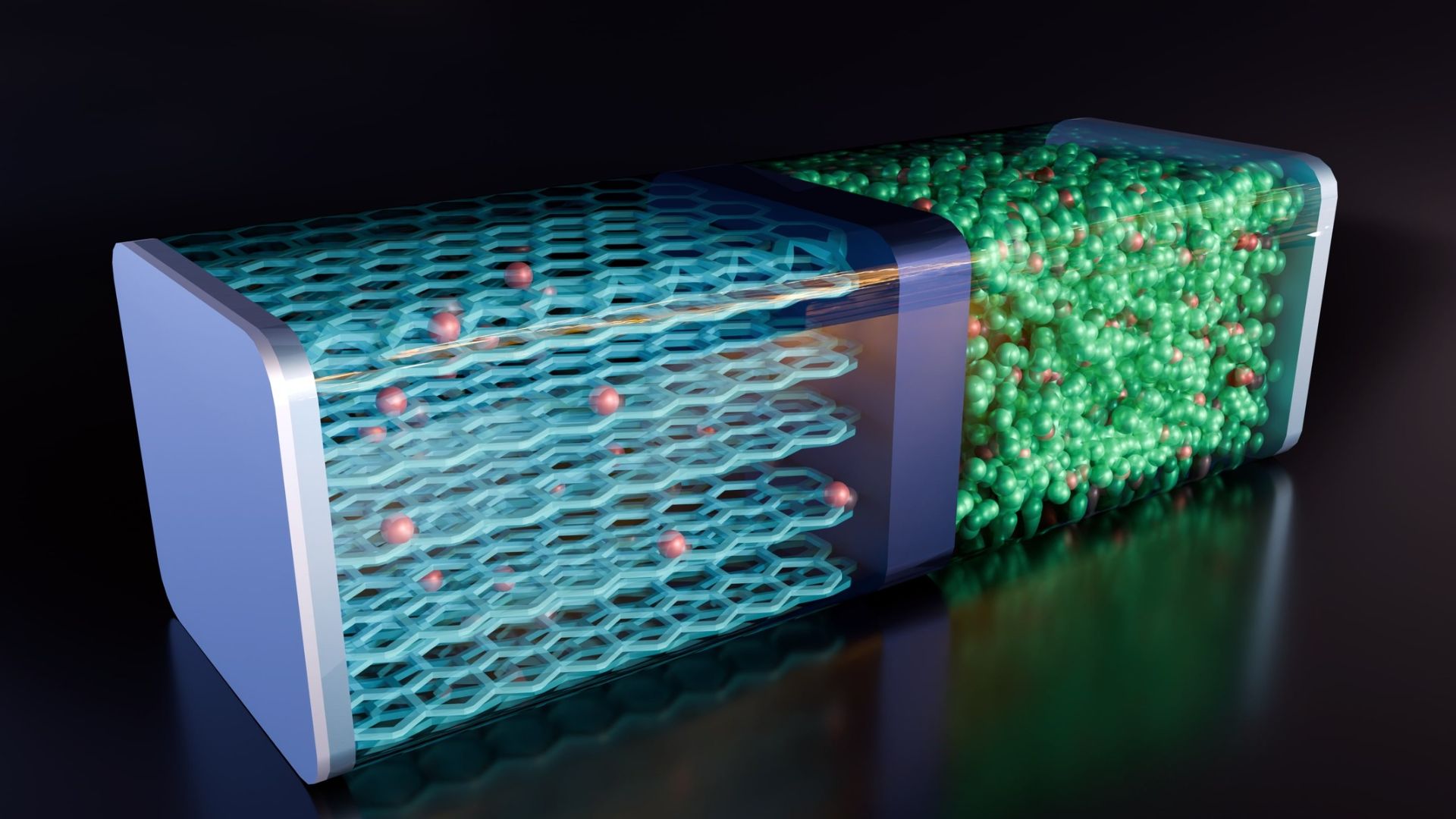
Every electric vehicle owner knows the quiet anxiety of watching a battery’s peak performance slowly fade over years of charging. Scientists have long chased a promising fix: lithium-rich layered cathodes that store far more energy than conventional cells. But these high-capacity materials come with some issues. Repeated charge-and-discharge cycles scramble their internal architecture and steadily drain operating voltage. A research team in South Korea has now solved that problem by rethinking how atoms are stacked inside the battery. Led by Professor Kisuk Kang of Seoul National University’s Department of Materials Science and Engineering, the team uncovered a structural design rule that keeps high-energy cathodes stable over time. Stacking layers differently Standard batteries depend mainly on transition metals like nickel to move electrons; lithium-rich cathodes place extra lithium inside their transition-metal layers. This structural tweak lets oxygen atoms participate in the chemical reaction too, unlocking greater energy storage capacity. That extra capacity comes at a steep structural cost. During repeated cycling, transition-metal ions drift from their original spots and get stuck, while pairs of oxygen ions fuse into unwanted “oxygen dimers.” Once those atomic shifts accumulate, the battery’s discharge voltage drops, leaving drivers and grid operators with less usable power. Earlier attempts to fix this relied on surface coatings or chemical additives, which often curbed the very oxygen reactions that made the materials attractive in the first place Professor Kang’s group explored cathode structural stability by altering vertical atomic stacking sequences, treating the material like interlocking blocks. They studied lithium-rich oxides featuring an O6 crystal arrangement. This structure weaves O3- and O1-type atomic subunit cells together within a single crystal. Measured performance Using electron microscopy, X-ray analysis, and atomic-scale computer simulations, the scientists watched how this hybrid stack behaved under stress. When transition-metal ions tried to wander out of place during charging, surrounding metal ions pushed back with stronger repulsive forces, nudging the wandering atoms back home during discharge. At the same time, the O6 geometry reshaped the local environment around oxygen atoms, stopping them from clumping into irreversible dimers. Lab tests confirmed the payoff. A representative O6-type cathode delivered a hefty initial discharge capacity of 277 mAh per gram while losing an average of just 0.31 millivolts per cycle over 100 cycles. Across multiple chemical compositions, O6 cathodes retained more than 98 percent of their initial average discharge voltage after 100 cycles, easily outperforming standard O3-type benchmarks. “This study reveals the relationship between the stacking structures and performance of layered cathode materials and, based on this understanding, proposes a new design principle,” said Professor Kang. “By controlling the stacking sequence of atomic layers, we have identified a promising candidate for next-generation high-energy-density cathode materials.” For automakers and renewable energy providers, the implications are immediate. Longer-lasting, higher-voltage cathodes could preserve EV driving range over hundreds of thousands of miles, keep wind and solar storage installations delivering steady output, and cut down on costly battery replacements. Next, the team plans to map out how the O6 arrangement takes shape during the ion-exchange process, in which sodium ions are swapped for lithium, paving the way for precision manufacturing at commercial scale. The findings were published in Nature Sustainability. Get the latest in engineering, tech, space & science - delivered daily to your inbox.Mrigakshi is a science journalist who enjoys writing about space exploration, biology, and technological innovations. Her work has been featured in well-known publications including Nature India, Supercluster, The Weather Channel and Astronomy magazine. If you have pitches in mind, please do not hesitate to email her.
100 cycles and barely a drop: Scientists crack voltage decay in high-capacity batteries
Full Article
Original Source
Read the full article at Interestingengineering →KhanList aggregates and links to publicly available news content. We do not host full articles from third-party sources. Always verify important information with original sources.