
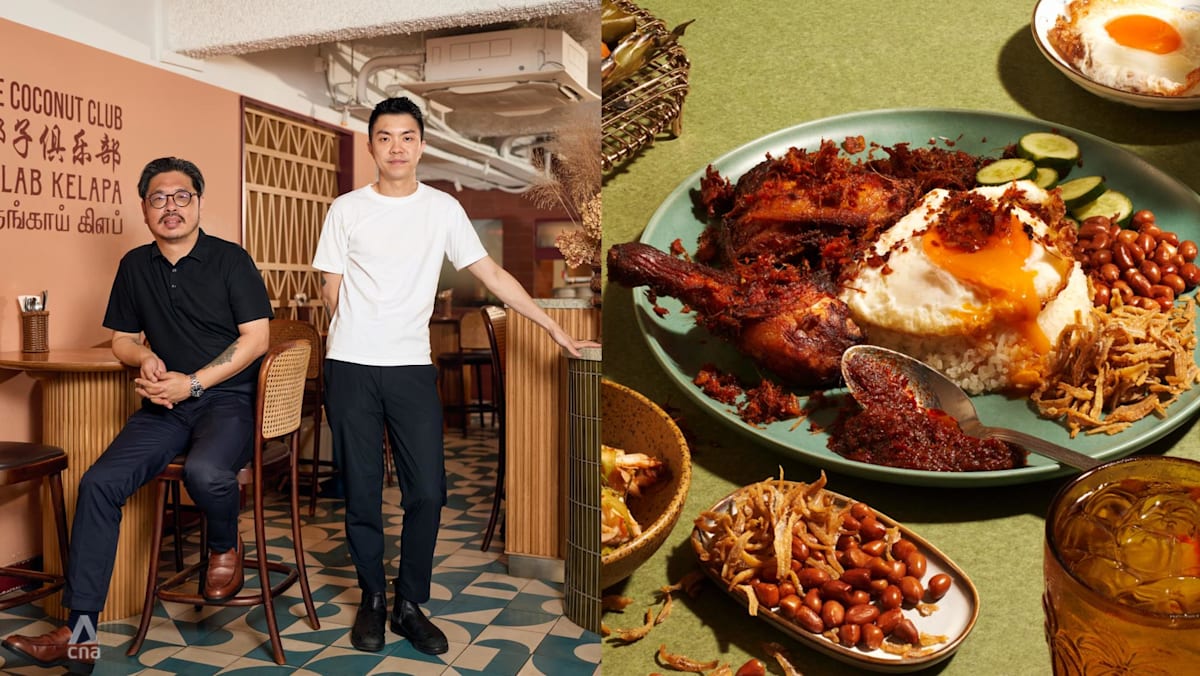
It’s been 10 years since The Coconut Club first opened its doors serving S$12.80 nasi lemak to a mildly scandalised public.Managing partner Daniel Sia, who has headed it up for the last five years, recalls that “I myself was skeptical when it first opened. I was like, ‘Seriously? Why is it so expensive?’“But, when I tried it – I wouldn't say it changed my life, but it did change my perception,” he chuckled. Impressed by the quality of the ingredients, “I said, ‘If you compare this to a similarly-priced product, it's worth the money."The Coconut Club was co-founded in Singapore in 2016 by Lee Eng Su, who set out to elevate the humble nasi lemak through painstaking attention to ingredients, particularly freshly squeezed coconut milk.Its original S$12.80 nasi lemak raised eyebrows at a time when the dish was largely associated with inexpensive hawker fare, but the restaurant soon attracted a loyal following and earned Michelin Bib Gourmand recognition.It helped that, just two months after the opening in October, the restaurant received a high-profile endorsement when then-Prime Minister Lee Hsien Loong hosted then-Philippine president Rodrigo Duterte there over a nasi lemak meal. The Coconut Club's flagship restaurant at Beach Road. (Photo: The Coconut Club) Following Eng Su’s untimely death in 2019, the business continued under his brother before being acquired by hospitality group The Lo & Behold Group in 2021. It subsequently moved from its original Ann Siang Hill premises to a larger flagship restaurant on Beach Road in 2022, expanding its menu of locally-inspired dishes while retaining nasi lemak as its signature.Its expansion continued with a more casual neighbourhood outlet in Siglap in 2023, followed by an all-day dining concept at New Bahru in River Valley in 2024.The components on the plate have remained the same: jasmine rice infused with coconut; organic chicken marinated for 12 hours in housemade rempah; fried ikan bilis; and spicy-sweet sambal. All about nasi lemak (Photo: The Coconut Club) And, yes, there are still people who complain about the pricing, Sia disclosed. A plate of ayam goreng berempah nasi lemak today costs S$22 due to inflation and rising costs.But, “we’ve created restaurants that people dress up for and choose for a date. We have people bringing their overseas friends. We have people bringing their own wines.” Around the main specialty dish, there’s now a menu of small plates and sharing plates that includes beef cheek rendang, threadfin fish curry, sambal squid and seafood laksa, as well as a cocktail menu that features pandan highballs and masala chai penicillins.“We even had somebody propose,” Sia shared. The proposal took place when the restaurant was at Ann Siang Hill, and when it moved to Beach Road, the couple booked out the place for their wedding. “And then, a couple of months ago, they came back, with a one-year-old kid.”GROWTH AND CHANGE The Coconut Club's managing partner Daniel Sia with executive chef Marcus Leow (Photo: CNA/Dillon Tan) “Coconut Club, when it first opened, really was one of the very first to serve local food in a restaurant kind of setting, with a dish that is found in hawker centres. The brand is one of the early pioneers of championing local Singaporean food, and we really want to take this even further in the next 10 years as well,” Sia said.What that looks like is “constant improvement on a daily basis, making the nasi lemak better than it was the day before.”For example, a lot of tweaking has gone into the star of the dish: the rice. “Initially, there was chicken fat in the rice. Some people are vegetarian, so we took that out, and also, I felt that the chicken fat actually distracted from the coconut flavour. We improved on increasing the coconut flavour while making it lighter. And the sambal – some people said it was too spicy; not sweet enough. We heard the feedback and we worked on it. Most importantly, all the components need to make the coconut rice better, rather than overpower the coconut flavour.” (Photo: The Coconut Club) A lot of geekiness has gone into the pursuit of the perfect nasi lemak, according to Sia. There’s the machine, developed by a Formula One engineer, that cold-presses the coconuts so that heat doesn’t affect their flavour. There’s the daily ikan bilis inspection to make sure they are the right size. And, there’s the taking into account the micro-seasons of coconuts, which cooks are trained to taste as the fruits can have a higher water content during rainy seasons.For a dish like beef rendang, for example, there’s extensive experimentation with different cuts, sourcing and techniques, like steam-baking beef cheek so the meat retains more flavour and a better texture.“There is a place for hawker food that you eat on a regular basis. There's also a place for restaurants serving local Singaporean food,” Sia opined. “If you compare, it's still a plate of nasi lemak, but in terms of the quality, care and technical skills that we put in, it’s different from what you can get for cheaper.” Not just nasi lemak (Photo: The Coconut Club) What makes The Coconut Club’s nasi lemak Singaporean?“We don't get stuck into, ‘It should be like that’ or ‘it should only be eaten with this or that’,” Sia said. “Singapore is a mashup of different cultures and races. So, it makes a Singaporean version a little bit more exciting because we have different things, like kerabus and curries that can go with the coconut rice”, with the unifying factor being that “everything needs to complement the rice”.Their upcoming 10th anniversary celebrations will embrace this idea with a series of collaborations including a rotating hawker residency launching Oct 24 with New Station Rice Bar, a capsule collection of merchandise with local apparel label Wacky Wears, a Berempah Birthday Bash on Oct 25 with every item priced at S$10, and a limited-edition pastry box with chef Maira Yeo.MORE THAN COCONUTSIn 10 years, an entire ecosystem of chefs embracing local cuisine has blossomed, and The Coconut Club, which once blazed a trail, isn’t an anomaly any more.“It's difficult to do it on your own, but, I think, because there are other people championing local Singaporean food as well, it makes the market more aware that local Singaporean food should be preserved and celebrated,” Sia said. “You know, there was a debate in Parliament about having not enough local brands in the malls. I think people are a bit more aware that we should try and keep that heritage alive in Singapore, rather than just going for the foreign brands and foreign food.” (Photo: CNA/Dillon Tan) Looking ahead, the journey of seeing where contemporary interpretations of Singapore cuisine could go continues. In April last year, Sia and chef Marcus Leow, formerly of Magic Square and Naked Finn, opened Belimbing on the floor above The Coconut Club’s Beach Road flagship, with Leow heading Belimbing’s kitchen on top of serving as executive chef for The Coconut Club.Belimbing’s finer, contemporary interpretations of Singaporean cuisine include dishes like the wagyu with sunchoke abacus seeds and pongteh broth; charcoal-grilled “assam pedas” Taiwanese threadfin with burnt eggplant and razor clam; and mud crab and porcini mushroom XO claypot rice served with crab fat curry that are on its latest menu. Chicken kerabu (Photo: Belimbing) Leow enjoys pushing the boundaries of what Singaporean cuisine can be with menus that may not read very Singaporean at first glance, but evoke a sense of familiarity or nostalgia in diners.As a young chef, “I didn't really think about Singaporean food that much. I thought of other cuisines as more interesting, like French or Spanish,” he said.Now, he feels it’s crucial for a newer generation of cooks “to understand why our cuisine is so important”. The onus is also on chefs to better communicate to diners “the amount of care, the amount of thought, the amount of work and the finesse that we put in. It doesn't mean that food from foreign cuisines should be more expensive.” Belimbing's main dining room (Photo: Belimbing) Elevated local food today “shouldn't just be about putting premium ingredients on the menu and then calling it an elevated version”. Instead, it should be “thinking about what makes like great dishes really good” and refining processes, he asserted.For example, “in Belimbing’s previous menu, we did something with kedongdong, which people think is just used in a drink or in a sambal. We did it in a sorbet form. It was very nice to see older folks say, ‘I didn't know you could do it like that’.”In the past, “the attitude towards traditional cuisine was very much ‘if it's not broken, don't fix it’,” Leow observed.“Now, there are a lot of people in my generation who are exploring Singapore’s cuisine”, probing the idea that “Singaporean cuisine can be forward-looking”. “It’s obviously changing the perception not only of local diners, but also making Singapore cuisine a hotter destination. I'm really happy that people are much more receptive to Singaporean cuisine now. At Belimbing and The Coconut Club, I don't feel that worried to put out something that's a bit different.“I think everyone plays a part in pushing the cuisine forward.”The Coconut Club is at 269 Beach Road, 97 Frankel Avenue and 46 Kim Yam Road, New Bahru 01-14. Belimbing is at 269A Beach Road.
10 years of The Coconut Club: How its S$12.80 nasi lemak challenged the way we value local food
Full Article
Original Source
Read the full article at Cnalifestyle →KhanList aggregates and links to publicly available news content. We do not host full articles from third-party sources. Always verify important information with original sources.