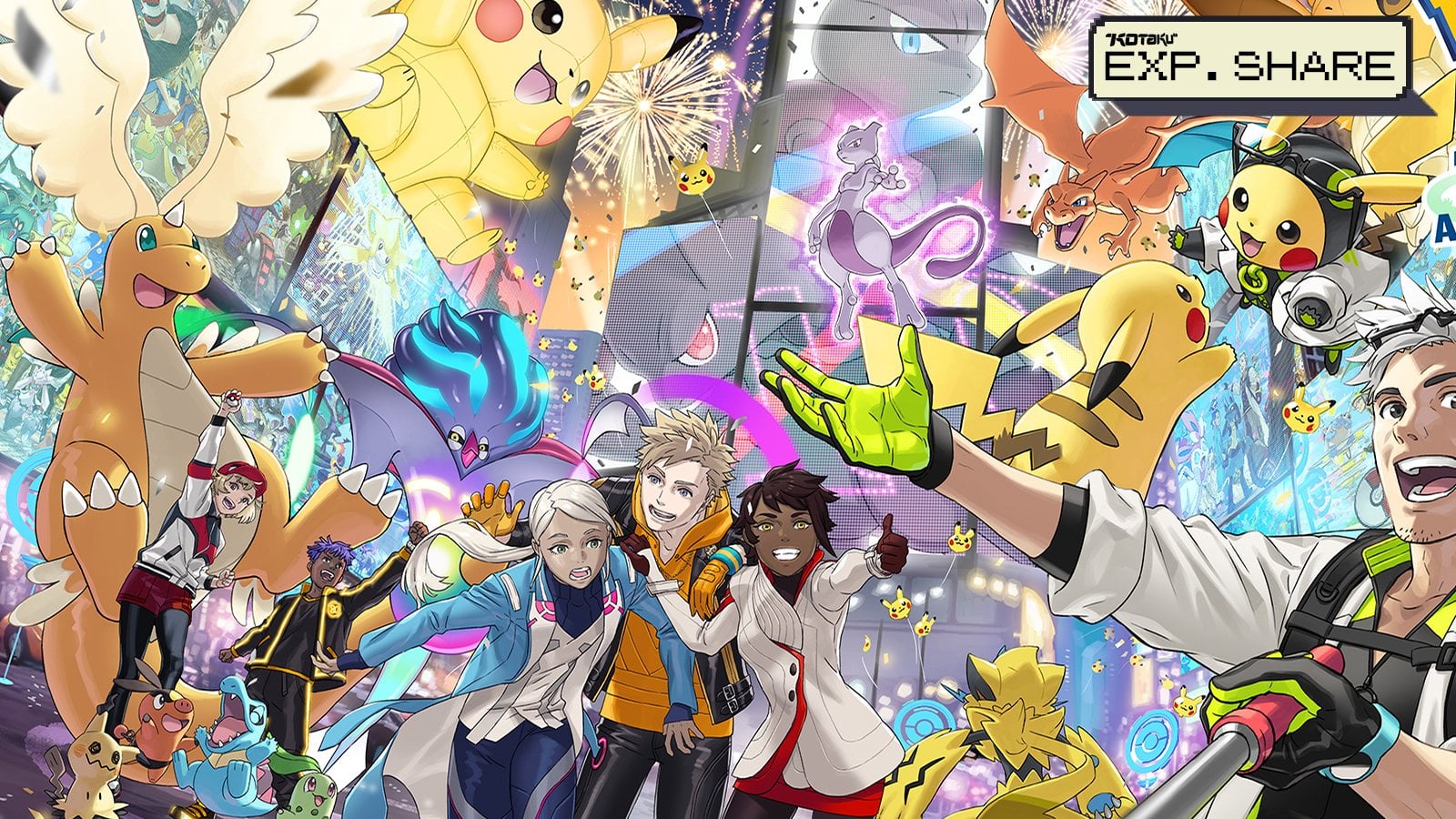
On July 9, three days after Pokémon Go’s 10th anniversary, thousands of players gathered in New York City’s Times Square for a celebratory event that ended with people working together to catch an event-exclusive Mewtwo. For those there, it was a magical realization of the promise Pokémon Go has always claimed to hold. The AR monster-collecting app has been a fixture in communities both online and off, and having a massive crowd work together to capture one of the most iconic monsters in the series’ history is one hell of a way to ring in the big one-oh. But underneath the cheers of the crowd, a pesky, uncomfortable ringing can be heard. Pokémon Go was the biggest video game in the world at one point, and proof that Pokémania was alive and well in 2016. Everyone, whether they be a hardcore Pokémon master, a lapsed trainer who hadn’t played a Nintendo console in years, or newcomers who had never picked up a Poké Ball, was either playing the game or at least aware of it. As most successful, popular things do these days, Pokémon Go has raised prices on its microtransactions, grown more flooded with ads, and made unpopular design changes that have pushed some players out. The degree of enshittification Pokémon Go has inflicted on its players has been debated for as long as the game has been installed on phones and tablets, and some players point to developer Niantic’s acquisition by Saudi-owned Scopely and its rebranding as Scopely Digital as a turning point after which things got much worse. But for a lot of people who played the game early on and then bounced, those old memories of millions of people united are still crystalized. Living the dream Luke Herr, a Pokémon fan and podcaster, recalls how Pokémon Go bonded him with fellow players on the Ohio State University campus, and that regular play sessions became a “communal event.” “You could tell if the servers were up or down based on how many people were looking at their phones,” Herr tells Kotaku. “Strangers would stop and ask you questions, and suddenly I was walking seven or eight miles a day, going out and exploring and dealing with the original bugs the game had. I remember spending 40 minutes looking for a Tauros at night that had probably vanished 10 minutes after I started searching, but the nearby Pokémon listing didn’t reset unless you restarted the game.” What started as a game played by passersby ended up becoming a centerpiece at events that helped the larger Columbus community. © The Pokémon Company / Kotaku “We held canned food and toy drives for some of the community day events and even got sponsors for events early on,” Herr says. “I usually ended up playing on the OSU campus even after I moved and needed to drive because it was this communal event—we’d wanted walkable spaces where we wouldn’t be blocking off other people. I remember crowds of 60 plus people going from raid to raid ranging from kids to seniors across the campus and people would be like ‘what are you doing’ and as soon as someone said ‘Pokémon Go’ they’d be like ‘that’s still a thing’ and it was like, ‘yeah, there’s 60 people here specifically playing the same game.’” Pokémon Go wasn’t just the realization of the monster-catching experience that long-time fans had imagined as kids; it was also an entry point for those who never had a chance to go on a Pokémon adventure on a Nintendo platform. “What got me started with Pokémon Go was, at the time it was released, I hadn’t ever had a system that could play a main-line Pokémon game, so I was thrilled they’d made a mobile game I could play,” Pokémon fan Sean O’Neill says. “I was so excited about it that I got my mom to download it with me. I remember us trying desperately to track down an Eevee a few miles from us.” Family bonding is a pretty consistent theme for folks I spoke to. Chris Braak, a parent to two kids, started playing the game with his children and his wife at the height of the covid-19 pandemic as something they could do outside without breaking social distance protocols. “My older son was five,” Braak says. “He’d just started pre-k when suddenly the schools closed and he had to be sent home again. We couldn’t go anywhere or visit with anyone, so Pokémon Go ended up being a lifeline. We could run around safely outside catching Pokémon. I have very distinct memories of seeing a rare Pokémon on the map and grabbing the boys and taking them down the street to try to catch it, or driving around at night with everyone looking for Pokémon gyms where we could battle. It was a difficult time for everyone, but it was especially difficult if you had young kids, because you had to find a way to explain what was going on in a way that wouldn’t terrify them, and I don’t think we always succeeded at it, but Pokémon Go was one of the few unalloyed good experiences from that time, it made both my sons into huge Pokémon fans.” Pokémon Go has always been good at incentivizing people to break out of their comfort zones, meet people, and go to places they’ve never been, whether that be locally or somewhere a plane flight away. Hays Kronke, a “retired ghost-type gym leader” who uninstalled Go in 2024, traveled several times over the years to meet new players, find Pokémon, and come back home with new stories. “I would regularly meet in person for trades, raid hours, community days, PvP tournaments, and even non-PoGo related events like birthday parties,” Kronke tells Kotaku. “I think this is the true strength of the game, getting to connect with people and share stories about how ‘I found this Snorlax on vacation in Mexico’ or ‘I walk with this Lugia because I saw the Lugia movie in the theater with my mom.’ To this day, I still think fondly of a shiny Minun I caught on my wedding day. Me and my wife even travelled to massive in-person events in Ontario and Tokyo specifically for PoGo. We still tell stories about some of the weird and/or cool people we’ve met over the years.” Stories like these represent the ideal Pokémon Go experience. People from all over the world and from different walks of life uniting under a common goal. As someone who grew up in a small town where Pokémon Go was notoriously difficult to play early on because the area lacked the kind of infrastructure that would have marked local landmarks as PokéStops, attending my first Go Fest in New York City in 2023 and meeting so many people of different ages all brought together by a love of Pokémon was like getting hit with seven years of FOMO all at once. Whatever happened after 2016, it was undeniable that Pokémon still had the power to unite people across generations. But nothing that glitters stays gold forever. Trouble in paradise When a game is as big as this one, it’s bound to have controversies, and in Pokémon Go’s case, each of them has likely lost the game players, or in some cases, forced them out. Despite Pokémon Go carrying a veneer of being for “everyone,” that hasn’t always proved to be true. In 2023, there was a community-wide controversy as Pokémon Go dialed back Remote Raid passes, which allowed players to take part in in-game raids from a distance, rather than having to be in a specific area to participate. Introduced as a precautionary measure during the covid-19 pandemic, the Remote Raid passes had actually given disabled players and those who lived in rural areas a new way to be part of the community, but now they came with daily restrictions and resulted in what felt like a “tax” on people who couldn’t make their way to a big city to play. The move prompted protests and a boycott under the hashtag #HearUsNiantic, resulting in players either uninstalling Pokémon Go or significantly changing how they engaged with it. “When Niantic effectively nerfed Remote Raid Passes, even if I wasn’t buying them anymore, I objected to its willful destruction of online communities built around a feature they themselves brought to the game,” Pokémon Go player Joseph Mangano tells Kotaku. “At one point, I was a paying customer, but now I’m free-to-play. My spending stopped after the first #HearUsNiantic campaign started when, despite the company ultimately reversing course on the rollback of COVID-influenced interaction radius increases, I found its disregard for the wishes of its devoted fanbase distasteful.” © The Pokémon Company For some, the exit they made wasn’t quite as dramatic. As Pokémon Go sought new ways to keep players engaged, some just decided they didn’t have time for the game’s more demanding schedule. “[Go] went from one monthly event to a monthly event and a weekly raid night and ballooned from there,” Herr says. “Suddenly there was a special event each weeknight and something almost every weekend for three to four hours. I somehow always found time for the weekend events, but it turned into something to schedule around which was stressful—especially when you then had eight-hour events on Saturdays and Sundays for Safari Zones. And then with more events that required raid passes or special passes, it turned into what I called my ‘gym fees’ where I was paying something like $20 a month to $60 to avoid missing out on events.” Across the board, Pokémon Go has become more expensive than ever. Though the game is free-to-play, its spread of microtransactions have become harder to ignore. Matthew Reynolds, founder and editor of the Pokémon Go site One More Catch, points to a growing trend in microtransaction-pushing since the 2025 Scopely acquisition. “A good example of these changes are with Giovanni, a PvE boss who has a lucrative Shadow Legendary Pokémon up for grabs,” Reynolds tells Kotaku. “Previously, the item to find him (a Super Rocket Radar) would come as part of a questline, but now it’s rewarded at the end of a Go Pass, with instant access available if you unlock the paid track of rewards. It just makes for a less exciting chase, with monetization very much at the fore in a way it wasn’t previously.” © The Pokémon Company Some 2026 changes have worked to streamline the structure of the game and focus players on the game’s Battle Pass equivalent, which Reynolds says has made the game “more formulaic and less dynamic,” though he believes the game is moving in a better direction. “[Scopely Digital] does appear to be addressing some of these issues, including recently bringing back Spotlight Hour, adding more bonuses amongst its weekly structure, and offering Timed Research between Go Pass-driven events,” Reynolds says. “All positive steps, and I hope this trend continues—but as it stands, it’s still a more formulaic and monetized game than it was a few years ago. I’d love to see the likes of Collection Challenges and regular Special Research return for that questline fix, which was when Pokémon Go was at its most fun to play for me.” Mapping out the Pokémon world While the microtransactions, cluttered schedule, and unpopular changes have put dents in the armor, one of the most frightening, lingering questions that surrounds Pokémon Go concerns its use of player data. This is a game that maps where you go and asks players for photos of their surroundings. It’s not uncommon for apps on your phone to track your every move, but the cultural ubiquity of the game and the range of location data it stores has certainly given players pause over the years. “Whenever I’ve thought about what data Pokémon Go has, it has scared me a bit out of using the game,” O’Neill says. “Because I didn’t have any Pokéstops or gyms around me when the game started, meeting people nearby through the game wasn’t really viable, so the only way I made any friends in-game for a while was by posting my code online and, in hindsight, putting far too much trust into complete strangers. I actually stopped sending and collecting gifts to/from my friends list because all my gifts were from places on my college campus, and I didn’t want anyone to be able to figure that out. I think my distrust in the game has only grown because I’ve gotten older and reassessed what info I’m providing and how it could be used.” Braak says he saw the way Pokémon Go incentivized scanning as a red flag from the beginning, and he even tried to enforce a household rule to not use it with his kids. “I remember when they introduced the thing where you could scan PokéStops with your camera to get extra rewards, and feeling really uncomfortable about it,” he says. “I don’t think I could have articulated exactly how I thought those scans might be misused, but it just felt like something. Someone was going to use this for something I didn’t like. I refused to ever do that one, and told the kids not to either, but I don’t know if they listened to me about it.” In just the past decade, it’s become clear that corporations are mining everyone for data, and Jak Marshall, a data scientist in video games, says that there should be a baseline assumption that data collected is being used in ways that are relevant to the business they’re dealing with. “If I’m playing Pokémon Go, I expect that the data collected about during my play sessions is used for improving the Pokémon Go product,” Marshall says. “Are players engaged? What days and times do they play? Which geographical regions have a lot of community groups in them? That sort of thing. Beyond that kind of use case, players should be clearly informed and be able to opt out of their data being used. A spatial dataset assembled by millions of worldwide players is a very valuable asset any way that you look at it, but it was built by a cohort of players who deservedly have a stake in how that data is used, and at the very least they should share ownership of that work.” © The Pokémon Company The lack of transparency about that usage was put on display earlier this year when a viral story claimed Pokémon Go’s map data was being used to train drones after Niantic Spatial, the company that retained Niantic’s spatial data after the developer was acquired by Scopely, entered an agreement with Vantor, a “spatial intelligence” company that has provided support on military operations. The agreement meant that data collected by Niantic would be used to assist the company’s navigation systems in places without a proper GPS signal. The insinuation that Pokémon Go’s data could be part of military strikes was understandably alarming, but Niantic Spatial released statements to Kotaku denying that Go’s player data was being shared with Vantor as part of the agreement, and also clarified that the company no longer receives any data from Pokémon Go now that Scopely had acquired the studio formerly known as Niantic. “Now as part of Scopely, Pokémon GO data is not shared with Niantic Spatial,” a company spokesperson said. “AR Scans collected through Pokémon GO were submitted voluntarily by players who opted into the feature and were subject to the applicable Terms of Service and Privacy Policy at the time. The discontinuation of AR scanning and the end of data sharing with Niantic Spatial were part of the transition planning associated with Pokémon GO‘s move to Scopely.” Braak says the fear that Pokémon Go’s data could go to anyone who pays drives home the fact that in the modern era, when you choose to participate in something, no matter how benign it seems, you never know where your information is going to land. “Each one of these things is a point in a constellation that makes up the problem, which is that it doesn’t matter which company acquired what, or who owns it, it doesn’t matter if last time the data wasn’t misused or this time it wasn’t, because every part of this is just proof that there’s no protection against it,” he says. “At any point, anyone who is rich enough could buy up all this data and could make use of it however they wanted—training autonomous drones or tracking down immigrants or whatever—Niantic could sell the data or they could be bought out by another company and then sell the data, they could refuse to sell the data to someone who’d misuse it but then that company could sell the data. There’s nothing standing in the way of any of that except the basic human conscience of a bunch of CEOs and board members who are all specifically charged with caring about nothing except for profit.” The knowledge that Pokémon Go could be the catalyst for something terrible has put a cloud on some of those memories of the early days. “There’s something really dispiriting about knowing that these memories, some of the only great memories I have with my kids during a really difficult time for all of us, can just be bought up and deployed by whatever billionaire psychopath wants it, whenever they want it, and they can use it to murder or terrorize kids around the world,” Braak says. “And there’s something really exhausting about having to weigh every new technology, every fun game, everything my kids get excited about, and trying to guess how some venture capital turd is going to get his grubby hands on it and use it to make the world worse.” Kronke says that the threat of Pokémon Go one day being used for something horrible exists with any digital product these days because corporate excess infects even the most unassuming entertainment. “Looking back, I’ve had years of great memories with PoGo,” they say. “Nothing can ever take those away, but in our dystopian 2026 world, everything has a price and it’s always more than the price tag indicates. The billionaires of the world are insatiable and they are more than willing to use a cute electric mouse to strengthen fascist tools to facilitate their greed and control. There’s no ethical consumption under capitalism, etc. etc. etc.” Welcome to Exp. Share, Kotaku ’s Pokémon column in which we dive deep to explore notable characters, urban legends, communities, and just plain weird quirks from throughout the Pokémon franchise. While in some cases the dangers remain theoretical, Niantic’s acquisition and rebranding as Scopely Digital has had immediate ramifications. Scopely, a mobile game company owned by the Saudi Arabian government, is one of many attempts by the Saudi government at “sportwashing,” or buying into the video game industry to embed itself in a culture that people like in order to distract from its well-documented human rights violations. For some, this acquisition prompted their hard break away from the game; for others, it was just another grievance to toss on the pile. © The Pokémon Company “It’s pretty miserable seeing a game you like get bought by a Saudi group,” Pokémon fan Nica tells Kotaku. “I’m a woman, and part of the LGBTQ community, so it’s disheartening knowing a country that wants to repress everything about me owns a game I used to play a lot. I don’t think I’ll return to the game for that reason, even though that wasn’t the reason I stopped. I can’t trust a company that’s had more than a single scare about mishandling data, even if not all the stories are true. I also can’t trust a company that’d sell themselves to a Saudi company, especially a game in a series as widespread and ‘for everyone’ as Pokémon.” The Saudi government has money in a lot more places than just Pokémon Go, and its presence in the video game industry has become so large, it’s become almost impossible to ignore. Speedrunning and historically queer-inclusive event Games Done Quick recently came under fire for accepting a sponsorship from SNK, which the Saudi government acquired a majority stake in about four years ago, for the 30th anniversary of the Metal Slug franchise. The stream was canceled while it was underway and the event coordinators apologized, but it does go to show that Saudi money is popping up in many parts of the video game industry these days, and fans are having to make hard decisions about what they’re willing to invest time and money into. “I think a lot of game companies see being acquired as a neutral thing, something that will happen and they’ll get no backlash for,” Nica says. “I also think using data for terrible things is something they assume will be fine, because people sign these scummy agreements to play the game and sign away all that data. The thing is, though, at least to me, companies need to learn that they’ll lose people if they misuse the trust of their users. I can’t be the only one who’s going to steer clear of a game that genuinely got me through some hard times and made me some really special memories. If someone who cares about it as much as me is willing to never go back, then I’m sure a lot of people are going to stop playing if they haven’t already.” Not even multiple controversies can topple a giant Do any of these problems really affect the game’s popularity? It’s hard to say. Though there has been significant dropoff since the 2016 peak, Pokémon Go still brings in around 115 million players a month. It’s natural for a game’s player count to dwindle as the years go by, but that number is still nothing to scoff at, likely chipped away at more by general loss of interest than any specific issue fans have brought up in the past decade. For those that have been tuned in and uninstalled for any sort of ethical reason, Pokémon Go’s legacy is bittersweet. “Overall I’m just kinda frustrated and sad about it,” Pokémon fan Jack says. “The data stuff was always kinda poking in the back of my mind but I figured since every company was doing that shit I should try to focus on the positive side of things, except that side has been getting smaller and smaller and I think I’m just done. Maybe they’ll do something to win me back, provide some actual proof that they aren’t using our data for shady shit, or at least make some changes so if you don’t have other players nearby then you don’t just eat shit, but I doubt it.” © The Pokémon Company Like many long-term relationships, Pokémon Go is complicated for some fans. There have been incredible highs, and stomach-churning lows. “I definitely had a lot of fun,” Herr says. “it got me to walk so much more than I would otherwise, and I have distinct memories from the game. Standing on the RFK bridge with a dozen other people fighting Rayquaza in 2023 and then catching one with perfect stats is something I will always remember—this almost transcendent event. Thinking back on spending days during Go Fests carrying around 30 pounds of water bottles that got lighter as the day went by because I was able to give water to the people—I’ll remember that. (I probably prevented a lot of heat stroke). There’s a lot of good experiences I had and people I wouldn’t have met otherwise and it brought together a community in a way I wouldn’t have experienced otherwise.” Even as millions of players have dropped off in the past 10 years, events like the Times Square anniversary gathering put Pokémon Go’s staying power on full display. Games like Scarlet and Violet have added cooperative play for trainers to explore the world together, but nothing quite matches the feeling of putting on your running shoes to go on a journey with your friends in search of rare Pokémon. At one point, Pokémon Go was the ideal Pokémon experience, finally putting your favorite monsters in your path for you to catch like you pretended to on the playground. Now, it’s still that, but it has more asterisks next to its name than ever before.
10 Years Later, The Legacy Of Pokémon Go Has Never Been More Complicated
Full Article
Original Source
Read the full article at Kotaku →KhanList aggregates and links to publicly available news content. We do not host full articles from third-party sources. Always verify important information with original sources.