
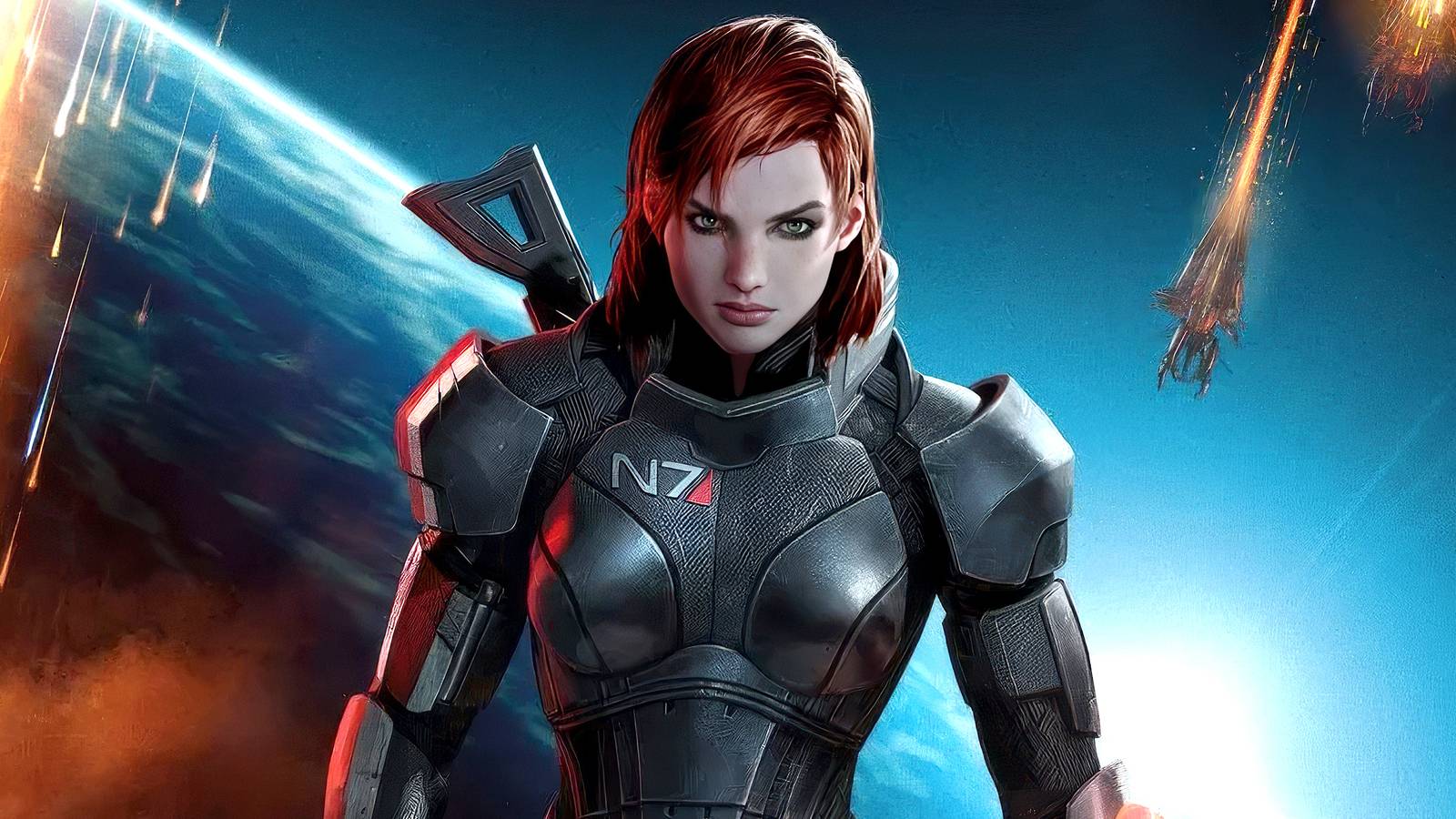
Image via BioWare Published Aug 10, 2026, 7:20 AM EDT Ryan Heffernan is a Senior Writer at Collider. Storytelling has been one of his interests since an early age, with his appreciation for film and television becoming a particular interest of his during his teenage years. This passion saw Ryan graduate from the University of Canberra in 2020 with an Honours Degree in Film Production. In the years since, he has found freelance work as a videographer and editor in the Canberra region while also becoming entrenched in the city's film-making community. In addition to cinema and writing, Ryan's other major interest is sport, with him having a particular love for Australian Rules football, Formula 1, and cricket. He also has casual interests in reading, gaming, and history. Sign in to your Collider account The rampant rise in the popularity of gaming has been one of the defining trends of entertainment culture in the 21st century. Increased accessibility to players and rapidly advancing technology in the field have been instrumental in this, but so too has the continuous evolution of storytelling in the format, which has the unique ability to place the audience—in this case, the gamer—in the middle of the narrative. Rather than being a passive observer, the player is cast as the major protagonist, with the game having to then find a balance between predetermined plot mechanics and meaningful interactivity that makes the gamer’s experience feel unique and impactful. The art of achieving this while delivering a compelling tale loaded with great plotting, memorable characters, and thematic resonance is not to be taken lightly, but it is one many games have perfected, with these 10 titles standing out as particularly well-written story-driven video games. 11 'Life is Strange' (2015) Image via Dontnod Entertainment Determining how to bridge the gap between the player and the protagonist, and then executing that approach, is a story design obstacle all narrative-driven games must face. While there is no shortage of ways it can be done, Life is Strange has emerged as a particularly noteworthy example of how to achieve such a task with elegance and impact as it crafts an emotionally absorbing mixture of adolescent angst and mystery suspense. Unfolding over five episodes, it sees gamers play as Max Caulfield (Hannah Telle), a photography student who discovers she has the ability to rewind time and uses the power to prevent tragedies and investigate a local girl’s disappearance. It’s time-reversing element works beautifully with the depth of the story, combining the raw vulnerability of the characters with a harrowing exploration of choice, action, and consequence. Also featuring one of the most emotionally arduous endings in video game history, Life is Strange excels as a triumph of character development and emotional depth in gaming narratives. 10 'Final Fantasy VI' (1994) Image via Square The entirety of the Final Fantasy series has been renowned for its fantasy storytelling and world-building, with the franchise producing several all-time great narrative games like the thematically-striking Final Fantasy VII and the inviting lightness of Final Fantasy IX. However, 1994’s Final Fantasy VI remains the gold standard of storytelling in the fantasy RPG genre, let alone in the video game series. Made unforgettable by its bold plot twists, it sees the tri-continental planet known as the World of Balance under threat by the cruel and expanding Gestahlian Empire. However, two-thirds of the way through the story, the emperor is betrayed by a sociopathic court magician who plunges the world into an apocalyptic chaos that leaves the heroes to salvage what little is left. Final Fantasy VI’s defiance of narrative conventions is inspiring, not only in its shocking story of the villain’s success, but in its ensemble of 14 playable characters, all of whom are defined by their own morals and unique backstories of grief, existential crisis, and redemption. 9 'The Witcher III: Wild Hunt' (2015) Image via CD Projekt It is frankly quite absurd just how many elements of gaming The Witcher 3: Wild Hunt manages to perfect. Its dark and complex world-building is faultless, its gameplay is a fluid mixture of pre-planned strategy and skill, and its monumental map and graphics remain awe-inspiring even 11 years on. All of these qualities are frequently cited as reasons why it is one of the greatest games of all time, and while the ceaseless praise is warranted, it does sometimes distract from just how brilliant the writing of the story is. The vast open-world fantasy adventure sees the player control Geralt (Doug Cockle) as he searches for Ciri (Jo Wyatt), his adopted daughter, who is being hunted by a powerful, evil entity throughout the war-ravaged bleakness of The Continent. Rejecting notions of good and evil, The Witcher 3: Wild Hunt revels in a space of challenging morality that thrives with the characters, circumstances, and world lore being so deftly defined in the writing. Considering even the side quests flaunt a moral gravitas that is challenging to navigate, The Witcher 3 delivers one of the most powerful and piercing stories in gaming history. 8 'Firewatch' (2016) Image via Campo Santo It is often the case in gaming that single-player stories take on a sense of epic gravitas and monumental stakes. Firewatch does things a little differently, and it conjures what is still one of the most beautiful and emotionally engrossing video game experiences of all time in the process. The player controls Henry (Rich Sommer), a fire lookout who accepts a job in the remote Wyoming wilderness to escape the reality of his wife’s early onset dementia. In the isolation, he forms a bond via walkie-talkie with a fellow lookout while stumbling upon a bizarre mystery. Even as the game plays with suspense in its mystery elements, Firewatch’s beating heart is the connection between Henry and Delilah (Cissy Jones), which is realized with what is possibly the greatest and most profoundly human dialogue ever written for a game. The player’s ability to shape Henry’s personality through dialogue choices and make the experience feel unique and personal is just an added bonus, while the sorrowful yet anti-climactic revelation of the mystery only accentuates Firewatch’s interest in grounded and messy realism over Hollywood-style sensationalism. 7 'Silent Hill 2' (2001) Image via Konami While it is a generalization, there are effectively two kinds of horror: funhouse thrills and psychologically-probing terror. Even the most sickening and traumatizing horror video games tend to lean into the fun vulgarity of the genre, but Silent Hill 2 extracts both visceral fear and harrowing dramatic conviction from its descent into the darkest depths of horror, a descent that is supported by commanding thematic poignancy and rich though disturbing symbolism. Players control James Sunderland (Guy Cihi) as a mysterious letter from his dead wife lures him to Silent Hill. The horrifying world that awaits him isn’t one of maniacal cults like other Silent Hill games feature, but a nightmare of his own mind realized with repressed desires, hidden sins, and the full breadth of complex feelings James accrued while caring for his terminally ill wife. The monsters gamers encounter are a raw and unfiltered reflection of James’ psyche, while the game’s multiple possible endings pry into the psychology of the player, leaning on ideas they emphasized in their playthrough to ensure their own priorities and James’ fate are intimately bound. 6 5 'The Walking Dead' (2012) Image via Telltale Games As both a major comic book series and a hit television show, The Walking Dead has become one of the biggest brands in modern pop-culture, particularly in the wheelhouse of zombie horror. Developed by Telltale Games, the video game expansion of Robert Kirkman’s comics is the best told story in the multimedia franchise, with the episodic adventure game taking place during the virus outbreak as a convicted criminal finds redemption by protecting a little girl. By emphasizing raw human drama and moral dilemmas over action violence, the game presents an emotionally absorbing journey of a desperate group’s strive for survival. Anchored by the brilliant dynamic between the flawed and ambiguous Lee (Dave Fennoy) and the innocence of young Clementine (Melissa Hutchison), The Walking Dead forces players to navigate a volatile and callous world while feeling the obligation to nurture a child’s worldview and survival instincts. Emotionally devastating and entirely immersive, The Walking Dead remains a triumph of storytelling in gaming thanks to its phenomenal writing, brilliant voice acting, and arresting atmosphere. 4 'God of War' (2018) Image via Sony Interactive Entertainment A shift from Greek mythology to Norse legends, and a significant pivot from hack-and-slash action to character-driven storytelling, 2018’s God of War marks a soft reboot that is acutely attentive to the franchise’s past. It follows Kratos (Christopher Judge), a Spartan warrior-turned-Greek God of War who, after his war against Olympus, emerged in ancient Scandinavia where he met his second wife. The game transpires in the wake of her death, as Kratos travels with his son to fulfill his wife’s dying wish while being hunted by the Æsir god, Baldur (Jeremy Davies). The storytelling is masterful in how it re-envisions Kratos, transforming him from a monstrous entity into a father trying to protect his son while hiding his past from him. The reinvention of the character enables the game to unfold with outstanding thematic depth. In Kratos’ desperation to keep his son from replicating the sins he committed, the combat in the game is imbued with a weighted emotional core as it deals with regret, generational trauma, coming-of-age, and the cyclical nature of violence through the lens of a beautiful and complex father-son relationship. 3 'The Last of Us' (2013) Image via Naughty Dog Thanks to HBO’s TV adaptation, the story of The Last of Us is perhaps the best-known video game narrative around the world. The fact that many of the best scenes from the show were shot-for-shot recreations of moments in the game is a testament to the mastery of Neil Druckmann’s writing, which perfectly conjures an engrossing and high-stakes sense of emotional drama as it follows world-weary survivor Joel (Troy Baker) as he is tasked with escorting Ellie (Ashley Johnson), a teenage girl immune to the mutating Cordyceps virus, across a post-apocalyptic America. Within a world of relentless danger, the narrative finds its beating heart in the absorbing bond between Joel and Ellie. Their surrogate father-daughter dynamic is handled with astute craft and emotional intelligence, with the game realizing both as psychologically complex characters in their own right, while making their relationship perfectly complimentary. Coupling this character-driven core with an atmosphere of terrifying intensity and suspense, The Last of Us thrives as an enrapturing masterclass in intimate storytelling. Collider Exclusive · Sci-Fi Survival Quiz Which Sci-Fi World Would You Survive? The Matrix · Mad Max · Blade Runner · Dune · Star Wars Five universes. Five completely different ways the future went wrong — or sideways, or up in flames. Only one of them is the world your instincts were built for. Eight questions will figure out which dystopia, galaxy, or desert wasteland you'd actually make it out of alive. 💊The Matrix 🔥Mad Max 🌧️Blade Runner 🏜️Dune 🚀Star Wars TEST YOUR SURVIVAL → 01 You sense something is deeply wrong with the world around you. What do you do? The first instinct is often the truest one. APull on every thread until I understand the system — then figure out how to break it. BStop asking questions and start stockpiling — food, fuel, weapons. Questions don't keep you alive. CKeep my head down, observe carefully, and trust no one until I know who's pulling the strings. DStudy the patterns. Every system has a rhythm — learn it, and you learn how to survive it. EFind the people fighting back and join them. You can't fix a broken galaxy alone. NEXT QUESTION → 02 In a world of scarcity, what resource do you guard most fiercely? What we protect reveals what we believe survival actually requires. AKnowledge. If you understand the system, you don't need resources — you can generate them. BFuel. Everything else — movement, power, escape — runs on it. CTrust. In a world of fakes and informants, a truly reliable ally is rarer than any commodity. DWater. And after water, information — the two things empires are truly built on. EShips and credits. The galaxy is big — you survive it by being able to move through it freely. NEXT QUESTION → 03 What kind of threat keeps you up at night? Fear is useful data — if you're honest about what you're actually afraid of. AThat reality itself is a lie — that everything I experience has been constructed to keep me compliant. BA raid. No warning, no mercy — just the roar of engines and then nothing left. CBeing identified. Once someone with power decides you're a problem, you're already out of time. DBeing outmanoeuvred — losing a political game I didn't even know I was playing. EThe Empire tightening its grip until there's nowhere left to run. NEXT QUESTION → 04 How do you deal with authority you don't trust? Every dystopia has a power structure. Your approach to it determines everything. ASubvert it from the inside — learn its rules well enough to weaponise them against it. BIgnore it and stay out of its reach. The further from any power structure, the better. CAppear to comply while doing exactly what I need to do. Visibility is the enemy. DManoeuvre within it carefully. You can't beat a system you refuse to understand. EResist openly when I have to. Some things are worth the risk of being seen. NEXT QUESTION → 05 Which environment could you actually endure long-term? Survival isn't just tactical — it's physical, psychological, and very much about where you are. AUnderground bunkers and server rooms — cramped, artificial, but with access to everything that matters. BOpen wasteland — brutal sun, no shelter, constant movement. At least the threat is honest. CA dense, rain-soaked city where you can disappear into the crowd and nobody asks questions. DMerciless desert — extreme heat, no water, and something enormous living beneath the sand. EThe fringe — backwater planets and busy spaceports where the Empire's attention rarely reaches. NEXT QUESTION → 06 Who do you want in your corner when things fall apart? The company you keep is the clearest signal of who you actually are. AA tight crew of believers who've seen behind the curtain and have nothing left to lose. BOne or two people I'd trust with my life. Any more than that and someone talks. CNobody, ideally. Alliances are liabilities. I work alone unless I have no choice. DA community bound by shared hardship and mutual survival — people who need each other to last. EA ragtag team with wildly different skills and total commitment when it counts. NEXT QUESTION → 07 Where do you draw the line — if you draw one at all? Every survivor eventually faces a moment that tests what they're actually made of. AI won't harm the innocent — even the ones who'd report me without hesitation. BI do what I have to to protect the people I've chosen. Everything else is negotiable. CThe line shifts depending on who's asking and what's at stake. DI draw a long-term line — nothing that compromises my people's future, even if it'd help now. ESome lines, once crossed, can't be uncrossed. I know which ones they are. NEXT QUESTION → 08 What would actually make survival worth it? Staying alive is one thing. Having a reason to is another. AWaking others up — dismantling the illusion so no one else has to live inside it. BFinding somewhere — or someone — worth protecting. A reason to keep moving. CAnswers. Understanding what I am, what any of this means, before time runs out. DLegacy — shaping the future in a way that outlasts me by generations. EFreedom — for myself, for others, for every world still living under someone else's boot. REVEAL MY WORLD → Your Fate Has Been Calculated You'd Survive In…Your answers point to the world your instincts were built for. This is the universe your temperament, your survival instincts, and your particular brand of stubbornness were made for. The MatrixYou took the red pill a long time ago — probably before anyone offered it to you. You're a systems thinker who can't help but notice the seams in things. You're drawn to understanding how the system works before figuring out how to break it. You'd find the Resistance, or it would find you — your instinct for spotting constructed realities is the machines' worst nightmare. You function best when you have access to information and the freedom to act on it. The Matrix built an airtight prison. You'd be the one probing the walls for the door. Mad MaxThe wasteland doesn't reward the clever or the well-connected — it rewards those who are hard to kill and harder to break. That's you. You don't need comfort, community, or a cause larger than the next horizon. You need a vehicle, a clear threat, and enough fuel to outrun it — and you're good at all three. You are unsentimental enough to survive that world, and decent enough — just barely — to be something more than another raider. In the wasteland, that distinction is everything. Blade RunnerYou'd survive here because you know how to exist in moral grey areas without losing yourself completely. You read people accurately, keep your circle small, and ask the questions others prefer not to answer. In a city where humanity is a legal designation rather than a feeling, you hold onto something that keeps you functional. You're not a hero. But you're not lost, either. In Blade Runner's world, that distinction is everything. DuneArrakis is the most hostile environment in the known universe — and you are precisely the kind of person it rewards. Patience, discipline, and political awareness are your core strengths — and on Arrakis, they're survival tools. You understand that the long game matters more than any single victory. Others come to Dune and are consumed by it. You'd learn its logic and earn its respect. In time, you wouldn't just survive Arrakis — you'd begin to reshape it. Star WarsThe galaxy far, far away is vast, loud, and in a constant state of violent political upheaval — and you wouldn't have it any other way. You find meaning in being part of something larger than yourself — a cause, a crew, a rebellion. You'd gravitate toward the Rebellion, or the fringes, or whatever pocket of the galaxy still believes the Empire's grip can be broken. You fight — not because you have to, but because standing aside isn't something you're capable of. In Star Wars, that willingness is what makes all the difference. ↻ RETAKE THE QUIZ 2 'Mass Effect' Trilogy (2007-2012) Image via BioWare Sci-fi adventure has been a great source of propulsive storytelling in gaming, with the Halo series and Cyberpunk 2077 just some of the more noteworthy titles in this genre. While both of those gaming brands have exceptional storytelling, the Mass Effect trilogy is an unrivaled masterpiece in this regard. The three games deliver one holistic story following Commander Shepard (Mark Meer/Jennifer Hale), an elite human soldier in a distant future tasked with rallying alien factions to stand against the Reapers, an ancient mechanical evil devouring all life they encounter. With the second and third games remembering the save data from their predecessors, Mass Effect runs seamlessly as a fluid, epic story of survival and war that transpires on an intergalactic scale. The player’s actions and dialogue decisions have huge ramifications on how the story unfolds, a feat that masterfully combines emotional intimacy with political intrigue, enthralling lore, and weighted stakes.
10 Story-Driven Video Games That Are Perfectly Written
Full Article
Original Source
Read the full article at Collider →KhanList aggregates and links to publicly available news content. We do not host full articles from third-party sources. Always verify important information with original sources.