
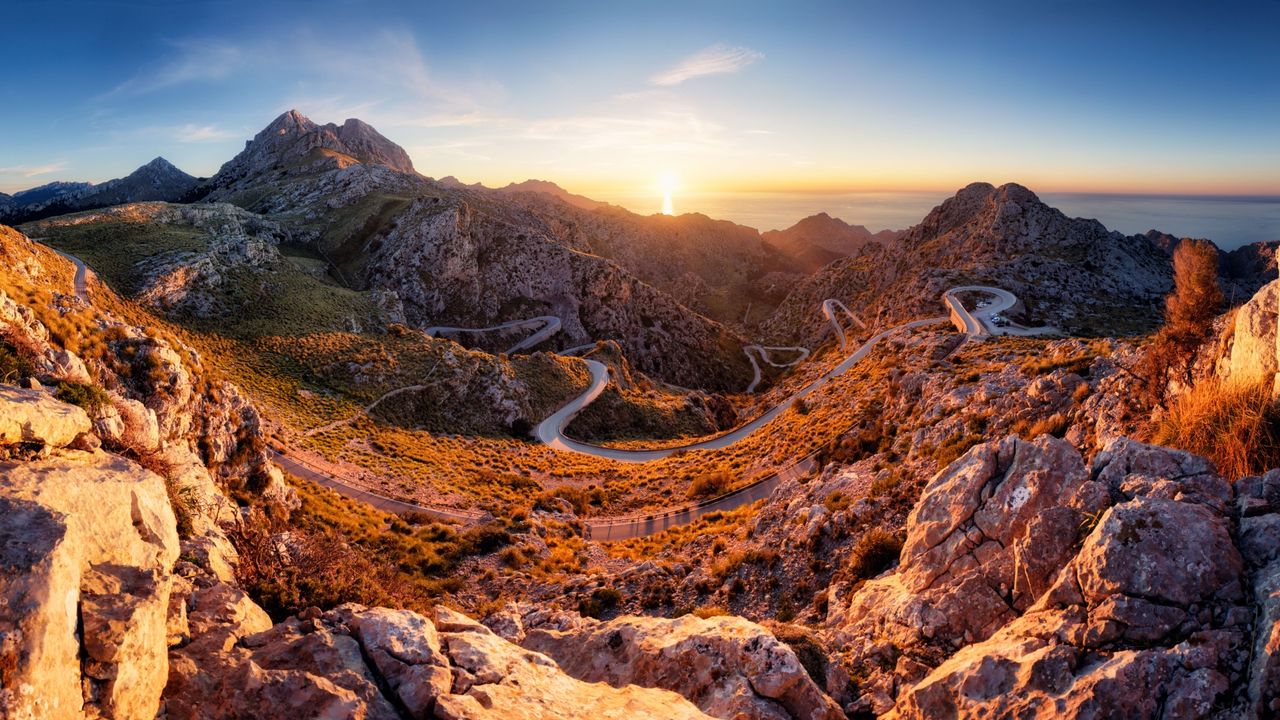
On these roads, the destination is less important than the journey as every mile offers scenic vistas.Getty ImagesEurope’s many scenic coastal road trips are reminders that travel is about more than just reaching the next destination. Some of these roads wind their way along dramatic cliffs where the waves crash against the shore, while others pass by placid and pristine beaches, cross bridges that are engineering wonders, and connect remote fishing villages untouched by the passage of time. On these routes the landscape is constantly changing, and it’s hard to resist the temptation to pull over to the side of the road, again and again, to gaze at the beautiful landscapes in front of you.For many of us, driving is synonymous with freedom, adventure, and an enthusiastic embrace of our wanderlust. When you’re behind the wheel, you can choose where you want to stop and when to take a detour off the beaten path to discover a remote site or an unexpected experience that might turn out to be the highlight of your trip. Sitting in your car, or on a motorcycle, the miles unfold before you like a film, perhaps with your favorite road trip playlist serving as a soundtrack. As your mind wanders to distant places, your vehicle will carry you to them. It’s arguably travel in its most liberating and intoxicating form.Driving along one of these coastal roads includes opportunities to discover hidden lookouts, remote lighthouses, inaccessible coves, and restaurants where you can watch fishing boats arrive in a quiet harbor to unload their daily catch that is then headed straight for your plate. Another bonus: the views along these routes change with the seasons, but they are stunning year-round.Below, find our picks for the 10 best coastal road trips in Europe where there's scenic vistas awaiting at the end of every turn.Nus de sa Corbata (which in Mallorquí translates to, "the knot of the tie"), a landmark on Mallorca’s highway Ma-2141 in Spain Getty ImagesHighway Ma-2141 from Coll dels Reis to Sa Calobra, Mallorca, SpainSome roads are impressive thanks to the stunning landscapes they pass through; others are remarkable feats of engineering. Spain’s Ma-2141, which descends from Coll dels Reis to the cove of Sa Calobra, in the coastal Serra de Tramuntana on Mallorca, asks “Por qué no los dos?” In a distance of just over six miles, it covers an elevation difference of more than 2,000 feet along a route that feels like it was etched into the side of the mountain.The route is an almost uninterrupted succession of hairpin bends, stunning lookout points, and limestone cliffs that drop vertically down into the valley below. Its most famous spot is the Nus de sa Corbata, a 270-degree spiral curve where the road loops back over itself thanks to an ingenious bridge—a unique solution that has become an icon of this scenic drive.During the course of the descent to the sea, the landscape changes constantly. Pine forests give way to steep slopes and gorges with the deep-blue Mediterranean visible in the distance. On the drive to Sa Calobra one turn may offer a view of a small cove with crystal-clear waters, and then a few minutes farther on, you’ll come to the Torrent de Pareis, an impressive rocky canyon that ends at the water’s edge.Driving this road requires attention and a steady hand at the wheel, especially during peak season when it’s also a popular cycling route. However, making this journey first thing in the morning or at sunset is an especially memorable experience. More than a mere coastal road, it’s a masterpiece of engineering set within a spectacular Mediterranean landscape.A stretch of Norway’s Atlantic Ocean Road Getty ImagesThe Atlantic Ocean Road, NorwayFew roads have become tourist icons as quickly as Norway’s Atlantic Ocean Road (Atlanterhavsvegen) which opened in 1989. The core section of the road is only five miles long, but the longer National Scenic Route extends for 22.4 miles connecting Karvag (on the outskirts of the town of Kristiansund) and Bud. Along the way, it winds through a landscape of islands, reefs, and small fishing communities linked by eight bridges and several causeways that seem to float above the ocean.The best-known section is the Storseisundet Bridge, with a dramatic profile that creates an interesting optical illusion. (While from a distance, it may look like you’ll plunge into the sea as you cross the bridge, it is completely safe!) The true charm of the route, however, lies in driving between the open sea and the rugged and irregular coastline of northwestern Norway. On one side, grassy islets and small fishermen’s cottages come into view; on the other, the Atlantic constantly changes color and mood depending on the wind and the light.The road is one of 18 National Scenic Routes in Norway and features numerous lookouts and rest areas to help travelers take in the scenery. On stormy days, the waves crash against the bases of its bridges with an impressive force. When the sea is calm, the drive takes on a serene and mesmerizing beauty.In addition to admiring the wild landscapes of this part of Norway, a drive on the road offers excellent opportunities for birdwatching, fishing, and exploring small coastal villages where daily life remains closely tied to the ocean.The Cliffs of Moher on Ireland’s west coast overlook the Atlantic Getty ImagesThe Wild Atlantic Way, IrelandThe Wild Atlantic Way runs for 1,553 miles on Ireland’s west coast, but one of the most famous stretches is the section that links the small port of Doolin with the dramatic Cliffs of Moher.The Atlantic completely dominates the landscapes of this part of Ireland. As the road winds through green pastures bordered by stone walls, the ocean is a constant presence, visible in the distance. Sheep graze alongside the road—and sometimes cross in front of vehicles moving at their own leisurely pace.The Cliffs of Moher, one of Ireland’s greatest natural landmarks, rise to heights of more than 700 feet above the sea. The road also includes many less famous spots—small, hidden beaches, ancient fortifications, and cozy pubs where traditional music remains a part of everyday Irish life.Driving under Ireland’s ever-changing skies, where the sun can give way to rain several times an hour, is part of the charm of this wild coastline.Loch Torridon in Scotland Getty ImagesNorth Coast 500, ScotlandThe North Coast 500—a 516-mile route across northern Scotland which —has become one of Europe’s great scenic drives since its launch in 2015. One of its most spectacular stretches runs between the towns of Applecross and Torridon.The route crosses the famous Bealach na Bà, one of the most challenging mountain passes in the British Isles. At its highest point, there are extraordinary panoramic views of the sea and the peaks of the Highlands, before the begins a descent to the sea with many hairpin turns.The route continues along a rugged stretch of coastline dotted with white-sand beaches, small and nearly deserted coves, and mountains that seem to soar directly out of the ocean. The sense of solitude here is powerful, especially if you drive the road at any time other than the brief peak summer season.A view of the Amalfi coast from the Amalfitana SS163 highway in Italy Getty ImagesAmalfitana SS163, ItalyThe Italian highway that connects Sorrento with Vietri sul Mare is one of the most famous in Europe, and also one of the most spectacular. The SS163 winds its way along cliffs that plunge into the Tyrrhenian Sea.Every curve of the 30-mile route offers another postcard-perfect view. You’ll see terraces planted with lemon trees, villages with houses perched above the sea, and small beaches hidden among the cliffs. Positano, Amalfi, and Ravello alone are worth the trip, though much of the charm lies simply in driving slowly and watching the landscape change with every passing mile.In the summer, traffic can be heavy, but during the spring and fall, the experience is more relaxed. Temperatures remain pleasant, the colors of the Mediterranean are just as vibrant, and it’s easier to pull over at the numerous scenic overlooks.The Franjo Tuđman Bridge on Highway D8 in Croatia crosses over the Rijeka Dubrovačka estuary. Getty ImagesThe Adriatic Highway (Highway D8), CroatiaThe D8, popularly known as the Adriatic Highway, runs along much of Croatia’s coast and offers views of some of the most beautiful scenery in the eastern Mediterranean. The stretch between Zadar and Dubrovnik is particularly spectacular with its combination of sea, mountains, and an endless string of islands.Most of the highway runs close to the water’s edge, passing through fishing villages and looking out towards the Dalmatian archipelago. Along the way, you’ll encounter towns such as Šibenik, Trogir, Split, and Makarska, all of which have lively historic centers.One of the highlights of the journey comes as you approach Dubrovnik. The city rises up against the sea like a vision, especially at sunset, when the stone walls take on golden hues.It’s an ideal route for enjoying a mix of scenic driving, beaches, and sightseeing without having to cover long distances each day.A bridge crossing the Arade River connects Portimão and Lagos in Portugal. Getty ImagesNacional 125 Highway, PortugalThe N125 highway runs through Portugal’s Algarve region from east to west, offering an opportunity to explore the country’s southern coast at a leisurely pace. Although it veers slightly inland in some sections, most of it passes besides beaches, cliffs, and fishing villages that make this one of the most appealing road trips on the Iberian Peninsula.Begin your journey among the white houses and the peaceful atmosphere of the charming town of Tavira and then continue alongside the lagoons and sandbars of the Ria Formosa Natural Park. One after the next, you’ll enter towns such as Olhão, Faro, Albufeira, and Lagos, each with its own distinct character. You can explore traditional fishermen’s quarters, wander along lively marinas filled with yachts, and get lost in historic centers with cobblestone streets.As the route approaches the western tip of the Algarve, the landscape changes completely. Long, golden beaches give way to imposing limestone cliffs and headlands battered by the Atlantic. The finale in the popular surf town of Sagres is particularly spectacular, with sunsets at the nearby Cape St. Vincent a highlight.This is a drive to take slowly, stopping frequently to explore small coves, admire the rock formations at places like Ponta da Piedade, and enjoy meals with ocean views.The Corniche d’Or on France’s Mediterranean coast Getty ImagesCorniche d’Or, FranceUnlike some more developed parts of the French Riviera, along the Corniche d’Or you can still immerse yourself in nature. The pine trees reach almost to the water’s edge, and the many curves on the route create a constantly changing spectacle.This road is best enjoyed outside of the peak summer season, when there’s less traffic and a tranquil atmosphere returns to this part of the coast.Iceland’s Ring Road Getty ImagesRing Road, IcelandIceland’s Route 1 circles the entire island, but the stretch between Vík and Höfn, on the southern coast, is in a league of its own with its otherworldly landscape. The road winds its way by gigantic glaciers, black-sand beaches, lava fields, and glacial lagoons dotted with icebergs. Jökulsárlón, probably the most famous of these lagoons, offers one of the continent’s most breathtaking natural spectacles. Make sure to also stop and admire its little sister, Fjallsárlón, which is more tranquil and features an immense ice wall rising from the dark water.The scale of this part of Iceland feels immense. You’ll drive for miles while seeing hardly any signs of civilization, while the horizon is dominated by ice-capped mountains in one direction and the North Atlantic in the other. Few European roads offer such an intense sense of adventure.The Bay of Kotor, Montenegro Getty ImagesE65 between Herceg Novi and Kotor, MontenegroThe Bay of Kotor (also called the Gulf of Kotor) appears like a Scandinavian fjord that somehow ended up off of the Adriatic Sea. The drive along the Highway E65 which connects Herceg Novi with Kotor doesn’t take long—less than 90 minutes if you don’t stop—but it is an extraordinarily photogenic route.In this part of Montenegro, the sea cuts its way between rugged mountains, creating a dramatic landscape complete with churches on the water’s, small piers jutting into the bay, and towns like Perast, which has been called “Montenegro’s prettiest village.”The arrival in Kotor is especially memorable. The fortified city—a UNESCO World Heritage Site—is ringed by medieval walls appearing like a scene from another era.This story was originally published by Condé Nast Traveler Spain. It was translated by John Newton.Why Everyone Will Be Going to Osaka in 2025Nací junto al mar, en Alicante, un año antes del estreno mundial de 'Star Wars', por lo que me gusta seguir pensando que fui el primer Jedi. Con imaginación desbordante desde niño y una extraña, e incurable, adicción al peligro y la exploración conseguí abrirme la cabeza tres veces antes ... Read More
10 Scenic Coastal Road Trips in Europe, From Norway to Croatia
Full Article
Original Source
Read the full article at Cntraveler →KhanList aggregates and links to publicly available news content. We do not host full articles from third-party sources. Always verify important information with original sources.