
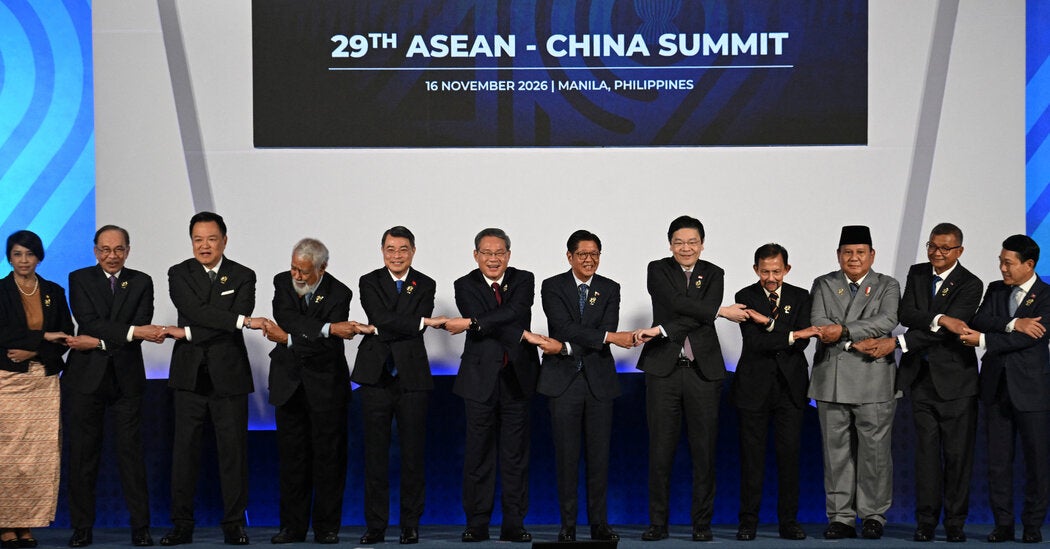
AdvertisementSKIP ADVERTISEMENTFrom semiconductor dominance to new power grids, defense deals and K-pop, the region — beyond China — is becoming increasingly interconnected and self-reliant.Political leaders pose during the Association of Southeast Asian Nations summit in Manila on Monday.Credit...Pool photo by Ted AljibeNov. 16, 2026, 4:00 p.m. ETPresident Trump’s trip to Asia this week will be largely be seen as a test of American power in the main region where the United States and China compete for influence.His meetings in Manila and Shenzhen, China, will be scrutinized for shifts on trade and security. Deals he might strike with Beijing — plus a gathering with President Xi Jinping of China and President Vladimir V. Putin of Russia — will put the world’s great-power contest on display, as all three seek to show strength.But Asia is not just a theater of competition. Many countries in the region have become wealthier, more technologically advanced and increasingly interconnected. Especially now, as China’s military becomes more threatening and the United States less reliable, they are hedging against greatness and relying more on neighbors.Asian students and workers are moving to neighboring states. Countries with expanding defense industries are selling weapons to new partners. Nations that compete for high-tech investment are even making plans to cooperate on energy and cybersecurity.“They’re all looking at what more they can do together when the great powers are behaving so badly,” said Ted Osius, a former U.S. ambassador to Vietnam and adjunct professor of geopolitics at Fulbright University in Ho Chi Minh City. “If you’re a middle power, you’re thinking ‘I need more options’.”Here are a few numbers that provide a sense of what the region contributes to the global economy, and how its nations are becoming more bound together to shape the world.700 million …The population of the 11 nations that make up the Association of Southeast Asian Nations, a regional grouping that is holding its annual summit in Manila. ASEAN approved a digital framework agreement on Saturday that aims to create a multilateral digital market. If it rolls out smoothly next year, a small business in Vietnam could sell and ship products to Singapore with invoices, payment and customs handled through a regional online system.$70.77 billion …The value of the Asia-Pacific market for medical tourism — the world’s largest. With portable insurance and medical visas, it’s becoming common to travel for better or more affordable cancer care, orthopedics, dentistry or cosmetic surgery. Life expectancy in high-income countries (like Japan) is around 84, compared with 79.8 in the United States, where health care costs are roughly twice as high.75 percent …The share of the world’s semiconductor chips that are manufactured in Asia. Without China, about 55 to 60 percent are made in Asia, led by South Korea and Taiwan, which makes more than 90 percent of the world’s high-end chips. The global market is worth roughly $1.5 trillion.6 out of 10 …The number of top-grossing musical acts in Asia that were K-pop performers from August 2025 to July 2026. The top four earners for live shows in Asia were all K-pop stars, with Seventeen topping the list. Lady Gaga ranked fifth in the region.33 …The number of universities in the Asia-Pacific region in the QS global top 100. Among them are 11 in mainland China and Hong Kong, plus nine in Australia. There are 37 in Europe and 26 in the United States.1.7 billion …The number of airline passenger journeys across the Asia-Pacific, excluding China, in 2024. Driven by booming demand in India and Southeast Asia, regional traffic is projected to more than double to 4.1 billion passengers over the next two decades.$630 million …The approximate cost of Indonesia’s recent deal to buy India’s BrahMos supersonic missile systems for coastal defense. India has inked similar deals with Vietnam and the Philippines, as the region seeks alternatives to expensive Western weapons systems.2,499 …The total number of Uniqlo stores worldwide, up from 1,795 in 2016. Even as its retail footprint in China has declined, growth in Southeast Asia, India and Australia has continued. The Japanese fashion brand is now one of the world’s fastest growing clothing retailers.3.65 million …The number of Japanese visits to South Korea in 2025 — a record for two countries that have been gradually overcoming a long history of resentment. The curiosity goes both ways: Koreans also set a record for trips to Japan last year, with 9.46 million visits.18 …The number of cross-border energy projects planned among ASEAN countries. With high-voltage lines on land and plans for some of the longest power cables ever to be placed underwater, the goal is to more than double transmission capacity and to pave the way for a multilateral power market that is more reliant on renewable energy, like hydropower.Damien Cave leads The Times’s new bureau in Ho Chi Minh City, Vietnam, covering shifts in power across Asia and the wider world.Related ContentAdvertisementSKIP ADVERTISEMENT
10 Numbers That Might Change How You See Asia
Full Article
Original Source
Read the full article at Nytimes →KhanList aggregates and links to publicly available news content. We do not host full articles from third-party sources. Always verify important information with original sources.