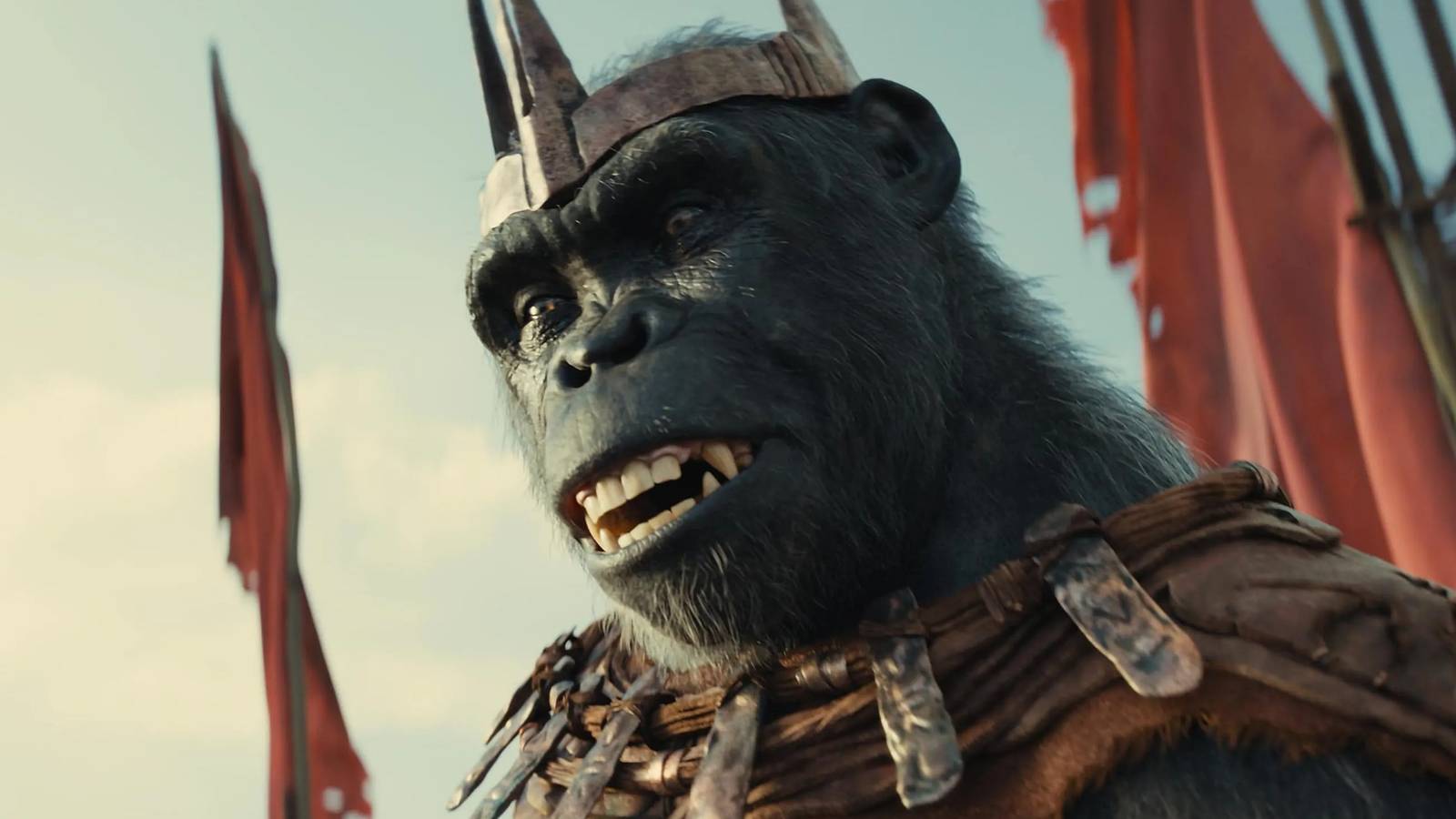
Image via 20th Century Studios Published Aug 15, 2026, 1:09 PM EDT Marcel is a writer who is passionate about most movies and series. He will watch anything that's good. He is a content manager by day and a videographer when needed. Marcel used to work at a major streaming service based in Asia Pacific as a Content Specialist and was the Distribution Manager for a local movie distribution company. Sign in to your Collider account Computer-generated imagery has been inseparable from blockbuster filmmaking today. It has completely transformed what is possible in filmmaking. From dinosaurs to massive superhero battles, CGI has become one of the most important tools in modern cinema. But as the technology becomes commonly used, not all of them are perfect. The best CGI are also the kind that takes time to create. With the increasingly demanding release calendar, sometimes even the biggest title can have an unconvincing effect. Here, we take a look at some movies with the most perfect CGI. They range from enormous blockbusters filled with digital creatures and fantastical environments to relatively grounded films that use CGI for something as simple as extending a set. All the movies on this list have an extraordinary attention to detail that transports the audience to the movies themselves. These movies may be decades old, but the effects still hold up until today. Image via Sony Pictures Releasing The Social Network follows Mark Zuckerberg (Jesse Eisenberg) as he creates Facebook with his friends from his Harvard dorm room. While he initially develops the website with his friend Eduardo Saverin (Andrew Garfield), Mark becomes embroiled in a lawsuit with the Winklevoss twins and eventually with Saverin himself as his ambitions leave behind the relationships that he has. The Social Network is not a Hollywood blockbuster where computer-generated characters are the main draw. However, there are reportedly over a thousand VFX shots in this film, more than a typical blockbuster film. The CGI employed in The Social Network is so perfect that you barely notice. The most noticeable one is obviously the Winklevoss' twins. Armie Hammer appears as both twins, with Josh Pence performing one twin physically and Hammer's face being digitally transferred onto Pence for much of the film. However, there are also other CGI effects, like augmenting sets or even adding cold breaths. David Fincher's films are famous for adding these invisible CGI effects that support his perfectionist vision. 9 'Inception' (2010) Image via Warner Bros. Pictures Inception follows Dom Cobb (Leonardo DiCaprio), an extractor who enters people's dreams and steals information from their subconscious. Offered the chance to have his criminal record erased, Cobb accepts an almost impossible assignment to perform an inception, which is to plant an idea instead of stealing one. With the help of an experienced crew, he dives into the subject's multiple dream layers to make sure the idea sticks. Different with The Social Network, Inception uses many practical effects and then perfects them with CGI, creating a smooth transition. The Paris bridge sequence where Cobb explains the mechanics to Ariadne, for example, has real mirrors to show the neverending corridor, and then with effects, it becomes seamless, while the zero-gravity sequence combines mechanical rigs with carefully controlled digital manipulation. The CGI is integrated into photography rather than overwhelming it, matching the film's lighting, camera movement, textures, and physical imperfections. This principle has guided Christopher Nolan's approach to effects in his movies. 8 'Titanic' (1997) Image via Paramount Pictures Titanic tells the doomed love story between Rose DeWitt Bukater (Kate Winslet), a young woman trapped within the suffocating expectations of upper-class society, and Jack Dawson (Leonardo DiCaprio), a poor artist who has won his ticket aboard the Titanic in a poker game. Their relationship develops aboard the ship while Rose's engagement to Cal Hockley (Billy Zane) becomes toxic. Everything changes when Titanic strikes an iceberg, and they all try to survive the nightmare. The effects were revolutionary because James Cameron combined practical miniatures, full-scale sets, motion-control photography, digital environments, CG passengers, digital water, and extensive compositing rather than relying on one technique. During the sinking, real actors and stunt performers interact with practical sets which is then combined with the CGI to create the unforgettable spectacle. Digital Domain, the main effects house, created CG extensions for the ship, water and smoke effects as well as numerous digital people as extras. It's a film that's always engrosses audiences whenever it plays on TV or is re-released in theaters, and the effects still hold up today. Collider Exclusive · Oscar Best Picture Quiz Which Oscar Best PictureIs Your Perfect Movie? Parasite · Everything Everywhere · Oppenheimer · Birdman · No Country Five Oscar Best Picture winners. Five completely different visions of what cinema can be — and what it can do to you. One of them is the film that was made for the way your mind works. Ten questions will figure out which one. 🪜Parasite 🌀Everything Everywhere ☢️Oppenheimer 🐦Birdman 🪙No Country for Old Men FIND YOUR FILM → 01 What kind of film experience do you actually want? The best movies don't just entertain — they leave something behind. ASomething that pulls the rug out — that makes me think I'm watching one kind of film and then reveals I'm watching another entirely. BSomething overwhelming — funny, sad, absurd, and genuinely moving, all at once. CSomething grand and weighty — a film that makes me feel the full scale of what I'm watching. DSomething formally daring — a film that pushes what cinema can even do. ESomething lean and relentless — pure tension with no wasted frame. NEXT QUESTION → 02 Which idea grabs you most in a film? Great films are driven by a central obsession. What's yours? AClass, inequality, and what people are willing to do when desperation meets opportunity. BIdentity, family, and the chaos of trying to hold your life together when everything is falling apart. CGenius, moral responsibility, and the catastrophic weight of a decision you can never take back. DEgo, legacy, and the terror of becoming irrelevant while you're still alive to watch it happen. EEvil, chance, and whether moral order actually exists or if we just tell ourselves it does. NEXT QUESTION → 03 How do you like your story told? Form is content. The way a story is shaped changes what it means. AGenre-twisting — I want it to start in one lane and migrate into something completely different. BMaximalist and genre-blending — comedy, action, drama, sci-fi, all in one ride. CEpic and non-linear — cutting between timelines, building a mosaic of cause and consequence. DA single unbroken flow — I want to feel like I'm living it in real time, no cuts to safety. ESpare and precise — every scene doing exactly what it needs to do and nothing more. NEXT QUESTION → 04 What makes a truly great antagonist? The opposition defines the protagonist. What kind of opposition fascinates you? AA system — invisible, structural, and almost impossible to fight because it has no single face. BThe self — the ways we sabotage, abandon, and fail the people we love most. CHistory — the unstoppable momentum of events that no single person can stop or redirect. DThe industry — the machinery of culture that chews up talent and spits out irrelevance. EPure, implacable evil — a force so certain of itself it becomes almost philosophical. NEXT QUESTION → 05 What do you want from a film's ending? The final note is the one that lingers. What do you want it to sound like? AShock and inevitability — a conclusion that recontextualises everything that came before it. BEarned emotion — I want to cry, laugh, and feel genuinely hopeful, even if the world is a mess. CDevastation and grandeur — an ending that makes me sit in silence for a few minutes after. DAmbiguity — something that leaves enough open that I'm still thinking about it days later. EBleakness — an honest refusal to pretend the world is tidier than it actually is. NEXT QUESTION → 06 Which setting pulls you in most? Where a film takes place shapes everything — mood, stakes, what's even possible. AA gleaming modern city with a hidden underside — beauty masking rot, wealth masking desperation. BA collapsing suburban life that opens onto something infinite — the multiverse of a single ordinary person. CThe corridors of power and science at a world-historical turning point — where decisions echo for decades. DThe grimy, alive chaos of New York and Hollywood — fame as both destination and trap. EVast, indifferent landscape — desert and highway where violence arrives without warning or reason. NEXT QUESTION → 07 What cinematic craft impresses you most? Every great film has a signature — a technical or artistic element that makes it unmistakable. AProduction design and mise-en-scène — every frame composed to carry meaning beneath the surface. BEditing and tonal control — the ability to move between registers without losing the audience. CScore and sound design — music that becomes inseparable from the dread and awe of what you're watching. DCinematography as performance — the camera not recording events but participating in them. ESilence and restraint — what's left unsaid and unshown doing more work than any dialogue could. NEXT QUESTION → 08 What kind of main character do you root for? The protagonist is the lens. Who you choose to follow says something about you. ASomeone smart and resourceful who makes increasingly dangerous decisions under pressure. BSomeone overwhelmed and ordinary who turns out to be capable of something extraordinary. CA brilliant, tortured figure whose gifts and flaws are inseparable from each other. DA self-destructive artist whose ego is both their superpower and their undoing. EA quiet, principled person trying to make sense of a world that has stopped making sense. NEXT QUESTION → 09 How do you feel about a film that takes its time? Pace is a choice. Some films sprint; others let tension accumulate slowly, deliberately. AI love a slow build when I know the payoff is going to be seismic — patience for a devastating reveal. BGive me relentless momentum — I want to feel breathless and emotionally spent by the end. CEpic runtime doesn't scare me — if the material demands three hours, give me three hours. DI want it to feel propulsive even when nothing is technically happening — restless energy throughout. EDeliberate and unhurried — I want dread to accumulate in the spaces between the action. NEXT QUESTION → 10 What do you want to feel walking out of the cinema? The best films leave a mark. What kind of mark do you want? AUnsettled — like I've just seen something I can't fully explain but can't stop thinking about. BMoved and energised — like the film reminded me what actually matters and gave me something to hold onto. CHumbled — like I've been in the presence of something genuinely important and overwhelming. DExhilarated — like I've just seen cinema doing something it's never quite done before. EHaunted — like a cold, quiet dread that stays with me for days. REVEAL MY FILM → The Academy Has Decided Your Perfect Film Is…Your answers have pointed to one Oscar Best Picture winner above all others. This is the film that was made for the way your mind works. ParasiteYou are drawn to films that operate on multiple levels simultaneously — that begin in one genre and quietly, brilliantly migrate into another. Bong Joon-ho's Parasite is a film about class, desire, and the architecture of inequality that manages to be darkly funny, deeply suspenseful, and genuinely shocking across a single extraordinary running time. Your instinct is for cinema that hides its true intentions until the moment it's ready to reveal them. Parasite is exactly that — a film that rewards close attention and punishes assumptions, right up to its devastating final image. Everything Everywhere All at OnceYou want it all — and this film gives you all of it. The Daniels' Everything Everywhere All at Once is one of the most maximalist films ever made: action comedy, multiverse sci-fi, family drama, existential crisis, and a genuinely earned emotional core that sneaks up on you amid the chaos. You are someone who responds to ambition, who doesn't want cinema to choose between being entertaining and being meaningful. This film refuses that choice entirely. It is overwhelming by design, and its overwhelming nature is precisely the point — because the feeling of being crushed by infinite possibility is exactly what it's about. OppenheimerYou are drawn to cinema on a grand scale — films that understand history not as a backdrop but as a force, and that place their characters inside that force and watch what happens. Christopher Nolan's Oppenheimer is a film about the terrifying gap between what we can do and what we should do, told with the full weight of one of the most consequential moments in human history behind it. You want your films to feel important without feeling self-important — to earn their ambition through sheer craft and the gravity of their subject. Oppenheimer does exactly that. It is enormous, complicated, and refuses easy comfort. BirdmanYou are drawn to films that foreground their own construction — that make the how of the filmmaking part of the what it's about. Alejandro González Iñárritu's Birdman, shot to appear as a single continuous take, is cinema examining itself through the cracked mirror of a fading actor's ego. You respond to formal daring, to the feeling that a film is doing something that probably shouldn't be possible. Michael Keaton's performance and Emmanuel Lubezki's restless camera create something genuinely unlike anything else — a film that is simultaneously about creativity, relevance, self-destruction, and the impossibility of ever truly knowing if your work means anything at all. No Country for Old MenYou are drawn to cinema that trusts silence, that refuses to explain itself, and that treats dread as a form of meaning. The Coen Brothers' No Country for Old Men is a film about the arrival of a new kind of evil — implacable, arbitrary, and utterly indifferent to the moral frameworks we use to make sense of the world. It is one of the most formally controlled films ever made, and its controlled restraint is what makes it so terrifying. You want your films to haunt you, not comfort you. You are not interested in resolution if resolution would be dishonest. No Country for Old Men is honest in a way that most cinema never dares to be. ↻ RETAKE THE QUIZ 7 'Godzilla Minus One' (2023) Image via Toho Set in post World War II Japan, Godzilla Minus One centers on Shikishima (Ryunosuke Kamiki), a former kamikaze pilot who returns home traumatized and burdened by guilt. He begins rebuilding his life with Noriko (Minami Hamabe) and an orphaned child, only for Japan's fragile recovery to be shattered by the arrival of Godzilla. Trying to make a change, he joins the people's movement to fight the monster. A recent Oscar winner, Godzilla Minus One is remarkable for accomplishing the visual effects needed in the film with a crew of only around 35 artists, which includes director Takashi Yamazaki himself. The artists built a highly detailed model, with the final asset involving billions of polygons that were converted into displacement maps for rendering. More importantly, Godzilla is animated with a sense of weight and anatomy that makes its every movement feel colossal. The combination of practical effects and the CGI effects create this sense of realism that makes the film beloved. The crew is set to bring wonders again with the imminent sequel, Godzilla Minus Zero. 6 'Toy Story 4' (2019) Image via Pixar Animation Studios Toy Story 4 follows the toys as they go on a road trip with their new owner, Bonnie. When Bonnie creates Forky (Tony Hale), a reluctant toy made from a plastic spork and craft materials, Woody (Tom Hanks) becomes determined to protect him despite Forky's insistence that he belongs in the trash. Woody also reunites with Bo Peep, who has become a free toy and helps other toys, making Woody rethink his purpose. Many may argue that Toy Story 4 is completely unnecessary, and they might be right. However, that did not stop Pixar from creating the most beautiful CGI animated film. Pixar itself notes that advances in technology had made some shots so realistic that the artists actually had to deliberately pull the realism back. Toy Story 4 is the first animated film to be presented in a wide 2.39:1 aspect ratio, which is more common for live action. It emulates anamorphic lenses, imitating the shallow depth of field and light leaks that follow those lenses. Despite that, the characters are still very familiar and the film still delivers the trademark Pixar warmth and melancholy by the time the credits roll. 5 'The Jungle Book' (2016) The Jungle Book follows Mowgli (Neel Sethi), a human boy raised by wolves in the jungles of India. He is forced to leave his home when the ruthless tiger Shere Khan (Idris Elba) decides that the presence of a human threatens the balance of the jungle. Guided by the panther Bagheera (Ben Kingsley) and the carefree bear Baloo (Bill Murray), Mowgli travels through the jungle trying to find his place in the world. This Jon Favreau film ranks among Disney's best live-action remakes. It justifies the live-action angle by presenting us with photorealistic animals that share the screen with Sethi's Mowgli. Sethi is practically the only element that is actually photographed in the real world. The rest are digital creations, handled by MPC and Weta. Some of the effects are especially impressive. For example, Christopher Walken's distinctive facial characteristics are present in King Louie, making the character more animated but still maintain its realism. Subsequent live-action remakes like The Lion King or The Little Mermaid are more concerned with realism but forget that these movies needed to be fun just like the animated films. 4 'Transformers: Revenge of the Fallen' (2009) Image via Paramount Pictures Transformers: Revenge of the Fallen picks up with Sam Witwicky (Shia LaBeouf) trying to return to a normal life after helping the Autobots save the world from Megatron. Now, the Decepticons return with a plan connected to an ancient Transformer known as the Fallen. Affected by the AllSpark's shard, Sam holds the key to finding the Matrix of Leadership that can help either side win the war. The CGI in Revenge of the Fallen is arguably even more impressive when you remember that this was released in 2009 and Michael Bay mostly shot the film on location instead of in a green-screen studio. The sequel introduced three times as many robots as the film, yet none of them look out of place. The Devastator sequence is the one famous for its complexity because of the countless moving parts inside the robot. There is also the outstanding sequence where Optimus fights a bunch of Decepticons in the middle of the forest. The presence of real-world elements and CGI robots definitely made the sequence harder to make. The movie may be chaotic, but the CGI is consistent. 3 'Kingdom of the Planet of the Apes' (2024) Image via 20th Century Studios Set generations after Caesar's death, Kingdom of the Planet of the Apes follows Noa (Owen Teague), a young chimpanzee whose peaceful life is destroyed when his village is attacked and his clan is captured by a violent ape kingdom. His journey eventually brings him together with the orangutan Raka (Peter Macon) and the mysteriously smart human Mae (Freya Allen), making him rethink the history of Caesar. The Planet of the Apes reboot series has revolutionized CGI every time a movie releases, and Kingdom sets the bar even higher. Weta's work here is extraordinary because the apes remain convincing and real in every situation. There is one sequence where the apes are in a river, and the way their fur interacts with water is too good to be mere digital creation. The production used more than 1,500 visual-effects shots, with over 30 minutes of the movie being completely digital. The facial capture technology has also advanced considerably. Most interestingly, the DVD release brings us behind the curtain and shows the Raw Cut, which puts the finished film side by side with the motion capture footage. 2 Avatar: Fire and Ash (2025) Image via 20th Century Studios Avatar: Fire and Ash continues the story of Jake Sully (Sam Worthington) and Neytiri (Zoe Saldana) after their clash with Quaritch (Stephen Lang). This time, Quaritch enlists the help of the wild Mangkwan people led by Varang (Oona Chaplin), forcing the Sullys and the ocean-dwelling Metkayina clan to enter another war with the RDA. If Avatar wowed us with never-before-seen effects and The Way of Water enamored us with realistic water sequences, Avatar: Fire and Ash has made it totally seamless and smooth that we could easily believe James Cameron went to another planet and shot this movie with actual blue aliens. Weta FX has effectively spent decades refining the technology required to create Pandora. The film contains more than 3,100 visual-effects shots, and still pushes the technology further, especially now with the fire effects that look so real. The environment, costumes and even the small trinkets all look very real. All three Avatar films have won Oscars for Best Visual Effects. 1 'Pirates of the Caribbean: Dead Man's Chest' (2006) Image via Walt Disney Studios Motion Pictures Pirates of the Caribbean: Dead Man's Chest finds Captain Jack Sparrow (Johnny Depp) in a blood debt to Davy Jones (Bill Nighy), captain of the Flying Dutchman. With his soul on the line, Jack seeks to find the fabled Davy Jones' heart to free him from the debt and from the monster Kraken. Once again, Will Turner (Orlando Bloom) and Elizabeth Swann (Keira Knightley) get involved in the adventure as they face the death penalty for aiding Jack. The real miracle of this sequel is Davy Jones. In 2006, ILM created a fully digital character who could stand alongside live-action actors and still feel like another performer in the scene. Even though Bill Nighy is fully covered in digital face and tentacles, the performance is still recognizably and unmistakably his. The animators studied his performance closely, and transferred the tiniest facial movements to the CG character. The same attention goes into the Flying Dutchman, the crew and the Kraken. ILM completed close to a thousand VFX shots in this record-breaking film. It is undeniable that Davy Jones is essential to the creation of subsequent CG characters ever since.
10 Movies With the Most Perfect CGI
Full Article
Original Source
Read the full article at Collider →KhanList aggregates and links to publicly available news content. We do not host full articles from third-party sources. Always verify important information with original sources.