
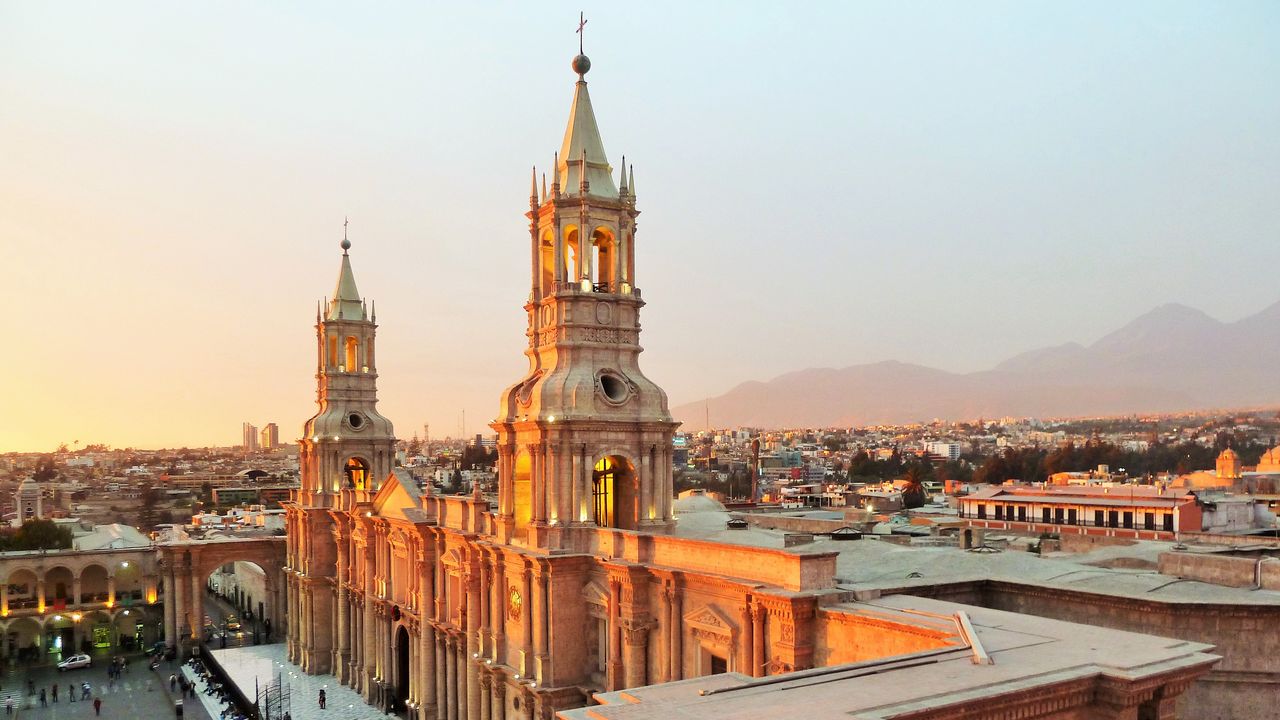
Living far away from family is hard at the best of times, but it becomes particularly difficult around the holidays. If there's one thing that makes it a little easier for me, it's being able to mix and match festive traditions from different countries to create something that's uniquely ours. As an Italian living in France with a British husband, I love bringing together the best of each culture for a rather extravagant Christmas. On Christmas Eve, we have oysters and Champagne, as per French tradition, followed by an Italian feast and plenty of Christmas crackers—although I draw the line at Christmas pudding, preferring a simple pandoro over anything else.Whether, like me, you spend Christmas far from your family, are planning to chase the sun this December or are driving home for the holidays, one of the great joys of Christmas is making memories and indulging in nostalgic traditions. All over the globe, different countries and cultures celebrate the season in different ways, marking the holiday with long-established rites and rituals or merging heritage to create beautiful new traditions. Below, we run through some of our favourite Christmas traditions around the world, and ask the Traveller editors about their own personal festive rituals. From seafood feasts on Christmas Day in Australia to surfing Santa’s taking to the waves in SoCal, these are the most wholesome traditions for some festive joy this season.Winter Illumination in Tokyo near MarunouchiGetty ImagesChristmas traditions around the worldJapan: KFC for ChristmasChristmas is not recognized as a national holiday in Japan, but the festive season is still celebrated—albeit slightly differently from how you’d expect. As part of a marketing campaign launched in 1974, a few years after KFC first opened in Japan, the brand came up with the slogan ‘Kentucky for Christmas’, and it stuck. On Christmas Day, many Japanese families tuck into a full feast of fried chicken—a tradition so popular that you often have to order weeks in advance to make sure you’ve got your bucket guaranteed for the big day. The original Christmas meal even came with a bottle of wine. Christmas cake is just as surprising in Japan, too—strawberry shortcake, made with layers of sponge, whipped cream and fresh strawberries, is a festive favourite.Italy, Rome at Christmas Getty ImagesItaly: La Befana, the friendly, festive witchAs you might imagine, food is at the heart of Christmas celebrations in Italy. Every region has its own traditions and dishes, enjoyed on Christmas Eve, Christmas Day and throughout the festive season. While northern Italians might tuck into tortellini in broth and other comforting dishes, in the south we go all out. In my family, we have twelve different dishes—mostly fish-based—served for Christmas Eve dinner, before indulging in traditional desserts and an unholy amount of nuts while playing tombola. If there is one tradition that the whole country shares, it's the rather quirky tradition of La Befana – a witch-like old woman who flies through the skies on a broomstick on the night of January 5, leaving gifts for children to discover on the morning of 6 January, known as Epiphany (Epifania in Italian). Well-behaved children receive sweets and presents, while naughty ones get coal – although these days it's usually sweet, sugary charcoal, which is actually delicious.Snowy evening window of a wooden house. On the windowsill are Christmas decorations and burning candlesGetty ImagesScotland: Hogmanay and kilts aplentyThe real difference between the Scottish festive season and that of much of the rest of the world is Hogmanay. Once Christmas Day is done and dusted, the focus is on New Year’s—or, as the Scots call it, Hogmanay. Street parties in cities such as Edinburgh roll on until the early hours, Robert Burns’ Auld Lang Syne is sung at midnight, and the ‘first-footing’ custom takes place—the first visitor to a home after midnight is believed to bring good luck for the year ahead (along with traditional gifts such as whisky, shortbread or a lump of coal, of course). Traditionally, a tall, dark-haired man is considered the luckiest first-footer.Cropped shot of a happy family having dessert together on ChristmasGetty ImagesAustraliaSeafood platters and pavlovaWhile much of the Northern Hemisphere is wrapping up against the cold, Christmas in Australia falls in the middle of summer, meaning festive celebrations often revolve around the beach, sunshine and outdoor gatherings. "The traditional Christmas lunch in Australia is usually seafood, a roast ham served cold, lots of salads and then a pavlova for dessert," explains Lauren Burvill, CNT’s senior commerce writer and resident Aussie. "After lunch the classic traditions are to play cricket in the backyard, or if you're lucky, on the beach. It's not unusual to see Santa on the beaches as well, often riding on an inflatable rescue boat from the local surf club. On Boxing Day the country's favourite pastime is to watch the cricket or the Sydney to Hobart yacht race."This is a conceptual photo relating to taking a Christmas vacation.Click on the links below to view lightboxes.Getty ImagesSouthern California, US: Surfing santasForget snowy landscapes and cosy fireplaces—in Southern California, you might spot Santa Claus swapping his sleigh for a surfboard during the festive season. "I grew up in greater Los Angeles, and though December isn't typically beach weather, something uncanny almost always happens on Christmas," explains Megan Spurrell, Conde Nast Traveler US’s associate articles director. "The temperatures spike to the mid-70s Fahrenheit with shining sun and many families, including my own, end up at the beach. But we also go to look out for a very SoCal figure, known as Surfing Santa. We keep our eyes out at Manhattan and Hermosa Beach, especially near the piers, though I've heard of surfing santas in Malibu and Santa Monica, too. Most are just local dudes with a Santa suit who reliably hit the waves on Christmas morning to entertain their neighbours (and get a surf session in)."Austria: The KrampusWhile many Western traditions see Santa leaving lumps of coal in stockings for badly behaved children, in Austria it's the terrifying Krampus who comes to punish them. As the folklore goes, the Krampus is a fearsome horned figure with a long, snake-like tongue, who accompanies Saint Nicholas on 5 December, otherwise known as Krampusnacht, the eve of Saint Nicholas Day. While Saint Nicholas rewards well-behaved children with sweets and small gifts, Krampus is said to frighten or punish those who have been naughty. Today, the tradition is celebrated with Krampuslauf parades, during which people dressed in elaborate horned masks and furry costumes take to the streets, particularly in Alpine towns and villages. The folklore even inspired a Christmas comedy horror film in 2015, starring Adam Scott and Toni Collette.ArequipaGetty ImagesPeru: Midnight partiesIn Peru, Christmas Eve, known as Nochebuena, is the main event, with families gathering for a festive dinner and celebrations that often continue well past midnight. "We alternate years of spending Christmas in Southern California with my mom and sisters, and going to Lima, Peru, with my husband's family" says Megan. "Though Peru has plenty of traditions tied to Christmas, perhaps my favourite is the sheer fact (shared in many Catholic and Latin American countries) that the whole affair begins at midnight on the 24th. It can be torture waiting until midnight proper to dig into the feast of turkey and arroz arabe that sits out waiting, but the entire city explodes in fireworks when the clock strikes 12. And then the party doesn't stop until the wee hours of the morning, sometimes at a family member's house or at the city's bars and clubs. It almost feels like a preview of New Year's Eve, just a few days earlier."Fried dumplings stuffed with cabbage and meat sprinkled with bacon greaves and chopped parsley on a white plate on a wooden rustic table.Getty ImagesPoland: Dumpling dinnersDumplings are a major part of Polish cuisine day to day, and Christmas is no exception. The traditional Christmas Eve supper, known as Wigilia, begins when the first star appears in the sky, with families gathering around the Christmas table for a feast that traditionally includes 12 meatless dishes. "My favourite part of seasonal eating has never been the Great British Christmas Roast, but instead 'Polish Christmas', celebrated by my family on Christmas Eve, a haphazard tribute to the Polish side of my family tree," says Olivia Squire, Traveller's features editor. "When I was a child, my grandmother used to make pierogi (Polish dumplings filled with mashed potato and cottage cheese) from scratch, which in more recent years has been taken over by my mum and I and usually involves a lot of swearing and tears. It's all worth it when we sit down to eat them alongside a vegetarian version of bigos (hunter's stew—an insult to my meat-loving ancestors), breaded fish and holy wafers, soundtracked by Carol's at King's, my English dad's addition."View over Trier´s main square and christmas market at dusk. Trier, located in Rheinland-Pfalz is German oldest city and looks back at 2000 years of history. Trier lies at scenic Mosel River Valley and near the border of Luxembourg.Getty ImagesGermany: SchrottwichtelnForget spending a fortune on Christmas presents—in Germany, the tradition of Schrottwichteln puts a rather amusing twist on exchanging gifts, with friends and family swapping unwanted, bizarre, or downright useless objects instead."For gifts, we follow the German tradition of Schrottwichteln (literally 'junk Secret Santa'), where everyone brings something completely useless, unwanted or gloriously ridiculous, often something they were given once and never knew what to do with. The more pointless, tacky or absurd, the better," Karin Mueller, Traveller's visuals director, tells us. "Our children have grown up with this ritual, and what began as a cosy dinner has become the highlight of the year. They never miss it. Now that they’re young adults, they bring their partners along, and it’s turned into this wonderfully chaotic, joyful, very-London celebration that I’m pretty sure they’ll keep going long after we stop hosting."Beautiful display of Christmas Lights at Mousehole Harbour Cornwall England UK EuropeGetty ImagesEnglandAcross England, Christmas is celebrated with familiar traditions, from exchanging gifts to tucking into mince pies and singing Christmas carols. But each county and neighbourhood has its own customs, too. In some seaside towns, brave locals take part in a Boxing Day dip—sprinting into the freezing sea to shake off the Christmas excesses, often while raising money for charity. There's also the age-old custom of burning a Yule log, traditionally associated with good fortune and protection from misfortune. In Cornwall, some communities gather in local pubs for a traditional Cornish ‘shout’, joining together to sing folk songs and sea shanties."In the hazy betwixmas period, the days of lounging on the sofa and gorging on Terry’s chocolate orange are punctuated by one magical evening at a local pub for a Cornish 'shout'", explains Lucy Bruton, CNT's social media manager. "A shout refers to the community coming together to sing sea shanties and folk songs in the pub, and the Lerryn (where my family live in Cornwall) shout is a particularly special one to me. The tiny pub feels packed to the eaves with people of all ages belting out some of my favourite Cornish songs – from "Trelawney" to "Lamorna" and, of course, “Cornwall My Home”. It’s dark, cosy and a real slice of the magic of Cornwall."A version of this story originally appeared on Condé Nast Traveller UK.
10 Magical Christmas Traditions Around the World
Full Article
Original Source
Read the full article at Cntraveler →KhanList aggregates and links to publicly available news content. We do not host full articles from third-party sources. Always verify important information with original sources.