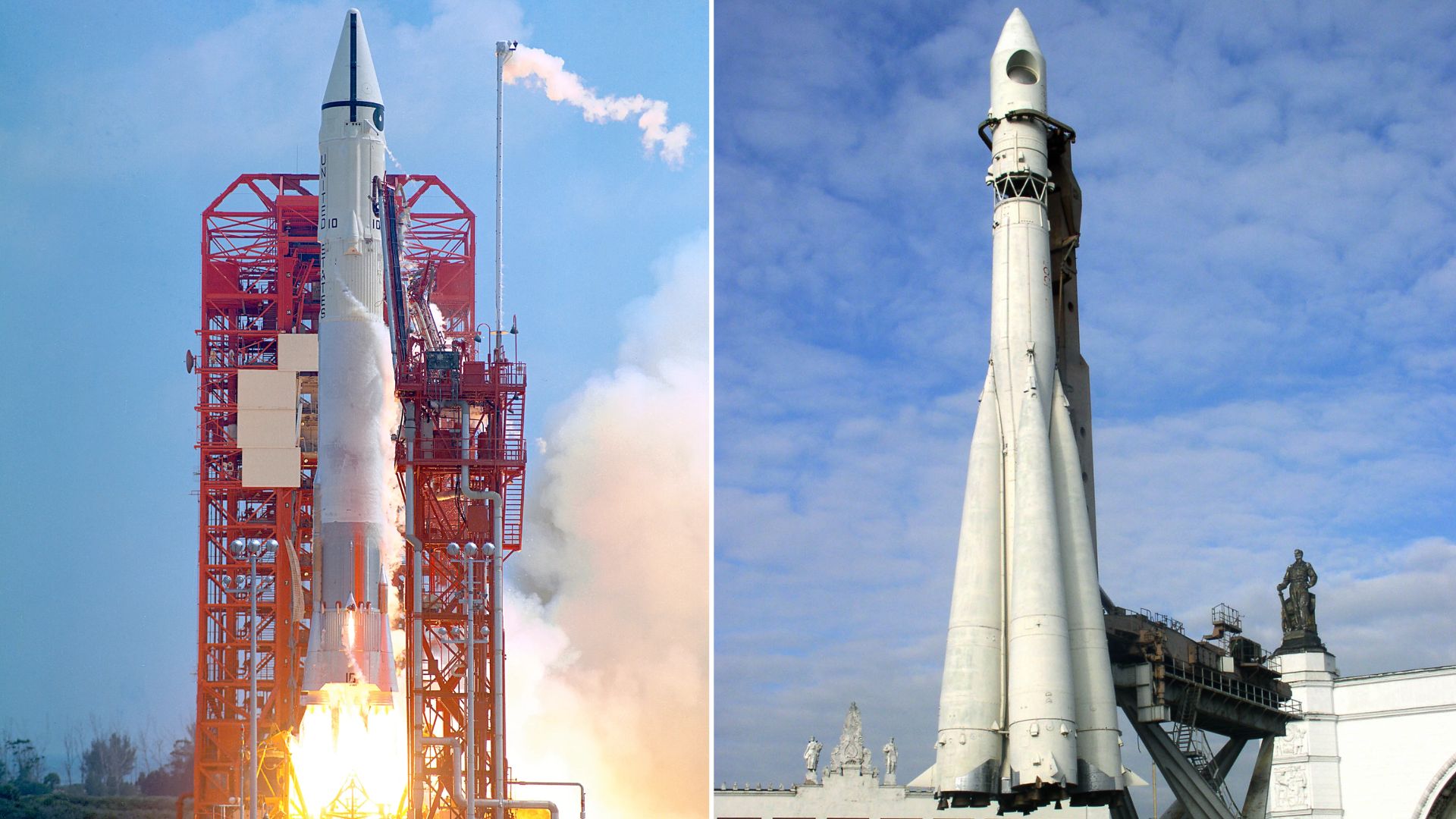
Rocket design has progressed through a series of engineering breakthroughs rather than one single technological leap. Some rockets introduced propulsion systems that became industry standards. Others pioneered lightweight structures, reusable hardware or entirely new approaches to manufacturing. Here are 10 designs whose engineering influence reached well beyond their individual missions. 1. V-2 – The rocket that made large liquid propulsion practical The German V-2 was a weapon, but its engineering legacy extended directly into the space age. It was the world’s first large liquid-propellant rocket and used a turbopump to force fuel and oxidizer into its combustion chamber. Its engine generated about 25 metric tons of thrust. After World War II, V-2 technology heavily influenced American, Soviet, British, and French rocket development. The basic problems its engineers solved- high-pressure propellant feed, combustion, cooling, and guidance- became fundamental challenges of modern rocketry. 2. R-7 – The unusual cluster that launched the Space Age Sergei Korolev’s R-7 looked unlike most later rockets. Four tapered boosters surrounded a central core, with all five sections firing together. The arrangement gave the relatively lightweight vehicle enormous liftoff thrust. Its most famous descendant, Soyuz, retained the fundamental architecture decades later. An R-7 variant launched Sputnik 1 in 1957, while later derivatives carried Yuri Gagarin and thousands of other spacecraft. ESA describes Soyuz as a direct design descendant of the R-7 and one of the most successful launch systems ever built. 3. Atlas – The rocket that made tanks dramatically lighter The Atlas introduced an extraordinary structural idea. Instead of making its propellant tanks rigid enough to support the vehicle by themselves, engineers used thin “balloon” tanks whose strength came from internal pressure. That saved considerable structural mass, but created an unusual problem. The empty rocket could not simply support its own weight without being pressurized. The concept remained in Atlas vehicles through multiple generations and also influenced the Centaur upper stage. It demonstrated just how much launch performance could be gained by treating structural mass as something to be engineered away. 4. Centaur – The cryogenic upper stage that opened deep space The Centaur was arguably as important as many complete rockets. Developed around liquid hydrogen and liquid oxygen, it became the first major rocket stage to use liquid hydrogen technology and pioneered the high-energy upper stages needed for ambitious missions. Centaur helped launch Surveyor spacecraft toward the Moon and later powered missions including Viking, Voyager, and Cassini. Its design showed why hydrogen’s high efficiency was particularly valuable once a rocket was already above most of Earth’s atmosphere. Centaur remains one of the most influential upper-stage designs in American spaceflight. 5. Saturn V – Extreme scale made practical The Saturn V demonstrated how far chemical rocketry could be pushed when multiple technologies were developed together. Its first stage used five enormous F-1 engines, producing roughly 7.5 million pounds of thrust at liftoff. Above them, hydrogen-fueled J-2 engines powered the upper stages. Engineers had to solve combustion instability, turbopump problems, structural loads, and the challenges of handling cryogenic propellants at unprecedented scale. The result was a three-stage vehicle capable of sending astronauts and spacecraft toward the Moon. 6. Space Shuttle – Reusability became part of the launch architecture The Space Shuttle was not fully reusable, but it radically changed the way engineers thought about launch vehicles. Its orbiter returned to Earth and flew again, while its solid rocket boosters were recovered, refurbished and reused. The system combined three liquid-fueled main engines, two reusable solid boosters and a large expendable external tank. NASA describes the Shuttle as the first reusable spacecraft system designed to launch vertically and return to Earth for an aircraft-like runway landing. Its engineering legacy continues. NASA’s modern SLS boosters are directly based on decades of Shuttle booster experience. 7. Ariane 5 – Heavy-lift commercial rocketry, optimized for the payload Europe’s Ariane 5 was designed around a different commercial philosophy. Carry large payloads efficiently, often placing two telecommunications satellites on one launch. Its cryogenic Vulcain-powered core was combined with large solid boosters, while successive versions continually increased performance. The Vulcain engine itself represented decades of work on liquid-hydrogen propulsion and extreme-temperature engineering. Ariane 5 ultimately flew 117 times between 1996 and 2023, launching everything from Galileo satellites to the James Webb Space Telescope. Its design became a cornerstone of Europe’s independent access to space. 8. Falcon 9 – The first orbital rocket built around routine reuse SpaceX’s Falcon 9 changed the economics and operational philosophy of orbital launch by making the first stage reusable. Instead of treating the booster as disposable hardware, SpaceX designed it to survive atmospheric reentry, perform a controlled landing and fly again. NASA calls Falcon 9 the world’s first orbital-class reusable rocket. That required integrating engines, guidance, landing systems, thermal protection and structural design around recovery from the beginning rather than adding recovery as an afterthought. The result helped establish rocket reuse as a central design objective for the modern launch industry. 9. Electron – Electric motors replaced conventional turbopumps Rocket Lab’s Electron introduced a radically different approach to small launch vehicles. Its Rutherford engines use electric turbopumps powered by batteries, replacing much of the turbomachinery normally associated with traditional pump-fed rocket engines. The engines also use extensive additive manufacturing, while the rocket itself uses a carbon-fiber composite structure. NASA describes Rutherford as the world’s first 3D-printed, electric-pump-fed rocket engine. Electron showed that sophisticated propulsion architecture could be made compact and production-oriented for the growing small-satellite market. 10. Delta – The idea of evolving a rocket instead of replacing it The Delta family demonstrated the power of incremental rocket engineering. Its origins go back to the Thor ballistic missile, combined with improved upper stages derived from the Vanguard program. Rather than continually replacing the entire launch vehicle, engineers evolved the architecture through successive versions, adapting it to different payloads and missions. NASA’s Goddard describes the Delta as having served the United States for more than four decades. That long evolutionary approach became a model for launch-vehicle development. Preserve proven hardware where it works, modify what needs improvement, and build capability over generations. Get the latest in engineering, tech, space & science - delivered daily to your inbox.Kaif Shaikh is a journalist and writer passionate about turning complex information into clear, impactful stories. His writing covers technology, sustainability, geopolitics, and occasionally fiction. A graduate in Journalism and Mass Communication, his work has appeared in the Times of India and beyond. After a near-fatal experience, Kaif began seeing both stories and silences differently. Outside work, he juggles far too many projects and passions, but always makes time to read, reflect, and hold onto the thread of wonder.
10 landmark rockets and the engineering breakthroughs behind them
Full Article
Original Source
Read the full article at Interestingengineering →KhanList aggregates and links to publicly available news content. We do not host full articles from third-party sources. Always verify important information with original sources.