
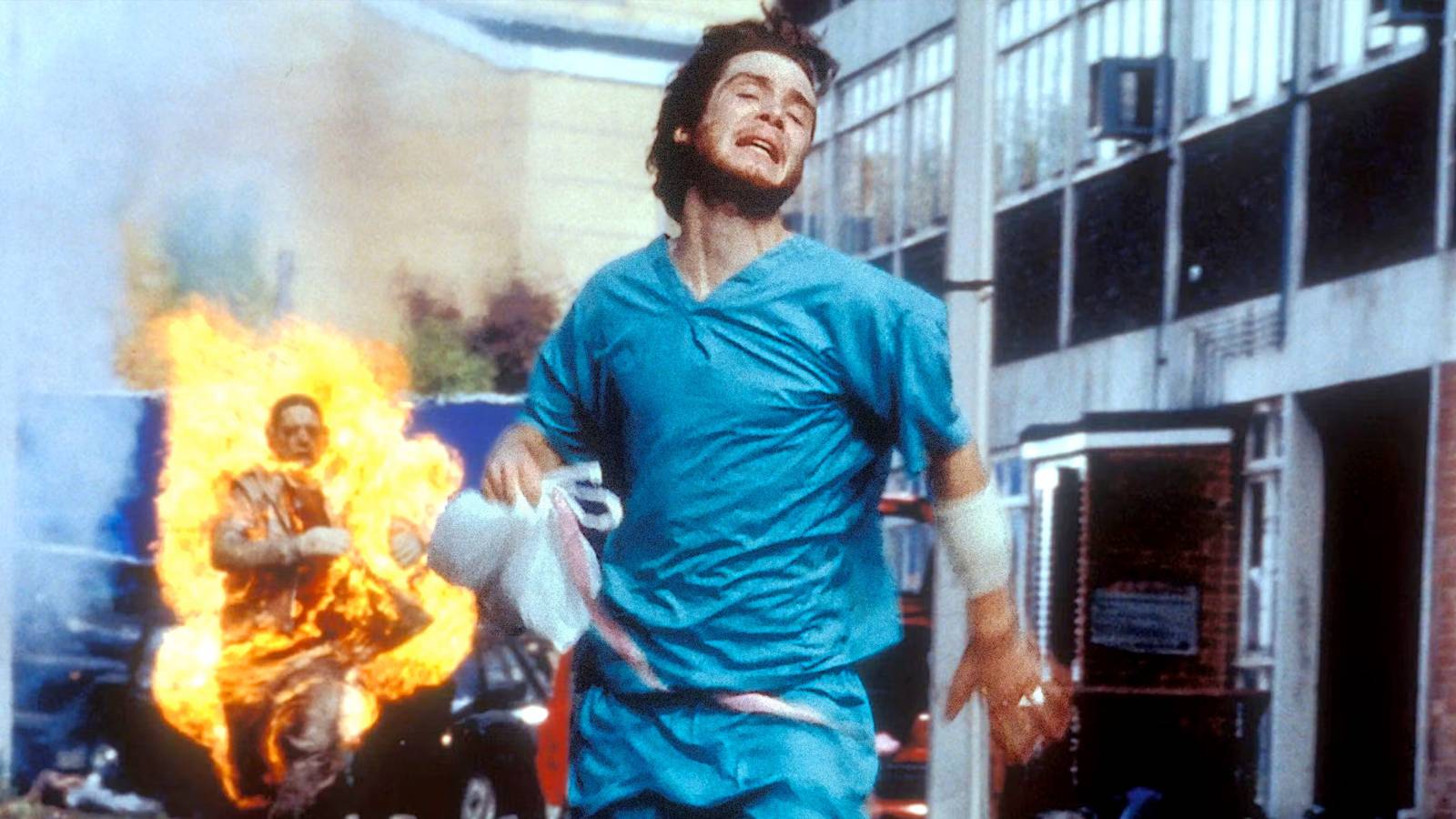
Zombies have starred in some of the most terrifying horror movies ever made. The zombie genre has proven remarkably adaptable since George A. Romero reinvented the living dead in 1968. Prior to that, zombies were actually voodoo slaves, not flesh-eating undead. Since they were reimagined in 1968, the low-budget horror genre has evolved into one of cinema's most enduring, capable of supporting everything from social satire and psychological drama to action blockbusters and dark comedy. While early zombie films focused primarily on survival against overwhelming odds, later entries expanded the concept, using outbreaks to explore consumerism, government failure, family relationships, class divisions, and humanity's tendency to self-destruct under pressure. Indeed, the best zombie movies succeed because the undead are rarely the only threat. Whether the creatures are shambling corpses, infected humans, or reanimated scientific experiments, zombies often expose deeper flaws within society and the people attempting to survive. The genre has also produced some of horror's most influential innovations, from Romero's flesh-eating ghouls to Danny Boyle's fast-moving infected and the emotionally charged character work found in modern international entries. Some transformed horror forever, while others perfected existing formulas through exceptional storytelling, unforgettable imagery, or groundbreaking technical achievements. Together, they showcase why zombie cinema remains one of horror's most consistently compelling forms. Dead Alive (1992) Released as Braindead outside North America, Peter Jackson's splatter masterpiece pushed practical gore effects to absurd new extremes. Dead Alive follows shy Lionel Cosgrove, whose overbearing mother becomes infected after being bitten by a grotesque Sumatran rat-monkey. The family nightmare quickly escalates into a full-scale zombie outbreak. Jackson demonstrated extraordinary visual inventiveness and comic timing. Every sequence becomes increasingly outrageous, culminating in the legendary lawnmower massacre. Despite its excessive violence, Dead Alive never loses its sense of humor or surprisingly heartfelt romance. Dead Alive embraces cartoonish absurdity while exhibiting practical effects work that is still impressive decades later. Many horror comedies have attempted to balance laughs and gore, but few have matched the sheer energy and imagination on display here. It’s gloriously silly, but not exactly high art. Blood Quantum (2019) Blood Quantum is one of the most original zombie premises of the modern era. Set within a Mi'kmaq community in Canada, the story unfolds during a zombie apocalypse where Indigenous people possess a natural immunity to the infection devastating the rest of the population. Rather than using its concept as a simple gimmick, Blood Quantum explores colonialism, borders, identity, and survival through the lens of horror. Michael Greyeyes anchors the narrative as Traylor, a tribal sheriff attempting to protect his community while managing growing tensions between survivors. Director Jeff Barnaby combines intense practical gore effects with pointed social commentary, creating a zombie movie that feels distinct from countless outbreak stories. Few modern zombie films offer such a fresh viewpoint, even if the action and suspense are less than perfect. Day Of The Dead (1985) George A. Romero's third zombie film abandoned the broader scope of Dawn of the Dead in favor of something darker and more pessimistic. In Day of the Dead, humanity has largely lost the war against the undead, and a group of scientists and soldiers are confined within an underground military bunker as civilization collapses above them. Day of the Dead's greatest strength is its focus on internal conflict. The zombies outside are dangerous, but the increasingly hostile relationship between the military and scientific personnel proves even more destructive. Tom Savini's practical effects work is among the finest ever created for a horror film, particularly during the movie's gruesome climax. Romero also introduced Bub, an intelligent zombie whose capacity for memory and learning raised questions about the nature of humanity itself. Initially divisive, Day of the Dead has been reassessed as one of the genre's most ambitious and intellectually interesting entries, just not quite as groundbreaking as others in the franchise. 28 Days Later (2002) Danny Boyle's 28 Days Later revitalized zombie cinema after years of relative stagnation. 28 Days Later begins with Jim awakening from a coma to discover that Britain has been devastated by the Rage Virus. Though technically infected rather than undead, the creatures function so similarly to zombies that the movie permanently altered the genre's trajectory. Boyle's use of digital cameras gave 28 Days Later a raw immediacy that distinguished it from earlier zombie movies, though it does age it considerably. Nevertheless, the unsettling images of an abandoned London are among the most iconic in horror history. Alex Garland's screenplay neatly combines post-apocalyptic survival with commentary on violence, authority, and social collapse. The infected themselves represented a major innovation. Unlike Romero's slow-moving creatures, these attackers sprinted at terrifying speed, influencing countless zombie films and games that followed. Few horror movies have had such a profound impact on an entire subgenre as 28 Days Later. REC (2007) REC transformed found-footage horror through relentless pacing and claustrophobic tension. It centers on television reporter Ángela Vidal and her cameraman as they accompany firefighters responding to an emergency call inside a Barcelona apartment building. Once inside, residents become trapped as a mysterious infection spreads. Unlike many found-footage projects, REC wastes virtually no time establishing its premise. The outbreak escalates rapidly, trapping characters in increasingly desperate circumstances. The confined setting creates a sense of panic that rarely lets up. Manuela Velasco delivers a compelling central performance, grounding the escalating chaos in recognizable human reactions. REC also cleverly combines zombie mythology with unexpected religious and supernatural elements. The climactic final sequence remains one of the most frightening endings in modern horror. Re-Animator (1985) Stuart Gordon's adaptation of H.P. Lovecraft's Herbert West–Reanimator approaches zombie horror from a different angle. Rather than depicting a widespread apocalypse, Re-Animator focuses on medical student Herbert West and his dangerous experiments with a serum capable of reviving the dead. Jeffrey Combs offers an iconic performance as West, portraying the character as brilliant, arrogant, and completely unconcerned with ethical boundaries. Re-Animator combines horror and comedy with remarkable confidence, balancing gruesome effects with darkly funny dialogue. Gordon's direction embraces outrageous excess while maintaining genuine suspense. While many zombie stories emphasize societal collapse, Re-Animator succeeds through its focus on scientific obsession and personal hubris. It is one of the most entertaining horror comedies ever made. Shaun Of The Dead (2004) Edgar Wright's Shaun of the Dead accomplished something extraordinarily difficult by creating a zombie comedy that works equally well as a genuine horror film. Simon Pegg stars as Shaun, an aimless electronics salesman whose attempt to repair his life coincides with a zombie outbreak across Britain. Shaun of the Dead's brilliance lies in its attention to detail. Wright carefully establishes visual jokes, character arcs, and zombie-related foreshadowing long before the outbreak becomes obvious. The comedy then arises naturally from the characters rather than by undermining the flesh-eaters themselves. Nick Frost, Kate Ashfield, Lucy Davis, and Bill Nighy deliver memorable supporting performances, and the screenplay balances humor, romance, and tragedy with surprising skill. Beyond its endless entertainment value, Shaun of the Dead also serves as a loving tribute to Romero's work – albeit one wrapped in a distinctly British sense of humor. Train To Busan (2016) Train to Busan proves that the zombie genre still has room for reinvention. The story follows workaholic fund manager Seok-woo and his daughter Su-an aboard a high-speed train traveling from Seoul to Busan when a zombie outbreak erupts across South Korea. The confined train setting creates constant tension, forcing survivors into increasingly dangerous confrontations with the infected. However, Train to Busan's emotional core is what elevates it above many competitors. Seok-woo's relationship with his daughter provides genuine dramatic weight, while the supporting characters receive enough development to make their fates matter too. The zombies themselves are fast, aggressive, and terrifyingly coordinated. Yet Train to Busan also pairs spectacular action with sharp observations about selfishness, class, and collective responsibility in crises. It is the greatest modern entry, largely because it never loses sight of its human story. Dawn Of The Dead (1978) George A. Romero expanded the scale of zombie cinema dramatically with Dawn of the Dead. As society collapses under the weight of the undead, four survivors seek refuge inside a suburban shopping mall, transforming the location into both a fortress and a prison. The mall setting allowed Romero to deliver one of horror cinema's most effective critiques of consumer culture. The zombies wander through stores almost instinctively, suggesting that mindless consumption survived even after death. At the same time, Dawn of the Dead excels as a survival thriller, carefully exploring the challenges of maintaining security and sanity during an apocalypse. Tom Savini's effects work was groundbreaking for its era, helping establish new standards for zombie gore. Dawn of the Dead is a near-perfect blend of horror, action, satire, and social commentary. Night Of The Living Dead (1968) Every modern zombie movie owes a debt to George A. Romero's Night of the Living Dead. Before its release, zombies largely resembled the mind-controlled servants of Haitian folklore. Romero fundamentally redefined the concept, introducing flesh-eating ghouls whose bite spread infection and whose overwhelming numbers threatened civilization itself. The story is deceptively simple. A group of strangers barricades themselves inside a Pennsylvania farmhouse while the dead inexplicably return to life. Romero transformed that premise into a powerful examination of fear, division, and social breakdown. Duane Jones' performance as Ben was groundbreaking for its era, placing a Black protagonist at the center of a major horror film during a period of intense social upheaval. Combined with its unforgettably bleak ending, realistic violence, and documentary-like style, Night of the Living Dead changed horror forever. More than half a century later, it is the single most important zombie movie ever made. Release Date October 4, 1968 Runtime 96 minutes Director George A. Romero
10 Greatest Zombie Movies Of All Time, Ranked
Full Article
Original Source
Read the full article at Screenrant →KhanList aggregates and links to publicly available news content. We do not host full articles from third-party sources. Always verify important information with original sources.