
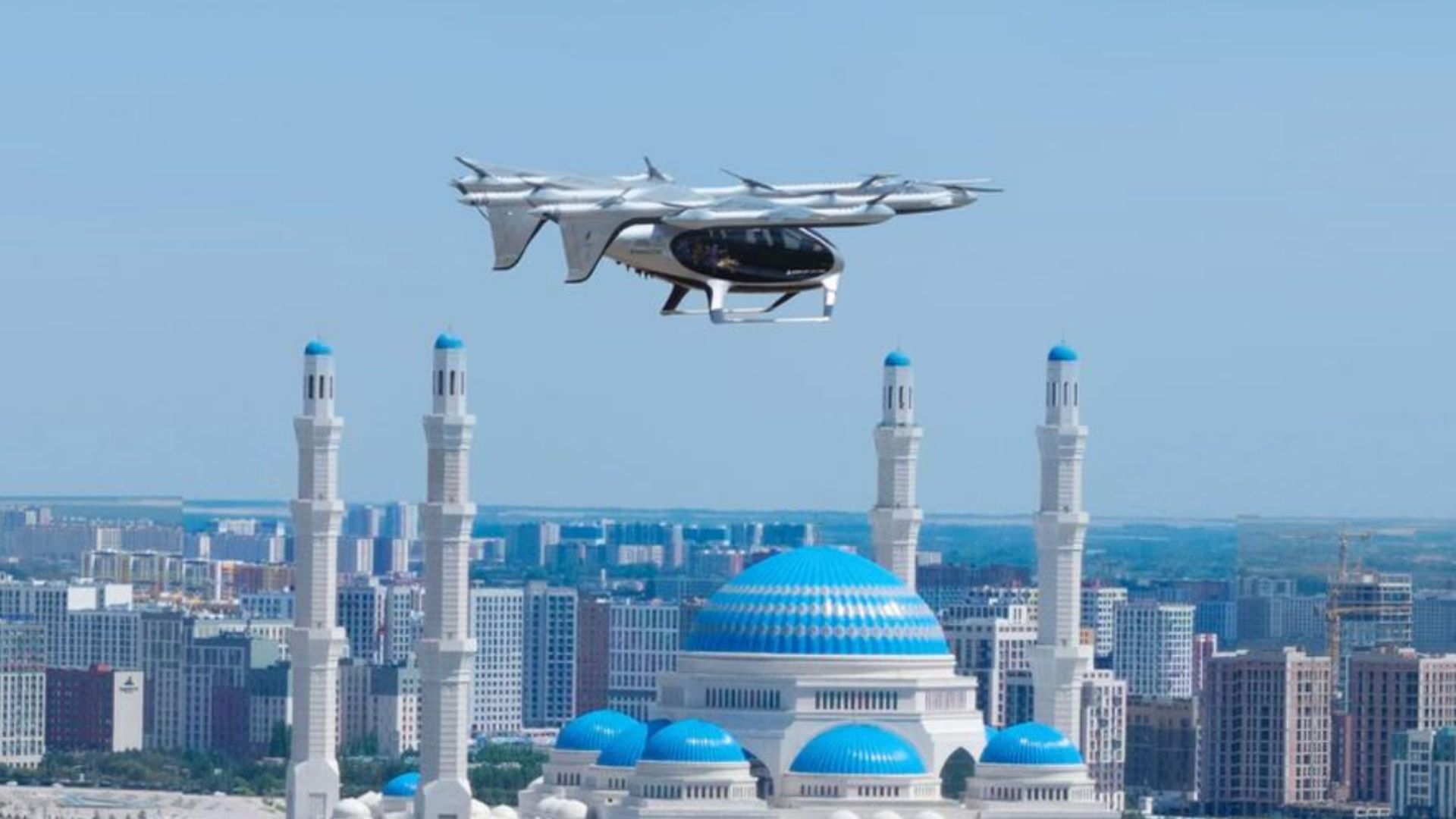
Helicopters are no longer the only aircraft capable of taking off vertically. Electric motors, autonomous flight systems and lightweight materials are giving rise to machines that lift like helicopters but fly more like conventional airplanes. Some are designed to carry passengers over congested cities, while others could transport soldiers, deliver cargo or give individuals their own personal aircraft. Here are 10 futuristic VTOL aircraft attempting to change how people and goods move through the sky. 1. Joby Aviation air taxi Joby Aviation Joby Aviation has developed one of the most mature electric vertical takeoff and landing aircraft in the industry. Its air taxi uses six tilting electric propellers to rise vertically before transitioning into forward flight. The aircraft is designed to carry a pilot and four passengers at speeds of up to 200 mph, with a range of up to 100 miles. Joby reported that its aircraft had completed more than 2,600 flights and covered over 50,000 miles by December 2025. 2. Archer Midnight Archer Midnight Archer Aviation’s Midnight is built for short, repeated journeys across crowded cities. The aircraft has 12 electric motors and propellers, providing additional redundancy if one propulsion unit fails. Midnight can carry four passengers and a pilot at speeds of up to 150 mph. Although its claimed range reaches 100 miles, it is optimized for consecutive journeys of around 20 to 50 miles. A piloted aircraft completed a 55-mile flight in 31 minutes in August 2025. 3. BETA ALIA VTOL Wikimedia Commons BETA Technologies has taken a relatively straightforward approach with its ALIA VTOL. Four horizontal propellers provide vertical lift, while a separate propeller at the rear drives the aircraft during forward flight. ALIA is designed to carry five passengers or around 200 cubic feet of cargo. It has a listed maximum speed of 153 knots, equivalent to approximately 176 mph. BETA is targeting passenger transport, medical missions, logistics and military operations with the platform. 4. AutoFlight Prosperity I AutoFlight China’s AutoFlight is developing Prosperity I for longer passenger journeys between cities and transport hubs. Its unusual propulsion system includes 10 lifting propellers and three propellers for forward flight. The aircraft has five seats, including one for the pilot, and a typical payload capacity of 350 kilograms. AutoFlight claims a range exceeding 250 kilometres and a cruise speed above 200 kilometres per hour. The passenger aircraft is currently progressing through airworthiness certification. 5. Vertical Aerospace Valo Valo is the latest electric aircraft being developed by Britain’s Vertical Aerospace. It uses eight tilt-shift propellers and a carbon-composite airframe to carry four passengers and one pilot. The all-electric aircraft is designed to travel up to 100 miles at speeds reaching 150 mph. Vertical is also planning a hybrid-electric version with a significantly more ambitious range of up to 1,000 miles. The company is targeting entry into service after regulatory approval, currently expected in 2028. 6. Horizon Cavorite X7 Hysky Instead of placing its lift propellers outside the aircraft, Horizon Aircraft has hidden them inside the wings. Panels open to expose 12 electric fans during vertical takeoff and close once the Cavorite X7 transitions into forward flight. The Canadian hybrid-electric aircraft is being developed to carry six passengers and one pilot. Horizon is targeting a range of approximately 500 miles and a maximum speed of around 280 mph. Its proposed missions include regional transport, defence and emergency response. 7. Jetson ONE Jetson ONE The Jetson ONE resembles a cross between an open-wheel racing car and an oversized drone. Its lightweight aluminium-and-carbon-fibre frame carries a single pilot above eight electrically powered propellers. The aircraft offers approximately 20 minutes of flight and has a software-limited maximum speed of 63 mph. It is controlled using a four-axis joystick and includes automatic landing, motor redundancy and a ballistic parachute. Unlike many proposed personal eVTOLs, early Jetson ONE aircraft have already reached customers. 8. ARIDGE Land Aircraft Carrier Aridge ARIDGE’s Land Aircraft Carrier approaches the flying-car problem by separating driving and flying. The system consists of a six-wheeled ground vehicle carrying a detachable two-seat electric aircraft inside its rear compartment. Once the vehicle reaches a suitable location, the aerial module can be released and prepared for vertical flight. This modular architecture avoids forcing one machine to operate effectively both on public roads and in the air. 9. Sikorsky Nomad Lockheed Martin Sikorsky’s Nomad is a family of autonomous aircraft built around a rotor-blown-wing design. Two large propellers generate airflow over the wing, allowing the aircraft to hover before transitioning into efficient horizontal flight. A 10.3-foot-wing prototype completed more than 40 takeoffs and landings, including 30 transitions between helicopter and airplane modes. The larger Nomad aircraft could eventually perform reconnaissance, light-attack and contested-logistics missions without putting a crew onboard. 10. Bell MV-75 Cheyenne II Bell MV Bell’s MV-75 Cheyenne II is being developed as the U.S. Army’s next-generation long-range assault aircraft. Derived from the V-280 Valor demonstrator, it uses tilting rotors to combine helicopter-like vertical flight with turboprop-like speed. The Army expects the MV-75 to fly more than twice as far and twice as fast as parts of its current helicopter fleet. It could eventually conduct air assault, medical evacuation, resupply and disaster-relief missions while replacing the UH-60 Black Hawk in certain roles. Conclusion These aircraft show there is no single solution to the vertical-flight problem. Companies are experimenting with tilting propellers, dedicated lift rotors, concealed fans, hybrid engines and autonomous flight systems. However, flying prototypes are only part of the challenge. Certification, infrastructure, battery life, noise and operating costs will ultimately decide which of these futuristic VTOL aircraft become everyday machines—and which remain captivating visions of aviation’s future. Recommended Articles
10 futuristic VTOL aircraft transforming urban mobility, combat & cargo operations
Full Article
Original Source
Read the full article at Interestingengineering →KhanList aggregates and links to publicly available news content. We do not host full articles from third-party sources. Always verify important information with original sources.