
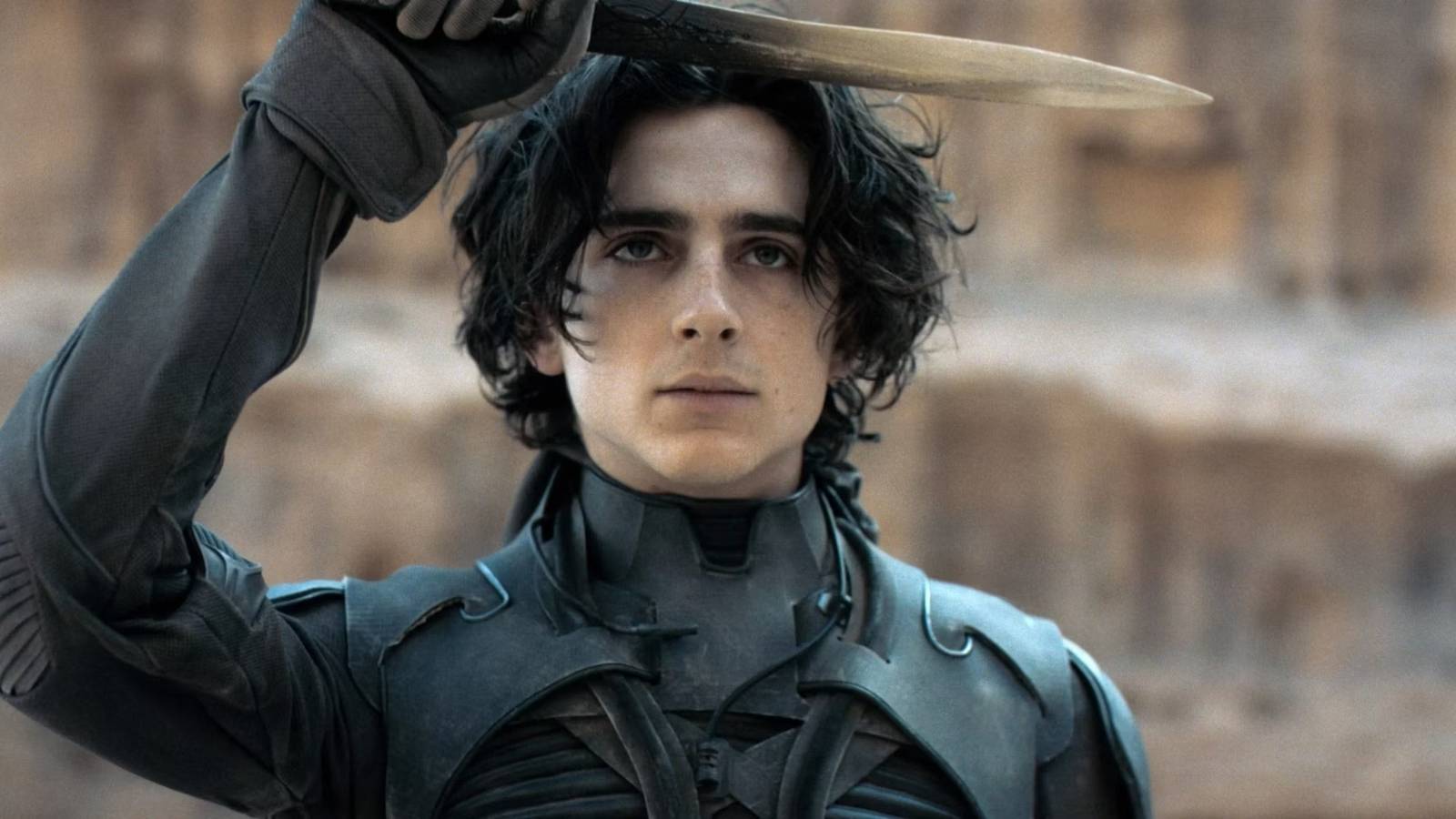
Image via Warner Bros. Published Oct 29, 2026, 2:09 PM EDT Sign in to your Collider account Science fiction is a super popular genre, and pretty much always has been since its inception. The genre basically focuses on futuristic visions for humanity, many of them hopeful, and many of them cynical. The stories almost always involve advanced technology, and sometimes include robots or alien life. There are a bunch of subgenres, with the "sci-fi" term being more of an umbrella term than anything. It can describe anything from near-future scenarios to distant space operas. The genre, like many genres of fiction, emerged with literature, and there have thus been thousands of sci-fi novels over the centuries. However, the genre as we know it today would never have gotten where it is without the influence of these other works. If you're a sci-fi fan, these are the quintessential books that you absolutely must read before kicking the bucket. 'Hyperion' (1989) Image via Doubleday Dan Simmons' Hyperion is a book that isn't quite as layered or important as some of the other books on this list, but it's a phenomenal read if you're in need of a great space opera story. That doesn't mean it has nothing to say for itself, though. The first in a series of four novels, Hyperion is set on the planet of the same name, where many worship a terrifying entity called the Shrike. As the galaxy is thrust into war and the end of the world approaches, seven misfit individuals travel to Hyperion. They are divided by their goals, but are unified in their last, desperate senses of hope. Hyperion is one of the most cinematic books ever written, with loads of large-scale action sequences, and a really interesting world. It's truly unmatched in terms of atmosphere and story, which is probably why it's become such a classic. It's actually kind of unbelievable that this hasn't had any adaptations yet. Hyperion is considered one of the finest sci-fi books ever written, and it's not hard to understand why once you read it. 'Jurassic Park' (1990) Image via Alfred A. Knopf Michael Crichton's Jurassic Park is more commonly associated with the 1993 movie of the same name, which became an instant and timeless classic. Sure, it's kind of dated now, since we know more about dinosaurs than they did at the time, but it's still a great experience. The book is about a group of scientists who decide to bring dinosaurs back to life using fossilized amber, putting the live specimens in a sort of zoo, and well, you probably know the rest at this point, right? Let's face it, it was a pretty bad idea to begin with. Many who have seen the movie find that they're disappointed in the book, but that doesn't change the fact that it's still something that ought to be read by anyone who fancies themselves a sci-fi fan. The main reason this book is so entertaining is because, quite simply, dinosaurs are awesome. Of course, other than that, it plays upon a lot of sci-fi tropes that people love and presents a unique and interesting story. Jurassic Park is an essential read for the fact that it serves as the basis for a legendary Hollywood classic. 'Foundation' (1951) Image via Grafton Books Isaac Asimov is one of the most prolific and famed science fiction authors of all time, so, of course, he belongs on this list. His most famous work is his novel Foundation, which is the first in a trilogy. One of the earliest space operas in existence, the plot centers on a galactic empire which has ruled for over 12,000 years. However, it is beginning to decline. A gifted psychohistorian called Hari can see into the future, where he witnesses a period of war, turmoil, death, and ruin that lasts for 30 millennia. Desperate to stop it, he gathers the galaxy's brightest individuals to a safe refuge known as the Foundation. Foundation is one of those books that is constantly being rediscovered by younger generations, and that never goes out of style. Ultimately, it is about the impermanence of empires and how even the mightiest kingdoms must fall eventually, as nothing can last forever. Moreover, the whole trilogy won a Hugo Award in 1966, and stands strong as one of the finest efforts in science fiction to date. 'The War of the Worlds' (1898) Image via Penguin Random House H. G. Wells' The War of the Worlds is one of those books that has been adapted to the screens both big and small countless times. The most recent effort, a 2025 movie starring Ice Cube, was an absolute travesty, and is currently considered one of the worst films ever made. However, most people more positively associate this title with a better 2005 film starring Tom Cruise. Though, it should be stated, neither of these adaptations are truly faithful to the source material. The book is basically the original alien invasion story, and is set in London, England, following a mysterious cylinder from space that crash-lands in the city. From the cylinder emerges an army of angry Martians, who begin to wage war on humanity itself. The book is so brilliant because it is recounted in such a matter-of-fact, almost journalistic style, making it seem like it was something that actually happened rather than a work of fiction. Of course, this makes it that much more compelling. It's wonderfully written, and comes with a concept that starts an entire subgenre within science fiction. Collider Exclusive · Sci-Fi Personality Quiz Which Sci-Fi Hero Are You Most Like? Paul Atreides · Captain Kirk · Princess Leia · Ellen Ripley · Max Rockatansky Five iconic heroes. Five completely different ways of facing an impossible universe. One of them shares your instincts, your values, and your particular way of refusing to back down. Eight questions will tell you which one. 🏜️Paul Atreides 🖖Capt. Kirk ✊Princess Leia 🔦Ellen Ripley 🔥Max Rockatansky FIND YOUR HERO → 01 How do you lead when the stakes couldn't be higher? The way you lead under pressure is the most honest thing about you. AI absorb everything — every variable, every pattern — and move only when I know the path forward. BI read the room, make the call, and own the consequences. Hesitation costs more than mistakes. CI rally people. A cause needs a voice, and I refuse to let fear be louder than conviction. DI assess the threat, establish what needs doing, and get it done without waiting for permission. EI don't lead. I act. Others can follow or not — I'm already moving. NEXT QUESTION → 02 What is your greatest strength in a crisis? The quality that keeps you alive when everything else fails. APrescience — the ability to see further ahead than anyone else and plan accordingly. BImprovisation — I'm at my best when the plan falls apart and I have to invent a new one. CConviction — I know what I'm fighting for, and that certainty doesn't waver under fire. DComposure — I stay functional when everyone around me is falling apart. Panic is a luxury. EEndurance — I outlast things. I take the hit and keep moving long after others have stopped. NEXT QUESTION → 03 What is the thing you'd sacrifice everything else for? Your deepest motivation is your truest compass. AThe survival and dignity of my people — even if I have to become something frightening to ensure it. BThe safety of my crew — every single one of them. No one gets left behind. CFreedom — for my people, for every world still crushed under the weight of an empire. DThe truth — what actually happened, what's actually out there, whether anyone believes me or not. EThe one person — or the one memory — that still makes any of this worth surviving for. NEXT QUESTION → 04 How do you relate to the people around you? Who you are to others under pressure is who you really are. AWith intensity and distance — I care deeply, but the weight I carry makes closeness complicated. BWith warmth and irreverence — I take the mission seriously, not myself. CWith directness and trust — I say what I mean, and I expect the people I work with to rise to it. DWith professional care but clear limits — I'll protect you, but I won't pretend we're family. EWith wariness that slowly becomes loyalty — I don't trust easily, but when I do, it holds. NEXT QUESTION → 05 You're facing a threat that no one else believes is real. What do you do? How you respond when you're the only one who sees it defines everything. APrepare in silence. If they won't listen, I'll be ready when they finally have to. BKeep pushing until someone listens — and if no one does, handle it myself. CBuild the case, find the allies, and make the threat impossible to ignore. DDocument everything. The truth matters even if no one believes it yet. EStop trying to convince anyone. Survive it. That's the only argument that counts. NEXT QUESTION → 06 What has your heroism cost you personally? Every hero pays. The question is what — and whether they'd pay it again. AMy innocence — I've seen what I'm capable of, and I can't unsee it. BPeople I loved — the command chair has a view, but it's a lonely one. CA normal life — I gave up everything ordinary the moment I chose the cause. DMy sense of safety — I know exactly what's out there now, and I can't pretend otherwise. EAlmost everything — and I'm still not sure what I'm carrying it all for. But I keep going. NEXT QUESTION → 07 How do you feel about the rules of the world you're in? Every hero has a relationship with the system. What's yours? AI understand them deeply — and I know exactly which ones must be broken, and why. BI respect the spirit of them and bend the letter when the situation demands it. CThe system is the problem. I'm not here to work within it — I'm here to dismantle it. DI follow protocol until protocol stops being useful. Then I make the call myself. EThe rules collapsed a long time ago. What's left is instinct, and mine are reliable. NEXT QUESTION → 08 When everything is on the line, what keeps you going? The answer is the most honest thing about you. ADestiny — or something that feels so much like it that the difference no longer matters. BThe people on my ship — their faces, their trust, the fact that they're counting on me. CThe belief that what we're fighting for is worth every sacrifice, including this one. DSheer refusal to let it win — whatever it is. I don't stop. That's just who I am. EI'm not sure anymore. But the road is still there, and I'm still on it. REVEAL MY HERO → Your Hero Has Been Identified Your Sci-Fi Hero Is…Your answers point to the iconic sci-fi hero who shares your instincts, your values, and your particular way of facing the impossible. Paul AtreidesYou carry a weight most people would crumble under — the knowledge of what you're capable of, and the burden of what you might have to become. You see further ahead than others and you plan accordingly, even when the vision frightens you. You are driven by loyalty to your people and a sense of destiny you didn't ask for but can't escape. Paul Atreides is not simply a hero — he is someone who understands the cost of power and chooses to bear it anyway. That gravity, that willingness to carry what others won't, is exactly you. Captain KirkYou lead with instinct, warmth, and an absolute refusal to accept a no-win scenario — because you've always believed there's a third option nobody else has thought of yet. You take the mission seriously without ever taking yourself too seriously. Your crew would follow you anywhere, not because you demand it, but because you've earned it. Kirk's genius isn't tactical — it's human. He reads people, bends rules with purpose, and wills outcomes into existence through sheer conviction. That combination of warmth, audacity, and relentless optimism is unmistakably yours. Princess LeiaYou are the kind of person who holds the line when everyone else is losing faith — not because you're fearless, but because giving up simply isn't something you're capable of. You lead through conviction. Your voice carries because your belief is unshakeable. You gave up everything ordinary the moment you chose the cause, and you've never looked back. Leia is not a supporting character in her own story — she is the moral centre of the entire rebellion. That same fierce, principled, unbreakable core is what defines you. Ellen RipleyYou are not reckless, not grandiose, and not particularly interested in being anyone's hero — you just refuse to stop when it matters. You see threats clearly, you document the truth even when no one listens, and when the time comes you handle it yourself. Ripley's heroism is earned, not performed. She doesn't have a speech — she has a flamethrower and a plan. You share her composure under the worst possible pressure, and her refusal to pretend the monster isn't there. When it counts, you don't flinch. That's everything. Max RockatanskyYou have been through fire that would break most people — and what came out the other side is something the world underestimates at its peril. You don't ask for help, don't need validation, and don't wait for anyone to tell you the rules no longer apply. Your loyalty, when it finally arrives, is absolute — but it's earned in silence and tested in action, not in words. Max is not a nihilist. He is someone who lost everything and found, against his will, that he still has something worth protecting. That bruised, stubborn, ultimately human core is exactly yours. ↻ RETAKE THE QUIZ 'Fahrenheit 451' (1953) Image via Ballantine Books Fahrenheit 451 is one of those books that only gets better and better with age, mainly because it's become so relevant. Ray Bradbury's dystopian novel is about an authoritarian society in which books are completely and totally banned. Any book that survives is thrown into a massive fire, where it is burned along with the home it came from. Guy Montag is a fireman— not a firefighter, but someone whose job it is to burn books and homes. He doesn't really see his horrifying work as anything more than a job until he is introduced to a small group of rebels who observe the world through the abstract ideas they learn from books and not from the government-orchestrated propaganda fed to them on their television screens. Fahrenheit 451 is a reminder of the importance of literacy and why reading is one of the most fundamental parts of a functioning, working society. Moreover, it is a cautionary tale about what happens when humanity loses its literacy and how people grow less inclined to question their surroundings because of it. 'Frankenstein' (1818) Image via Penguin Random House Mary Shelley's Frankenstein is a revolutionary bit of sci-fi and horror that not only blends the genres together, but broke a ton of social norms. At the time, Shelley had to use a pseudonym because a book written by a woman wouldn't have been socially accepted. Now though, she is recognized as one of the defining figures in the sci-fi and horror genres. Frankenstein, as many already know due to the story's fame, is about a scientist who stitches together an artificial human from deceased body parts. Using an electrical current, he reanimates the cadaver into a monster. The monster quickly becomes a social pariah and is cast out of human civilization, before being relentlessly hunted and pursued. All the monster wants is to be left alone. This book is a phenomenal work that critiques humanity's tendency to play God, and how unchecked ambition can result in catastrophe. Dr. Frankenstein was so preoccupied with whether he could that he never stopped to think about whether he should. Moreover, the book is one of the earliest examples of the "humans are the real monsters" trope that sci-fi loves so much. In short, it's a groundbreaking book that still holds up today. 'The Time Machine' (1895) Image via Reader's Library Classics It feels a bit like cheating to put H. G. Wells on this list twice, but considering both books basically spawned their own sub-genres, it would also feel disingenuous not to include them. The Time Machine was written three years before The War of the Worlds, and it's a very different type of story from the latter. As the title implies, this book is about time travel. More specifically, it's about a scientist who invents a time machine and uses it to thrust himself forward 800,000 years into the future. What he finds is not a prosperous, advanced society, but a blasted, ruined planet, one where civilization and humanity have long since disappeared. In its place are the terrifying Morlocks, flesh-eating humanoids that emerge at night to feed. Besides the Morlocks, there are the angelic Eloi, with both representing the duality of man, as it were. This book is pretty short, but absolutely imperative to read. Not only is it a cautionary tale and a frightening outlook on the future of Earth, it is also one of the oldest time travel stories out there. 'Nineteen Eighty-Four' (1949) Image via Penguin Books George Orwell's Nineteen Eighty-Four is one of the most famous dystopian novels ever written. This book takes place in an alternate, future (at the time, at least) version of the year 1984. Instead of hair metal, neon, and mullets, though, this version is bleak and depressing. The United States has fallen under a highly authoritarian regime, with mass surveillance everywhere, and a nameless figure called Big Brother monitoring citizens and violently suppressing opposition. You'd think that the book would end on a high note and present some tiny glimmer of hope or be about sparking a rebellion against oppression, but no. The book is utterly hopeless, showing what can happen when political power gets out of control. Moreover, it's a cautionary tale that has only gotten more and more relevant as time goes on. Orwell's work even spawned an adjective: "Orwellian," which refers to any political act that is draconian, totalizing, or repressive. This book isn't just a good story; it's an important societal and political commentary which everybody should be aware of, albeit one that is frequently misunderstood. 'Twenty Thousand Leagues Under the Sea' (1870) Image via Penguin Random House French author Jules Verne is widely considered to be the grandfather of the sci-fi genre, and looking at his bibliography, it isn't hard to see why. He is responsible for such works as Journey to the Center of the Earth and From the Earth to the Moon, with most of his stories being sci-fi adventures to places unknown and unreachable. In much the same vein is Twenty Thousand Leagues Under the Sea, which is arguably his best and most famous novel out there. The story opens up with a marine biologist being sent in to investigate reports of a mysterious sea monster appearing off the coast of the U.S. What they find is not a monster at all, but a submarine called the Nautilus, helmed by the enigmatic Captain Nemo. Nemo takes the biologist and his friends under his wing (or rather, fin) and takes them on a journey around the world on his submersible. Not only is this book a phenomenal adventure, it also has a surprisingly tragic and ambiguous ending, establishing Nemo as one of the most cryptic characters in all of literature. It's crucial that every sci-fi fan reads this book, because it influenced so many other works. 'Dune' (1965) Image via Ace Books Frank Herbert's Dune is a name that's been pretty popular lately, and this is due to the stellar Denis Villeneuve film adaptations. For nearly six decades after the first book came out, Dune was largely considered unfilmable by fans due to the cinematic scale of it. If the atrocious 1984 adaptation is anything to go by, the fans were right. However, 2021's film did the impossible and produced an adaptation that matched the scale of the book and was awesome to behold. The story is about Paul Atreides, a noble whose family assumes control of a business on the planet Arrakis. They are abruptly attacked by a rival family, who want control of the planet, forcing Paul and his mother to seek out the native Fremen. Once with the Fremen, Paul begins to orchestrate a rebellion against the people who ruined his house. This is one of the earliest space operas, laying the groundwork for future franchises like Star Wars, and spawning an immense legacy that has lasted for generations. There is truly no better time to read this book than now. It's an absolute must-read for any sci-fi fan. Dune Release Date September 15, 2021 Runtime 155 minutes A noble family becomes embroiled in a war for control over the galaxy's most valuable asset while its heir becomes troubled by visions of a dark future. Director Denis Villeneuve Writers Denis Villeneuve, Eric Roth, Jon Spaihts, Frank Herbert Producers Herb Gains, John Harrison, Joseph M. Caracciolo Jr., Mary Parent, Richard P. Rubinstein, Cale Boyter, Thomas Tull, Brian Herbert, Byron Merritt, Kim Herbert, Joshua Grode Main Genre Sci-Fi Distributor(s) Warner Bros. Pictures Studio(s) Legendary Pictures
10 Classic Sci-Fi Books To Read Before Kicking the Bucket
Full Article
Original Source
Read the full article at Collider →KhanList aggregates and links to publicly available news content. We do not host full articles from third-party sources. Always verify important information with original sources.