
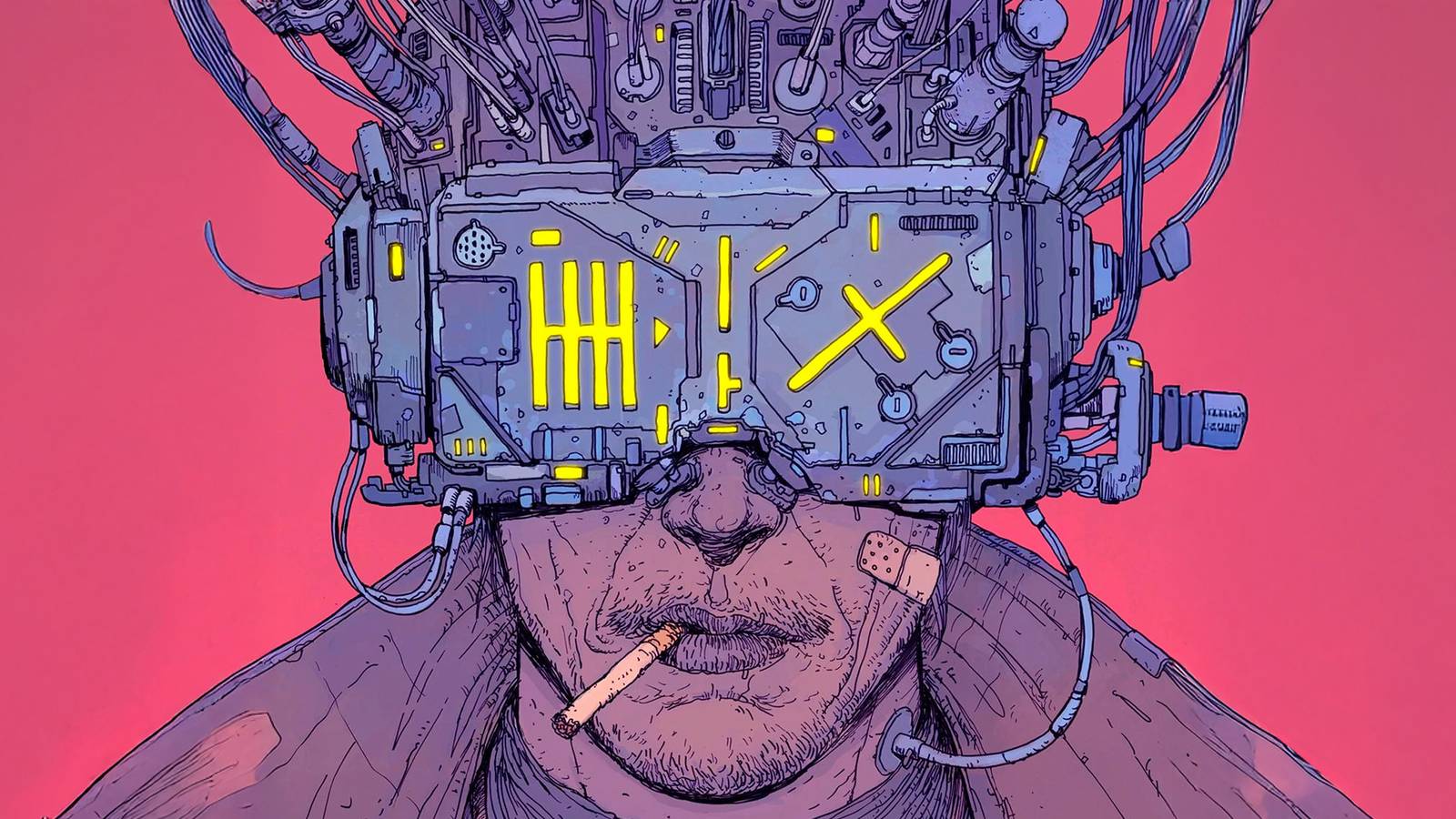
Image via Editora Aleph Published Jul 22, 2026, 7:51 AM EDT Luc Haasbroek is a writer and videographer from Durban, South Africa. He has been writing professionally about pop culture for eight years. Luc's areas of interest are broad: he's just as passionate about psychology and history as he is about movies and TV. He's especially drawn to the places where these topics overlap. Luc is also an avid producer of video essays and looks forward to expanding his writing career. When not writing, he can be found hiking, playing Dungeons & Dragons, hanging out with his cats, and doing deep dives on whatever topic happens to have captured his interest that week. Sign in to your Collider account Sci-fi and thrillers complement each other well. Both genres thrive on uncertainty, escalating stakes, and protagonists forced to solve seemingly impossible problems before disaster strikes. Combine speculative technology, alien civilizations, dystopian governments, or deadly scientific discoveries with relentless suspense, and the results can be compulsively readable. With that in mind, this list ranks some of the very best sci-fi thrillers ever. Some of them create their tension from scientific realism, while others venture into deeply philosophical territory. 10 'Dark Matter' (2016) Image via Crown Publishing Group "Are you happy with your life?" In this one, Jason Dessen is a physics professor living an ordinary... until he is kidnapped one evening and wakes up in a reality where everything has changed. His wife is no longer his wife, his son never existed, and Jason himself has become a brilliant scientific celebrity. From here, Dark Matter spins a darkly compelling tale of quantum mechanics and parallel universes. While some of the ideas at play here are very big-brain and speculative, the book stands out from the crowd with its rich emotional core. Where many sci-fi characters can feel like cardboard cutouts, the protagonist is layered and sympathetic, acting like a real person caught in a bizarre, overwhelming situation. Jason isn't simply trying to understand impossible science; he's desperately attempting to reclaim his family and identity. 9 'Do Androids Dream of Electric Sheep?' (1968) Image via Doubleday "More human than human." This book famously served as the basis for Blade Runner. Set in a post-apocalyptic future devastated by nuclear war, bounty hunter Rick Deckard earns his living tracking down escaped androids who have become virtually indistinguishable from human beings. His latest assignment appears routine until repeated encounters with increasingly sophisticated androids begin challenging everything he believes about humanity itself. Basically, this book blends detective fiction tropes with real philosophical inquiry, all within a bleak, forward-thinking sci-fi package. Indeed, the novel's central question is: what makes you a person? Each confrontation forces Deckard to question whether empathy, memory, and consciousness truly separate humans from the artificial beings he is paid to eliminate. This is thus a psychological, even existential thriller, one whose themes will probably only become more relevant in the years to come. 8 'Leviathan Wakes' (2011) Image via Orbit Books "The stars are better off without us." This is the first installment in the Expanse series, an entertaining hybrid of space opera, detective fiction, political intrigue, and cosmic horror. In Leviathan Wakes, humanity has successfully colonized the Solar System, but tensions between Earth, Mars, and the asteroid belt threaten to erupt into open war. Amid this volatile political landscape, detective Joe Miller investigates the disappearance of a wealthy young woman while spaceship officer James Holden inadvertently uncovers a conspiracy. From here, the story alternates between Miller's noir-style investigation and Holden's increasingly desperate struggle for survival, keeping the reader hooked and the pages turning. The mysteries are genuinely juicy, and the focus is on the characters rather than the mechanics of space travel or futuristic technology. Practically every chapter introduces twists, dangers, and hidden agendas. 7 'The Martian' (2011) Image via Ballantine Books "I'm pretty much f---ked." Project Hail Mary has been all the rage this year, though Andy Weir's best project is probably still The Martian. After a violent dust storm forces his crew to abandon Mars, astronaut Mark Watney is accidentally left behind and presumed dead. Stranded millions of miles from Earth with limited supplies, he must rely entirely on his scientific knowledge and ingenuity if he hopes to stay alive. Rather than serving up aliens or ray-guns, this book derives its suspense almost entirely from plausible scientific problems. Every success creates new obstacles, whether failing life-support systems, dwindling food supplies, catastrophic equipment failures, or the harsh Martian environment itself. Watching Watney MacGyver his way out of these puzzles is great fun, and his wit and optimism are endlessly entertaining. 6 'The Moon Is a Harsh Mistress' (1966) Image via Penguin Publishing Group "There ain't no such thing as a free lunch." The Moon Is a Harsh Mistress is one of the defining works by genre legend Robert A. Heinlein, author of Stranger in a Strange Land and Starship Troopers. Set in a future where the Moon serves as a penal colony controlled by Earth's governments, it follows technician Manuel Garcia O'Kelly-Davis after he discovers that the colony's central computer has developed self-awareness. Together with the sentient machine, nicknamed Mike, Manuel becomes one of the architects of a lunar revolution. Heinlein excels at turning political strategy into edge-of-your-seat suspense. Every decision made by the revolutionaries carries enormous consequences, as they attempt to outmaneuver a vastly superior enemy through cunning rather than brute force. It's a nice fusion of espionage, warfare, and human drama. Interesting bit of trivia: this book actually coined the phrase "There Ain't No Such Thing As a Free Lunch". 5 'The Three-Body Problem' (2006) Image via Tor Books "The universe is not a fairy tale." This is one of the most creative and intelligent hard sci-fi books of the 2000s. During China's Cultural Revolution, a series of seemingly unrelated events eventually lead scientists to uncover evidence of an extraterrestrial civilization preparing for first contact. The mystery unfolds gradually, allowing readers to piece together clues alongside nanomaterials researcher Wang Miao. Strange suicides among leading scientists, an impossibly sophisticated virtual reality game, and increasingly bizarre scientific anomalies all contribute to an atmosphere of mounting unease. Plus, the existential implications of first contact generate enormous emotional tension. Every answer raises even larger questions about humanity's place in the cosmos. Through all this, author Liu Cixin's scientific imagination is inexhaustibly creative, yet the novel never becomes merely an intellectual exercise. There's a compelling plot beneath the heady concepts. 4 'The Andromeda Strain' (1969) Image via Alfred A. Knopf "We have forty-eight hours." This book put Michael Crichton on the map, and established many of the conventions that continue to define the techno-thriller. In The Andromeda Strain, a military satellite returns to Earth carrying a mysterious extraterrestrial microorganism, and nearly everyone in a small Arizona town dies within minutes. A team of elite scientists is assembled inside a state-of-the-art underground laboratory to identify the organism before it escapes and threatens all of humanity. Crichton generates remarkable suspense through scientific procedure rather than traditional action. Every experiment, containment protocol, and laboratory analysis becomes a matter of life and death. Even a tiny mistake could spell global catastrophe. The book amplifies this by taking a grounded approach to the science and medicine. It's very technical and detailed, making it feel creepily plausible. This, too, was hugely influential. 3 'Neuromancer' (1984) Image via William Gibson / Ace Books "The sky above the port was the color of television, tuned to a dead channel." This is the archetypal cyberpunk book. Neuromancer introduces us to Henry Case, a washed-up hacker who is offered one final opportunity to regain access to cyberspace after mysterious employers recruit him for an impossibly dangerous mission involving artificial intelligence and corporate conspiracies. Author William Gibson was ahead of his time with this novel. Long before the internet became part of everyday life, he imagined hackers navigating vast digital landscapes while multinational corporations wielded unprecedented influence over society. He even coined now-ubiquitous terms like "cyberspace". Countless sci-fi stories would draw on these ideas. At the same time, beneath the groundbreaking world-building, Neuromancer is simply a well-constructed thriller, loaded with mysteries and shifting alliances. 2 'Jurassic Park' (1990) Image via Alfred A. Knopf "Your scientists were so preoccupied with whether they could, they didn't stop to think if they should." Crichton strikes again. Jurassic Park is a near-perfect fusion of scientific speculation and survival horror. Billionaire John Hammond invites a small group of scientists to preview his revolutionary wildlife park, where dinosaurs have been recreated through genetic engineering. What begins as a breathtaking scientific achievement rapidly descends into catastrophe once the park's sophisticated security systems begin to fail. That premise is just so juicy, and Crichton builds it on confidently. It's a tale of scientific hubris given a full blockbuster treatment. Early chapters focus on scientific ethics, corporate greed, and the unpredictability of complex systems before gradually transforming into a desperate struggle for survival against some of history's most formidable predators. There are several white-knuckle-tense sequences, like one with children trapped inside an overturned vehicle. 1 'Nineteen Eighty-Four' (1949) Image via Secker & Warburg "Big Brother is watching you." Almost 80 years since its release, Nineteen Eighty-Four is still the most powerful sci-fi thriller, and perhaps the most influential dystopia in fiction. Protagonist Winston Smith lives in Oceania, a totalitarian superstate where every citizen is subjected to constant surveillance, independent thought is treated as a crime, and history itself is rewritten to serve the ruling Party. Secretly yearning for freedom, Winston begins a forbidden relationship and quietly rebels against the regime, knowing that discovery will almost certainly mean death. Here, George Orwell paints a vivid picture of manipulation and censorship, where the tension comes from the constant threat of observation. The government in Nineteen Eighty-Four is frighteningly invasive. Not content with its citizens simply parroting the party line, it insists that they actually believe the state's lies and illogic. These ideas are so scary because they reflect authoritarian tendencies in the real world. Collider Exclusive · Sci-Fi Survival Quiz Which Sci-Fi World Would You Survive? The Matrix · Mad Max · Blade Runner · Dune · Star Wars Five universes. Five completely different ways the future went wrong — or sideways, or up in flames. Only one of them is the world your instincts were built for. Eight questions will figure out which dystopia, galaxy, or desert wasteland you'd actually make it out of alive. 💊The Matrix 🔥Mad Max 🌧️Blade Runner 🏜️Dune 🚀Star Wars TEST YOUR SURVIVAL → 01 You sense something is deeply wrong with the world around you. What do you do? The first instinct is often the truest one. APull on every thread until I understand the system — then figure out how to break it. BStop asking questions and start stockpiling — food, fuel, weapons. Questions don't keep you alive. CKeep my head down, observe carefully, and trust no one until I know who's pulling the strings. DStudy the patterns. Every system has a rhythm — learn it, and you learn how to survive it. EFind the people fighting back and join them. You can't fix a broken galaxy alone. NEXT QUESTION → 02 In a world of scarcity, what resource do you guard most fiercely? What we protect reveals what we believe survival actually requires. AKnowledge. If you understand the system, you don't need resources — you can generate them. BFuel. Everything else — movement, power, escape — runs on it. CTrust. In a world of fakes and informants, a truly reliable ally is rarer than any commodity. DWater. And after water, information — the two things empires are truly built on. EShips and credits. The galaxy is big — you survive it by being able to move through it freely. NEXT QUESTION → 03 What kind of threat keeps you up at night? Fear is useful data — if you're honest about what you're actually afraid of. AThat reality itself is a lie — that everything I experience has been constructed to keep me compliant. BA raid. No warning, no mercy — just the roar of engines and then nothing left. CBeing identified. Once someone with power decides you're a problem, you're already out of time. DBeing outmanoeuvred — losing a political game I didn't even know I was playing. EThe Empire tightening its grip until there's nowhere left to run. NEXT QUESTION → 04 How do you deal with authority you don't trust? Every dystopia has a power structure. Your approach to it determines everything. ASubvert it from the inside — learn its rules well enough to weaponise them against it. BIgnore it and stay out of its reach. The further from any power structure, the better. CAppear to comply while doing exactly what I need to do. Visibility is the enemy. DManoeuvre within it carefully. You can't beat a system you refuse to understand. EResist openly when I have to. Some things are worth the risk of being seen. NEXT QUESTION → 05 Which environment could you actually endure long-term? Survival isn't just tactical — it's physical, psychological, and very much about where you are. AUnderground bunkers and server rooms — cramped, artificial, but with access to everything that matters. BOpen wasteland — brutal sun, no shelter, constant movement. At least the threat is honest. CA dense, rain-soaked city where you can disappear into the crowd and nobody asks questions. DMerciless desert — extreme heat, no water, and something enormous living beneath the sand. EThe fringe — backwater planets and busy spaceports where the Empire's attention rarely reaches. NEXT QUESTION → 06 Who do you want in your corner when things fall apart? The company you keep is the clearest signal of who you actually are. AA tight crew of believers who've seen behind the curtain and have nothing left to lose. BOne or two people I'd trust with my life. Any more than that and someone talks. CNobody, ideally. Alliances are liabilities. I work alone unless I have no choice. DA community bound by shared hardship and mutual survival — people who need each other to last. EA ragtag team with wildly different skills and total commitment when it counts. NEXT QUESTION → 07 Where do you draw the line — if you draw one at all? Every survivor eventually faces a moment that tests what they're actually made of. AI won't harm the innocent — even the ones who'd report me without hesitation. BI do what I have to to protect the people I've chosen. Everything else is negotiable. CThe line shifts depending on who's asking and what's at stake. DI draw a long-term line — nothing that compromises my people's future, even if it'd help now. ESome lines, once crossed, can't be uncrossed. I know which ones they are. NEXT QUESTION → 08 What would actually make survival worth it? Staying alive is one thing. Having a reason to is another. AWaking others up — dismantling the illusion so no one else has to live inside it. BFinding somewhere — or someone — worth protecting. A reason to keep moving. CAnswers. Understanding what I am, what any of this means, before time runs out. DLegacy — shaping the future in a way that outlasts me by generations. EFreedom — for myself, for others, for every world still living under someone else's boot. REVEAL MY WORLD → Your Fate Has Been Calculated You'd Survive In…Your answers point to the world your instincts were built for. This is the universe your temperament, your survival instincts, and your particular brand of stubbornness were made for. The MatrixYou took the red pill a long time ago — probably before anyone offered it to you. You're a systems thinker who can't help but notice the seams in things. You're drawn to understanding how the system works before figuring out how to break it. You'd find the Resistance, or it would find you — your instinct for spotting constructed realities is the machines' worst nightmare. You function best when you have access to information and the freedom to act on it. The Matrix built an airtight prison. You'd be the one probing the walls for the door. Mad MaxThe wasteland doesn't reward the clever or the well-connected — it rewards those who are hard to kill and harder to break. That's you. You don't need comfort, community, or a cause larger than the next horizon. You need a vehicle, a clear threat, and enough fuel to outrun it — and you're good at all three. You are unsentimental enough to survive that world, and decent enough — just barely — to be something more than another raider. In the wasteland, that distinction is everything. Blade RunnerYou'd survive here because you know how to exist in moral grey areas without losing yourself completely. You read people accurately, keep your circle small, and ask the questions others prefer not to answer. In a city where humanity is a legal designation rather than a feeling, you hold onto something that keeps you functional. You're not a hero. But you're not lost, either. In Blade Runner's world, that distinction is everything. DuneArrakis is the most hostile environment in the known universe — and you are precisely the kind of person it rewards. Patience, discipline, and political awareness are your core strengths — and on Arrakis, they're survival tools. You understand that the long game matters more than any single victory. Others come to Dune and are consumed by it. You'd learn its logic and earn its respect. In time, you wouldn't just survive Arrakis — you'd begin to reshape it. Star WarsThe galaxy far, far away is vast, loud, and in a constant state of violent political upheaval — and you wouldn't have it any other way. You find meaning in being part of something larger than yourself — a cause, a crew, a rebellion. You'd gravitate toward the Rebellion, or the fringes, or whatever pocket of the galaxy still believes the Empire's grip can be broken. You fight — not because you have to, but because standing aside isn't something you're capable of. In Star Wars, that willingness is what makes all the difference. ↻ RETAKE THE QUIZ
10 Best Sci-Fi Thriller Books of All Time
Full Article
Original Source
Read the full article at Collider →KhanList aggregates and links to publicly available news content. We do not host full articles from third-party sources. Always verify important information with original sources.