
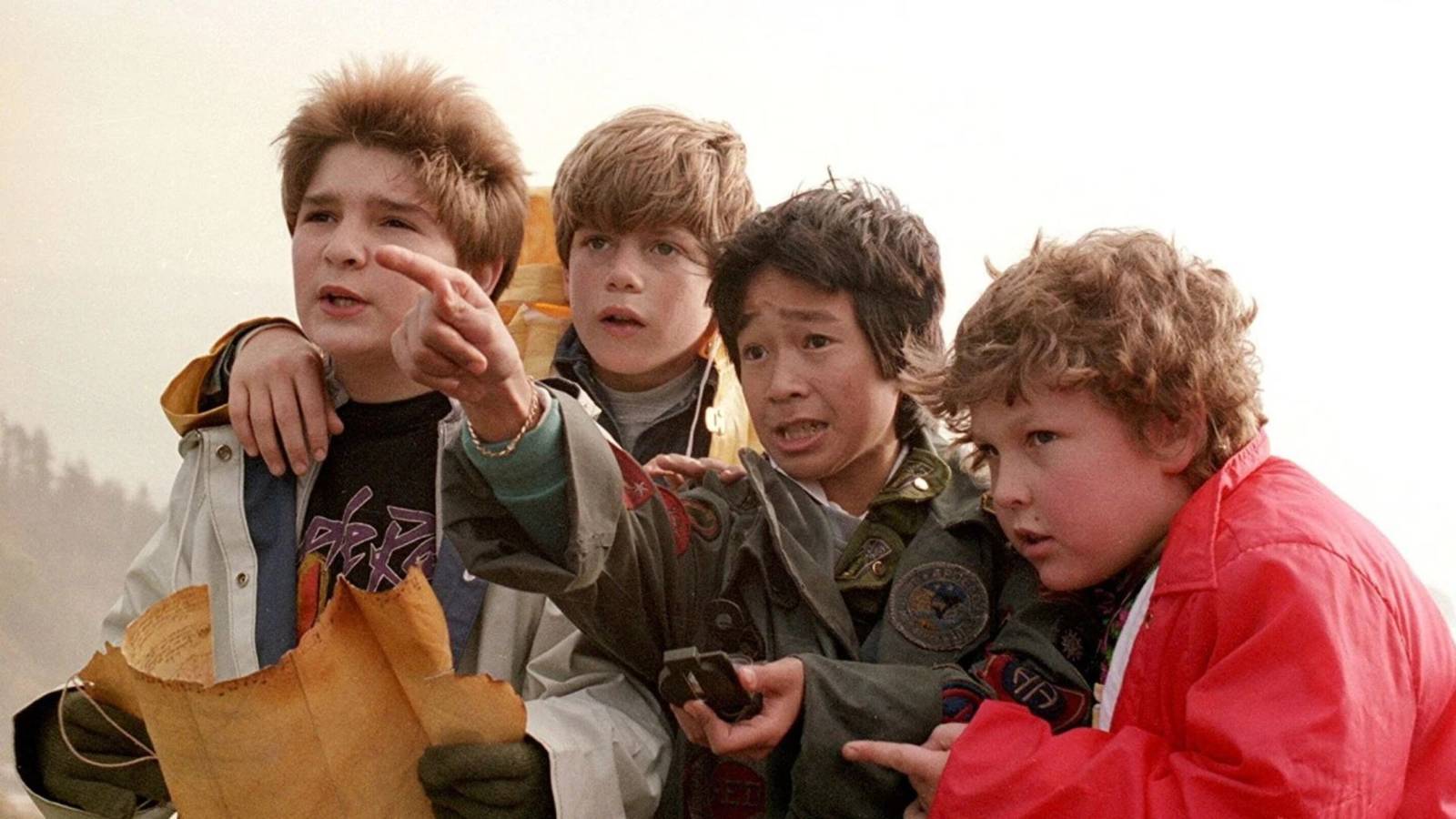
Memory has done some generous editing on the adventure movies we grew up with. It remembers the treasure maps, triumphant music, and heroes who somehow make it home. It tends to misplace the corpses. Revisit certain family favorites as an adult, and the most surprising thing isn't the special effects. It's what filmmakers were willing to put children through. That change in perspective will sound familiar to anyone who's revisited the Harry Potter movie details that hit differently as an adult. A frightening scene that once seemed like a brief obstacle can suddenly reveal something more troubling. The adults are often absent or spectacularly irresponsible, and victory doesn't erase everything the characters have endured. There is a difference, though, between an adventure that features danger and one whose cheerful reputation conceals real darkness. Jurassic Park has always been frightening. The Goonies, on the other hand, somehow became a shorthand for wholesome childhood mischief despite featuring armed criminals, threatened children, and a very dead man in a freezer. Some of the most memorable fantasy movies are built around extraordinary worlds, but their darker implications become clearer when the nostalgia wears off. Magical kingdoms can be cruel places. So can pirate ships. Even an ordinary board game may have consequences no one would wish on a child. These 10 movies are ranked by the gap between how fondly they're remembered and how disturbing they actually are, rather than by body count or overall quality. A film that's openly terrifying has less of a surprise advantage than one that convinced an entire generation it was having a perfectly normal afternoon at the movies. 10 Jurassic Park (1993) MovieStillsDB Steven Spielberg never pretended Jurassic Park was safe. Its opening makes that clear when a park worker is dragged into a raptor enclosure. Yet the film's reputation as a glorious dinosaur adventure can overshadow how much of it plays like a survival-horror movie. The dinosaurs are awe-inspiring, right up until they start treating the tourists as lunch. A grown-up rewatch also makes the human negligence harder to ignore. John Hammond invites his grandchildren into a park where basic security depends on a single underpaid programmer. Later, Ellie discovers Ray Arnold's severed arm while trying to restore the power. It's an extraordinarily nasty moment for a blockbuster marketed around the wonder of seeing dinosaurs come alive. Still, the menace is part of what most viewers remember. Jurassic Park ranks lower because its terror was always central to the experience, even if the film's family-adventure status has softened that memory. 9 King Kong (2005) Peter Jackson's King Kong is remembered for a tragic giant ape, a spectacular New York finale, and the astonishing detail of its digital effects. Getting to those moments, however, requires surviving Skull Island, which Jackson treats as a place where practically everything alive wants to eat the expedition. The infamous insect-pit sequence is particularly merciless. Crew members are trapped among enormous crawling creatures and swallowed by monstrous parasites. There is little of the escapist fun usually associated with a grand historical adventure in the scene. It's a sustained exercise in revulsion, and the characters' terror feels horribly physical. Jackson's film also ends by killing the creature viewers have come to love. The sadness isn't a revelation; most audiences know how King Kong ends. But the violence required to get there is easy to underestimate when the memory is dominated by Kong and Ann Darrow's unlikely bond. 8 Indiana Jones And The Temple Of Doom (1984) People remember the mine-cart chase, Short Round's wisecracks, and Harrison Ford at his most entertainingly battered. They also remember that Indiana Jones and the Temple of Doom gets dark. The question is whether they remember just how dark Spielberg's second Indiana Jones adventure actually becomes. The film involves the enslavement of children, brutal treatment inside a mine, and a sacrificial ritual in which Mola Ram pulls a beating heart from a man's chest. Even Indy becomes a threat after being forced to drink the Blood of Kali. It's an astonishing collection of horrors for an adventure filled with broad comedy and slapstick peril. The cruelty is too prominent to be a complete surprise, which is why this isn't higher. Nevertheless, the contrast between the movie's playful energy and its treatment of vulnerable children remains shocking. Its PG rating feels almost surreal on a modern rewatch. 7 The Mummy (1999) Image via Universal Brendan Fraser's Rick O'Connell makes The Mummy feel like a breezy throwback to the old-fashioned swashbuckler. He's funny, Rachel Weisz is delightful as Evelyn, and the whole adventure moves along so confidently that it's easy to forget the villain's preferred method of punishment involves being buried alive. Imhotep's resurrection brings something nastier than the occasional skeleton. Flesh-eating scarabs burrow beneath people's skin. His victims lose their eyes or tongues as he rebuilds his body, and the opening establishes his fate through a particularly horrible act of ritual punishment. The movie is having enormous fun, but its monster is genuinely repulsive. That's what makes the tonal balancing act impressive. Stephen Sommers can stage a romantic comedy one minute and a bit of gruesome body horror the next. The film's charm survives the shift, although the horror is much harder to shrug off when you're no longer watching through childhood eyes. 6 Pirates Of The Caribbean: Dead Man's Chest (2006) The original Pirates of the Caribbean introduced a charmingly undead crew and turned a theme-park ride into an adventure franchise. Dead Man's Chest takes that supernatural premise somewhere considerably less cheerful. Its funniest character is suddenly facing an eternity of servitude, and death itself has become a negotiable contract. Davy Jones condemns sailors to the Flying Dutchman, where they slowly become part of the ship. The Kraken tears vessels apart, while Jack Sparrow eventually finds himself staring into its mouth. Even Elizabeth's decision to save the survivors comes at a terrible personal cost. For all the jokes, the movie doesn't allow its heroes an uncomplicated victory. It's a remarkably bleak follow-up to a beloved Disney blockbuster, particularly when compared with the more straightforward pleasures of great pirate movies outside the Pirates of the Caribbean franchise. The adventure remains exhilarating, but its treatment of betrayal and damnation gives the sequel a much colder heart. 5 The Dark Crystal (1982) Jim Henson's name usually evokes lovable creatures and playful puppetry. The Dark Crystal uses those same artistic tools to introduce the Skeksis, grotesque rulers who maintain power through terror. Their elaborate costumes and fantasy-world design are extraordinary. Their government, on the other hand, is built on the destruction and exploitation of other species. The Skeksis drain the living essence from Podlings, reducing them to obedient servants. The Gelflings have been nearly exterminated, leaving Jen and Kira to face an enemy that seems far older and more powerful than either can comprehend. What looks like a strange fairy tale is also a story about oppression and the survival of a people. That underlying cruelty makes The Dark Crystal one of the clearest examples of dark fantasy operating beneath a seemingly child-friendly exterior. The Skeksis were nightmare material even in 1982. What becomes clearer on rewatch is how disturbing their entire society is, not merely their faces. 4 Jumanji (1995) The easiest thing to remember about Jumanji is Robin Williams being chased through a house full of jungle creatures. The harder thing to process is that Alan Parrish disappears into a board game for 26 years. He loses his childhood, his parents die believing he's missing, and the adult who finally emerges has barely had a chance to grow up. Judy and Peter, meanwhile, have already lost their own parents before they find the game. The chaos that follows looks like a wildly entertaining special-effects showcase, but it surrounds children who have experienced profound loss. The game's threats are terrifying partly because the adults who should protect them can offer so little reassurance. Williams makes Alan funny and sympathetic without disguising how damaged he is. When he discovers what became of his family, the fantasy's underlying sadness comes sharply into focus. For a movie remembered as an energetic family adventure, Jumanji has an unusually cruel understanding of what it means to lose time. 3 The Goonies (1985) Credit: MovieStillsDB The Goonies has the reputation of a perfect childhood adventure: friends discover a treasure map and save their neighborhood through ingenuity, determination, and an astonishing amount of yelling. Its villains are often remembered as comic-book crooks. On a rewatch, however, the Fratellis are much closer to genuinely dangerous criminals than goofy treasure-hunting obstacles. There's a dead federal agent in a freezer. Mama Fratelli threatens Chunk with a blender during an interrogation, and Sloth has been kept chained up by his own family. These aren't harmless pratfalls. They're grim details tucked into a movie that races so quickly from one joke to the next that children barely have time to consider them. The threat of losing the Goonies' homes gives the adventure another dimension. Their treasure hunt begins because the adults have run out of solutions. As with other family movies whose grown-up concerns are easy to miss, the story's emotional stakes feel more serious with age. Apparently, childhood nostalgia managed to edit out a corpse. 2 The NeverEnding Story (1984) The flying luckdragon may be the image most people associate with The NeverEnding Story, but its emotional landscape is nearly unbearable. Bastian is grieving his mother's death and retreating into a book while the adults around him struggle to understand him. Inside that story, the magical world of Fantasia is being erased by a force known simply as the Nothing. Then there is Artax. Atreyu's horse sinks into the Swamps of Sadness, and the young hero cannot persuade his closest companion to keep fighting. The scene is devastating without a conventional villain or a triumphant rescue. Depression and grief have become literal forces capable of destroying someone, even in a world filled with incredible creatures. The movie's fascination with storytelling places it among the great fantasy films of the 20th century. Yet its darkest moments suggest imagination isn't simply an escape from pain. Sometimes it's the only way a child can begin to understand it. The happy memories tend to feature Falkor; the difficult ones stay with Artax. 1 Return To Oz (1985) Anyone expecting more of the cheery Technicolor world from The Wizard of Oz is in for a rude awakening. Return to Oz begins with Dorothy's family treating her stories about Oz as evidence of psychological distress. She is taken to an institution and nearly subjected to electric shock treatment. And Oz is somehow worse. Oz has become a ruined, hostile place. The Wheelers pursue Dorothy through deserted streets, while Princess Mombi keeps an entire collection of interchangeable heads. The Nome King turns people into ornaments, giving the film's central quest a threat of permanent disappearance. Even the familiar characters Dorothy hopes to find have become victims of this altered kingdom. Disney has produced plenty of forgotten films worth revisiting, but few are as startling on a rewatch. Director Walter Murch doesn't gently update a beloved fantasy; he makes a child's return to a once-comforting world feel genuinely traumatic. No other movie here creates such a dramatic gulf between what audiences expect from a family adventure and what they're actually given. Release Date June 21, 1985 Runtime 109 Minutes Director Walter Murch Writers Walter Murch, Gill Dennis
10 Adventure Movies Much Darker Than You Remember Ranked, Including The Goonies
Full Article
Original Source
Read the full article at Screenrant →KhanList aggregates and links to publicly available news content. We do not host full articles from third-party sources. Always verify important information with original sources.