
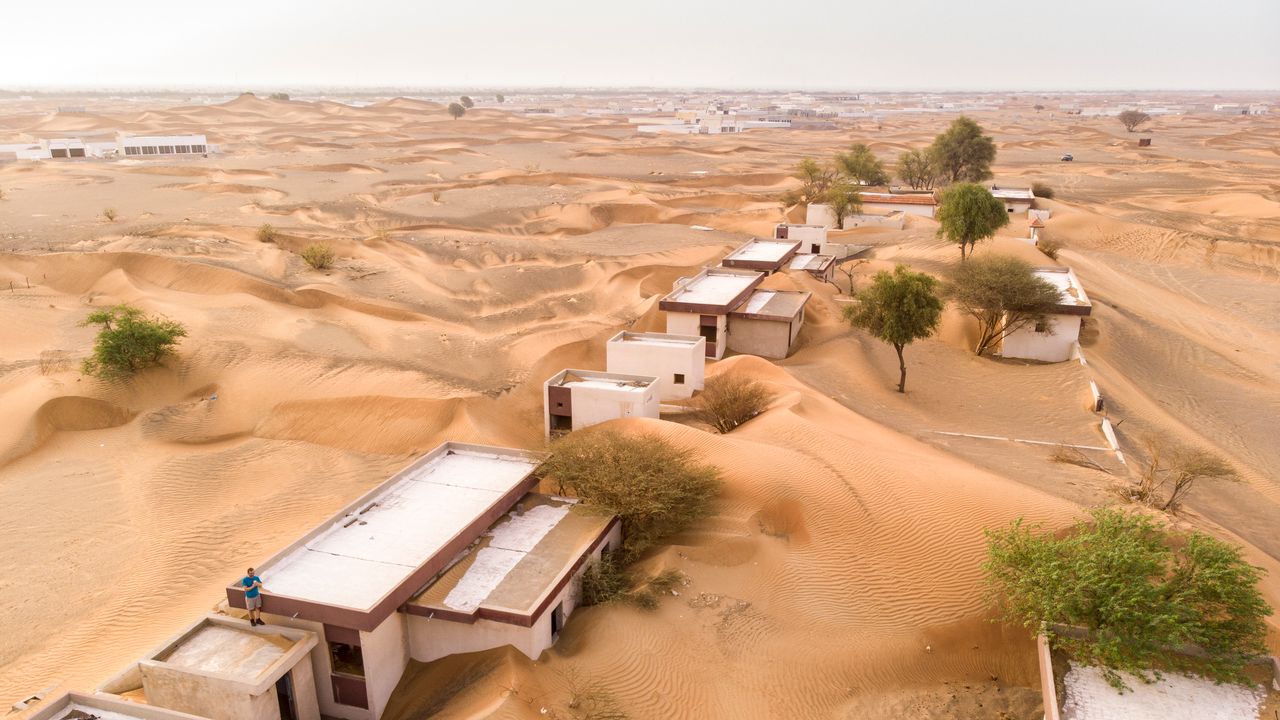
Skip to main contentWhether they’ve been encased in greenery or flooded with sand, the elements have overtaken these abandoned localesaerial view of abandoned village in a desert near dubai, overtaken by sand dunesKatiekk2When humans walk away, the natural world wastes no time moving in. In these cities reclaimed by nature—including abandoned villages, forts, and ghost towns—vines creep over crumbling walls, sand dunes push down doors, and layers of volcanic ash cover crumbling buildings. That uncanny feeling of wandering through left-behind cities has made for its own niche tourist appeal, and natural elements that overtake these towns in the absence of human residents add another layer of intrigue. Whether the result of natural disasters, shifting industries, or mysteries that remain unsolved, these places offer a haunting reminder of just how quickly civilization can be undone. Below, explore 11 cities reclaimed by nature and the eerie beauty left behind when the earth reclaims what was only momentarily ours.Photo: Johannes Eisele/AFP/Getty ImagesHoutouwan, ChinaOn Shengshan Island—part of a nearly 400-island archipelago roughly 40 miles east of Shanghai—thick vines cover homes, creep along stone walkways, and virtually blanket an entire town in lush vegetation. The area was once a thriving fishing village— it was established in the ’50s and reached a peak population of more than 2,000 by the ’80s. However, as the local fishing industry declined and residents sought to leave such a remote location with limited resources, the town was abandoned. Today only a handful of residents remain, though plenty of tourists visit daily to wander the village’s narrow paths and take in all the greenery.Photo: David Santiago Garcia/Getty ImagesAngkor Archaeological Temples, Siem Reap, CambodiaSpanning approximately 150 square miles, 72 major temples and other structures in Cambodia’s Siem Reap province make up the Angkor temple complex, dating back to the Khmer Kingdom in the first half of the 12th century. UNESCO considers the region to be one of the most important archaeological sites in Southeast Asia. Temples in the region include the iconic Angkor Wat, Bayon, Preah Khan, and Ta Prohm. When Portuguese missionaries arrived in the region in the 16th century, the city had been abandoned, and the surrounding vegetation had already started to enshroud the buildings. Today the complex’s many temples are a popular tourist destination, where the thick Banyan trunks snaking through the ancient moss-covered buildings are part of the allure.Photo: Pavel Tochinsky/Getty ImagesKolmanskop, NamibiaWhat was once a booming diamond mining town has slowly been retaken by the desert. It all began when a railway worker spotted a diamond in the sand in 1908, drawing swarms of wealth seekers to the German colonial settlement of Kolmanskop. Within a few years an entire town had sprung up, complete with decadently designed homes, a hospital, and even a theater that hosted touring opera companies. But aggressive mining depleted the area by 1930 and the miners moved on. By 1956, Kolmanskop was totally abandoned and the sand began to swallow up the town, washing over buildings and pushing through windows and doors.Video: Artur Debat/Getty ImagesSant Romà de Sau, SpainThe spire of a three-story Romanesque church punctures the surface of a tranquil reservoir, the only visible remnant of the submerged town surrounding it. Most of the structures of the 1,000-year-old San Romà de Sau disappeared from view in the early 1960s, when the Catalonian government decided to install a dam on the Ter river. The town’s residents were forced to evacuate following the officials’ decision, with some even exhuming their dearly departed before leaving home forever. According to Atlas Obscura, a cemetery and the ruins of the other waterlogged buildings sometimes emerge during times of low water level—an otherworldly sight for visitors, who have established the flooded ghost town as a tourist attraction.Photo: Ivan Romano/Getty ImagesValley of the Mills, Sorrento, ItalyPeer down a particularly humid crevasse in Sorrento and you’ll see a series of ancient industrial buildings—some dating as far back as the 13th century—overtaken by ferns. Called the Valley of the Mills, the foliage-rich fissure is home to defunct flour mills, a sawmill, and a washhouse, all of which were built there because of the area’s stream. Once the buildings were abandoned in the 1940s and the people left, the plants moved in, taking advantage of the area’s damp conditions. In 2019, the city approved plans to restore the mills and started some fern removal. However, after an uproar from the public, the project has been put on pause, and debates continue over how to best preserve the gorge.Photo: Giuseppe Cacace/AFP via Getty ImagesAl-Madam, United Arab EmiratesLike Kolmanskop, Al-Madam—located about an hour’s drive from Dubai—is another abandoned village swallowed up by sand dunes. But unlike Kolmanskop, the reason Al-Madam became deserted isn’t quite clear. Some say it was the harsh environmental conditions, including frequent sandstorms, while others point to problems with infrastructure and access to water and electricity in such a remote location. Meanwhile, local legend has it the residents were forced out by supernatural spirits, making it a ghost town in the truest sense.Photo: Christopher Pillitz/Getty ImagesPlymouth, MontserratWhen it comes to ghost towns, most people picture settlements on the outskirts of civilization. But this one is actually still the official capital of the island of Montserrat, a British Overseas Territory in the Caribbean. That being said, Plymouth is deserted—after lying dormant for centuries, the Soufrière Hills volcano erupted in 1995 and covered the town in ash. Pieces of the old Plymouth are still visible, including the courthouse pictured here as well as a bakery, gas station, and hotel—all frozen in time, like a modern-day Pompeii. The island’s de facto capital is now Brades, but ongoing eruptions have caused roughly two-thirds of Montserrat’s population to flee to the UK or neighboring islands.Photo: Stefano Guidi/Getty ImagesCuron, ItalyLake Resia in South Tyrol looks like the typically stunning alpine dreamscape you’d picture in northern Italy—typical, that is, if you ignore the 14th-century bell tower jutting out from the water. And the tower isn’t all that’s submerged in the lake. In 1950 the Italian government relocated residents in the area and flooded the land, creating an artificial lake to power a nearby hydroelectric plant. The tower—and the entire village it stood in, a place called Curon—are now underwater.Photo: Aerial Essex/Getty ImagesStack Rock Fort, Milford Haven, WalesOriginally constructed between 1850 and 1852, Stack Rock Fort was built to protect the Milford Haven Waterway in the United Kingdom from an invasion by sea, though it never engaged in any enemy combat. During World War I a small number of soldiers manned the fort, but by 1929 it was completely disarmed. In the decades since, Stack Rock has sold a few times (once for a whopping £60, or around $80), and it is currently owned by a community-interest company keen on preserving the property as a “living ruin.” That’s good news for the flocks of seagulls that call the fort home and all the moss that lines its walls, which makes the brick look like it’s glowing green.Photo: Dushyant Thakur Photography/Getty ImagesNetaji Subhash Chandra Bose Island (Ross Island), IndiaFicus roots wind throughout the ruins of the former British penal colony in the Andaman islands, approximately 800 miles to the southwest of the Indian mainland. Following the Sepoy Mutiny of 1857—which marked the first war of what would eventually result in Indian independence from colonial forces—the British were in search of a distant settlement in which to house prisoners for the purpose of suppressing the rebels. While the convicts were forced to clear the island’s thick forests and subjected to various illnesses and abuse, Ross Island’s colonial masters enjoyed landscaped gardens, swimming pools, and tennis courts. The penal colony officially closed in 1937, ending a dark chapter in the nation’s history. The property was renamed from Ross Island to Netaji Subhas Chandra Bose Island in 2018.Charlotte Collins is a digital features editor at Architectural Digest reporting news and features at the intersection of pop culture and design. She was formerly an assistant editor at InStyle magazine and has also worked in broadcast for CBS This Morning and 48 Hours. Her news, design, and entertainment coverage ... Read MoreAmelia Mularz is a freelance journalist specializing in interior design, garden, and travel stories. She has previously contributed to Real Simple, HGTV Magazine, New York magazine's The Strategist, and Travel + Leisure, among other titles. She has also held long-term roles at Vogue and The Knot. In 2018, she received ... Read More
10 Abandoned Cities Reclaimed by Nature That Are Eerily Beautiful
Full Article
Original Source
Read the full article at Architecturaldigest →KhanList aggregates and links to publicly available news content. We do not host full articles from third-party sources. Always verify important information with original sources.