
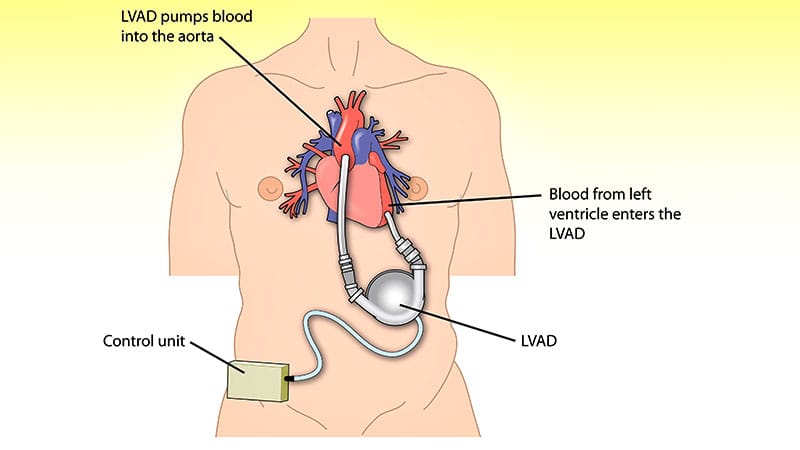
TOPLINEAmong children requiring ventricular assist device (VAD) support, 18% remained on the device for more than 6 months, and of those, more than 20% were still alive on support at 2 years. Patients requiring longer-term support were typically older, more likely to have cardiomyopathy, and more frequently received implantable continuous devices compared with those supported for 6 months or less.METHODOLOGYResearchers conducted a retrospective analysis of data from the Society of Thoracic Surgeons' Pediatric Interagency Registry for Mechanical Circulatory Support database, which includes patients from North America who received a mechanical circulatory support device.A total of 1137 patients aged younger than 19 years who underwent VAD placement between September 2012 and March 2022 were included; 43%-44% were women in this cohort.Patients alive on VAD support at 6 months were followed for up to 24 months and compared with those supported for 6 months or less, with the goal of characterizing their preimplant clinical characteristics, survival outcomes, adverse event (AE) frequency, and risk factors for subsequent mortality.Percentage of days alive and out of hospital (DAOH) was calculated by dividing the number of days a patient spent outside the hospital while on device support by the total time on the device.AEs assessed included infection, device malfunction, pump thrombosis, and stroke.TAKEAWAYOf the 1137 patients, 205 (18.0%) required VAD support for more than 6 months; these patients were older (11.2 years vs 4.9 years; P < .001) and had higher rates of cardiomyopathy (67.6% vs 56.9%; P = .0029) and implantable continuous devices (68.3% vs 33.6%; P < .0001) compared with those supported for 6 months or less.At 2 years from implant among patients with longer-term VAD use, 65% underwent transplantation, 9% died, and 20.1% remained alive on the device; within the first year of device placement, among the 126 patients with implantable continuous devices who were discharged alive with complete data, median DAOH was 82%.Mortality risk factors included prior cancer (hazard ratio [HR], 7.77; 95% CI, 2.04-29.55), dialysis (HR, 3.96; 95% CI, 1.02-15.35), nonimplantable continuous device (HR, 4.88; 95% CI, 1.45-16.42), and ascites (HR, 3.86; 95% CI, 1.21-12.34).AEs among longer-term VAD patients included infection (27.3%), device malfunction or pump thrombosis (13.7%), and stroke (4.9%).IN PRACTICE"In an era with increasingly long wait times for heart transplantation, this has significant clinical implications for single-ventricle patients, where there is precedent for transplant as a potential outcome even in the setting of longer-term VAD support," the authors wrote.SOURCEThe study was led by Erika J. Mejia, MD, Ann & Robert H. Lurie Children's Hospital, Feinberg School of Medicine, Northwestern University, Chicago. It was published online on August 20 in Journal of the American Heart Association.LIMITATIONSThe retrospective design of this registry-based study precluded causal conclusions. Small numbers of AEs in certain categories may have raised the risk for type II error. Additionally, the study could not assess the clinical severity of the AEs reported.DISCLOSURESNo specific funding was reported for this study. The authors reported no relevant conflicts of interest.This article was created using several editorial tools, including AI, as part of the process. Human editors reviewed this content before publication.
1 in 5 Kids on Long-Term VADs Still Supported at 2 Years
Full Article
Original Source
Read the full article at Medscape →KhanList aggregates and links to publicly available news content. We do not host full articles from third-party sources. Always verify important information with original sources.